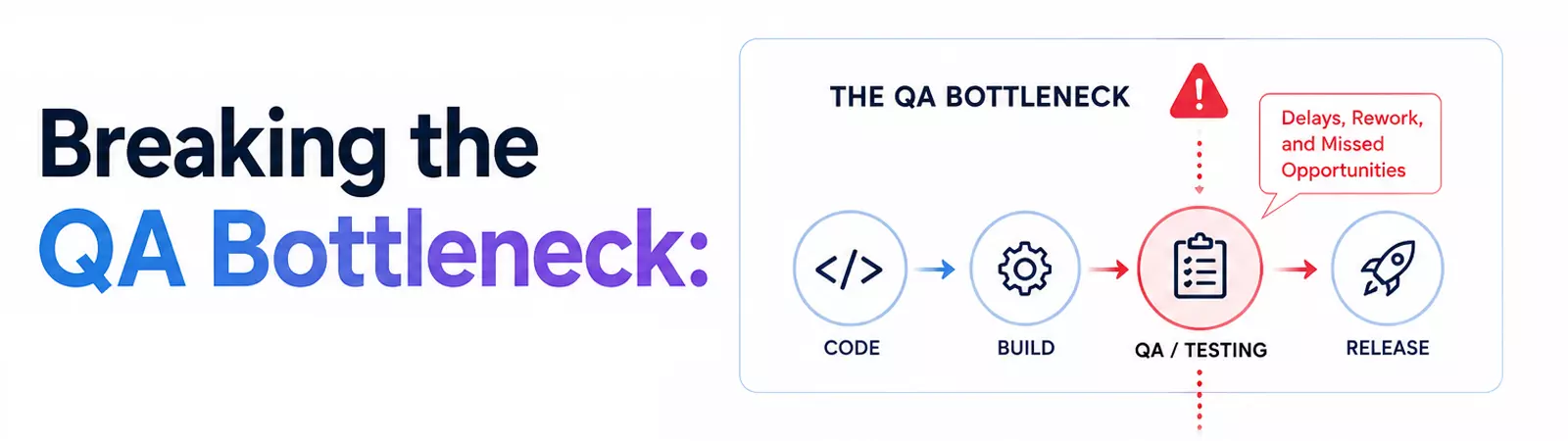
Three hours before a contractually committed deployment window, the pipeline turns red. Not one failure — forty-seven. The QA lead cannot determine whether they represent genuine regressions or environment noise that produced false positives in the last sprint. Ninety minutes to decide: hold the release and breach the SLA, or ship and absorb the risk.
They ship. Six hours later, a payment path that the automated suite never reached triggers a P1 incident affecting 12,000 active sessions.
This is when organizations realize their investment in software testing services has produced coverage, but not confidence. Coverage without confidence is operationally worthless under pressure.
This is an architectural failure — a QA model designed for a different delivery era, applied to a pipeline it was never built to support.
Traditional QA functions operate as downstream gates. Development completes, code lands in staging, a specialist team validates, and the release proceeds. This model rests on two assumptions: testing cycles have time to complete, and the team has context to interpret results. Both collapse at continuous delivery velocity.
As release frequency increases, the validation backlog outpaces team capacity. Organizations respond by compressing test cycles — fewer tests, skipped paths, spot checks replacing full coverage. Each determination is individually justifiable. Collectively, they erode actual quality posture while the reported one holds steady.
In one release audit across a cloud infrastructure platform, 71% of production defects that escaped QA had been present for more than three sprints — not because they were hidden, but because the handoff model created a gap where no one was specifically responsible.
Shift-left is not a testing philosophy. It is a governance restructuring.
In organizations where it works, quality ownership is distributed to the point of origin. Developers own unit and contract test coverage for their own services. Feature branches cannot be merged without automated validation that covers functional correctness, dependency contracts, and integration compliance. QA engineers are embedded in squads as architects of how work is validated during its lifecycle — not reviewers of finished output.
A fintech engineering team found that this single distinction moved their mean defect detection time from 4.8 days to under 7 hours. The testers did not change. The tools did not change. The ownership model did.
This requires QA directors to move from managing test execution to managing test architecture, coverage standards, and automation governance — evolving from quality assurance to quality engineering: proactive, embedded, and treated as a delivery discipline alongside performance and security.
Engineering organizations consistently undercount bottleneck costs because the most significant ones are indirect.
Idle time in engineering is the most underreported. One enterprise pipeline, processing six microservice releases per sprint, was losing 160 engineering hours per cycle to pipeline-blocked paralysis — developers context-switching while waiting for test results. Four engineers' full weekly output is absorbed by a process problem.
During a regression review at an enterprise logistics platform, 31% of release delays over six months traced back to 180 flaky automated tests flagged for remediation but never prioritized. Remediation estimate: four engineer-weeks. Actual cost: eighteen engineer-weeks in compounded idle time and deferred delivery.
Repeated rollbacks generate an informal delivery slowdown — more manual sign-offs, more conservative windows, more stakeholder checkpoints — each of which causes latency without reducing the underlying risk.
The 22-Hour Regression Suite: An e-commerce platform migrated to microservices but retained its original 16,000-case sequential test suite without revision. Runtime: 22 hours. Releases clustered at the weekend, Thursday nights consumed by execution, Friday deployments suspended. The suite had become the release governance mechanism — not by policy, but by inertia.
Pipeline Trust Erosion: One CI/CD pipeline carrying 3,400 automated tests reached 13% flakiness. Teams treated red pipelines as amber and re-ran failures as routine. When two genuine regressions appeared in the same sprint, they were absorbed into the noise and shipped. The root cause: no flakiness budget, no remediation SLA, no defined ownership across fourteen squads.
Staging Environment Drift: A multi-tenant SaaS platform maintained staging environments that diverged from production in configuration and data volume. Tests passed in staging and failed in production at a rate of 1 in 6 deployments. Adding manual review recreated the exact bottleneck that automation was built to eliminate.
A mature continuous testing strategy is not a single suite at release time. It is risk-calibrated validation gates distributed across the pipeline.
Commit-stage validation covers unit tests, static analysis, and dependency scanning — it must complete in under four minutes, or developers bypass it under pressure.
Build-stage integration and API testing cover cross-service contract validation and endpoint correctness after compilation. This is where microservices architectures are most vulnerable: individual services pass while integration contracts silently diverge.
Deployment-stage smoke testing confirms artifact health and critical journey functionality immediately after deploy. Organizations that treat deployment and testing as sequential routinely miss environment-specific failures, and smoke testing surfaces within minutes.
Release-gate validation covers risk-based automated regression testing, performance benchmarks, and security scanning calibrated to release risk. Gartner's DevOps maturity research finds test orchestration at this layer as the highest-leverage capability separating elite delivery organizations from those constrained by legacy testing architecture.
| Execution timing | Pre-release batch | Every commit, PR, and build |
| Defect discovery latency | Days to weeks | Minutes to hours |
| Regression cycle | 12–24+ hours | Under 45 minutes, parallelised |
| QA team role | Downstream gatekeeper | Embedded quality engineering |
| Deployment confidence | Manual sign-off | Observable test signal |
| Defect fix cost | Up to $500K post-release | Under $500 pre-merge |
| Release cadence | Two to four week cycles | On-demand, multiple per day |
| Toolchain | Disconnected QA systems | Native CI/CD hooks |
The dominant failure mode in enterprise QA automation is strategic, not technical.
Automation without a coverage strategy produces portfolios that are expensive to maintain and insufficient at risk coverage. A retail banking platform with 9,000 automated UI tests found that 58% of its test suite covered paths accounted for less than 4% of production transaction volume. Business-critical flows had shallow coverage because they had been validated by subject matter experts who had since left. The automation inherited the blind spots of the process it replaced.
When tests are owned collectively rather than by the squads owning the services, flakiness accumulates without accountability, and test debt grows without prioritization. The GitLab DevOps Report consistently shows that distributed test ownership produces higher pipeline reliability and faster defect detection than centralized automation models.
When unit results, integration outcomes, and manual execution records live in separate systems without a unified dashboard, release decisions are made on insufficient information — a governance architecture failure, not a data problem.
The criteria most commonly applied to external software testing services — certifications, headcount, per-test pricing — are the least predictive of strategic outcome.
Automation maturity is visible in how a provider discusses architecture, not execution volume. Flakiness governance, coverage strategy, and test debt management posture separate methodology from tool delivery.
CI/CD integration capability is mandatory. Can testing be invoked natively as a pipeline stage in your existing toolchain — GitHub Actions, GitLab CI, Jenkins, or Azure DevOps — or does it require manual coordination?
Reporting visibility determines whether the quality signal is actionable. Results in proprietary formats requiring manual interpretation do not belong in engineering workflows. Quality dashboards must be pipeline artifacts.
Scalability architecture must match the deployment frequency trajectory. Infrastructure unable to accommodate parallel execution across concurrent pipeline triggers will become a bottleneck before delivery velocity reaches its target.
Release cycles have not accelerated despite CI/CD investment — the constraint has migrated to testing.
Regression suites consistently exceed eight hours — feedback cannot be acted on within a sprint cycle.
Post-release incident rate is flat or rising despite QA team growth — the model is not scaling.
Engineering teams routinely compress test cycles under delivery pressure — testing is an obstacle, not a safeguard.
Flakiness exceeds eight percent across any pipeline layer — trust in quality signals has degraded.
The pipeline has scaled beyond forty micro services on a testing architecture designed for a monolith.
The State of DevOps Report identifies test automation maturity as a categorical differentiator — a structural divide in deployment frequency, change failure rate, and recovery time, not a spectrum position.
The organizations that have resolved their QA bottleneck share one characteristic: they stopped treating quality as a phase and started engineering it as a capability. The governance model — who owns quality, at what stage, with what accountability, and on what signal — determines whether the pipeline accelerates or stalls.
In contemporary software delivery, the bottleneck is rarely deployment speed. It is the organization's ability to trust its own quality signals under pressure. That trust is not built by running more tests. It is built by designing the right architecture, distributing the right ownership, and treating quality engineering as a strategic delivery function—not a compliance gate at the end of the line.