Many organizations are hampered by packaged solutions, while those embracing bespoke application development have radically improved operations and workforce output.
In today's landscape, where technological uniqueness divides thriving entities from failing ones, crafting dedicated applications has transitioned from an optional enhancement to a survival requirement. As rivals wrestle with inflexible, standardized platforms that hobble efficiency and stunt expansion, visionary organizations forge precisely-fitted tools that convert their distinctive methods into unassailable edges.
This goes beyond chasing fads—it concerns developing systems that magnify your organizational essence as opponents stay shackled by platform constraints. The sector champions of 2026 won't be those with fattest technology wallets—they'll be organizations whose tailored platforms echo their commercial aspirations exactly and expand alongside their dreams.
Custom app development is when you design, build, and roll out software tailored to what your organization needs to do, how your people work, and where you're trying to go—you get exactly what you want, with no compromises.
The problem with packaged software is simple—you end up reshaping your entire operation around someone else's blueprint.
Custom applications flip that script completely. They mold themselves around your existing methods, slot perfectly into your current tech stack, expand without limits as you grow, and shift direction whenever your business does. In 2026's cutthroat market, this kind of flexibility isn't a luxury anymore—it's the bare minimum for staying relevant while others fade away.
These days, getting custom software built means a lot more than just coding. You're talking strategic advice, figuring out what the business really needs, designing how users will actually use it, testing ideas, planning your cloud setup and infrastructure, baking in security and ensuring compliance with regulations, and then keeping everything running smoothly and getting better over time. It all has to work together to build something that doesn't just fix today's problems—it's ready for whatever comes next.
The best development partners today? They're not just code monkeys. They get that building software is really about building advantages that keep getting stronger. They know your industry inside out, they've got the tech chops, and they understand business. That means your tech spending actually lines up with where you're trying to go.
So enterprise application development—that's when you're building these massive, complicated software systems that basically run the whole company. We're talking about connecting different departments, thousands of people using it, millions of transactions flying through, and it's gotta stay secure, handle growth, and never go down.
But what makes it different from regular app development? Enterprise apps have to deal with crazy complexity. You've got your CRM talking to inventory, which talks to accounting, which feeds into analytics. Everything's connected. And it's not just about making them talk—it's about making sure when Sarah in sales updates a deal, it triggers the right workflow in operations, updates financial forecasts, and maybe even adjusts manufacturing schedules. This is where partners like AD Infosystem really shine—they've been through this maze enough times to know exactly how to orchestrate these moving parts without creating chaos.
The scale is nuts, too. We're not building for a hundred users who'll forgive the occasional hiccup. This is thousands of employees across multiple locations, maybe different countries, all hammering the system 24/7. And if it goes down? You're losing serious money every minute. Some enterprises lose millions per hour of downtime. That's why AD Infosystem builds with redundancy—meaning backup systems—and fail-safes—mechanisms to automatically recover from failures—from day one. They get that downtime isn't just inconvenient, it's catastrophic.
Security's a whole other beast. Enterprise apps are treasure troves of sensitive data—customer info, financial records, trade secrets. One breach and you're on the evening news. So you build in military-grade security from day one. Role-based access, encryption everywhere, audit trails for everything, compliance with every three-letter regulation you can think of. AD Infosystem doesn't treat security as an add-on—it's woven into every line of code they write, because they know one vulnerability can sink an entire enterprise.
Cloud-native development is the practice of building software specifically for the cloud. You use things like microservices, containers, serverless tech—all that good stuff. What you get is software that scales itself, works everywhere, bounces back from problems, stays up way more than old-school systems, and costs way less to run.
The magic happens because you're not just hosting old-school apps in the cloud—you're building differently from the ground up. Take microservices, which means designing your application as a set of small, independent programs that each handle a specific task. Instead of one giant application that does everything, you break it into small, independent services. For example, user authentication is one service that verifies a user's identity, payment processing is another that handles transactions, and inventory management is another that tracks products. Each one can be updated, scaled, or fixed without touching the others.
Containers are game-changers too. Think of them as these lightweight packages that include your app and everything it needs to run. Deploy them anywhere—AWS, Google Cloud, your own servers—and they just work. No more "well, it worked on my machine" excuses. And when Black Friday hits and traffic spikes 10x? Your containerized app automatically spins up more instances.
Then there’s serverless, which means you don’t manage servers yourself. You only provide the code, and the cloud service runs it as needed, charging you only for the time your code is actually in use. This is ideal for unpredictable workloads—for instance, when processing uploaded images or sending notifications—because you pay only when something actually happens, not for idle capacity.
The real kicker is how all this makes your app practically bulletproof. One microservice crashes? The others keep running. One data center goes down? Traffic automatically routes elsewhere. Updates? Roll them out gradually—if something breaks, only 5% of users see it while you fix it. Try doing that with traditional enterprise software.
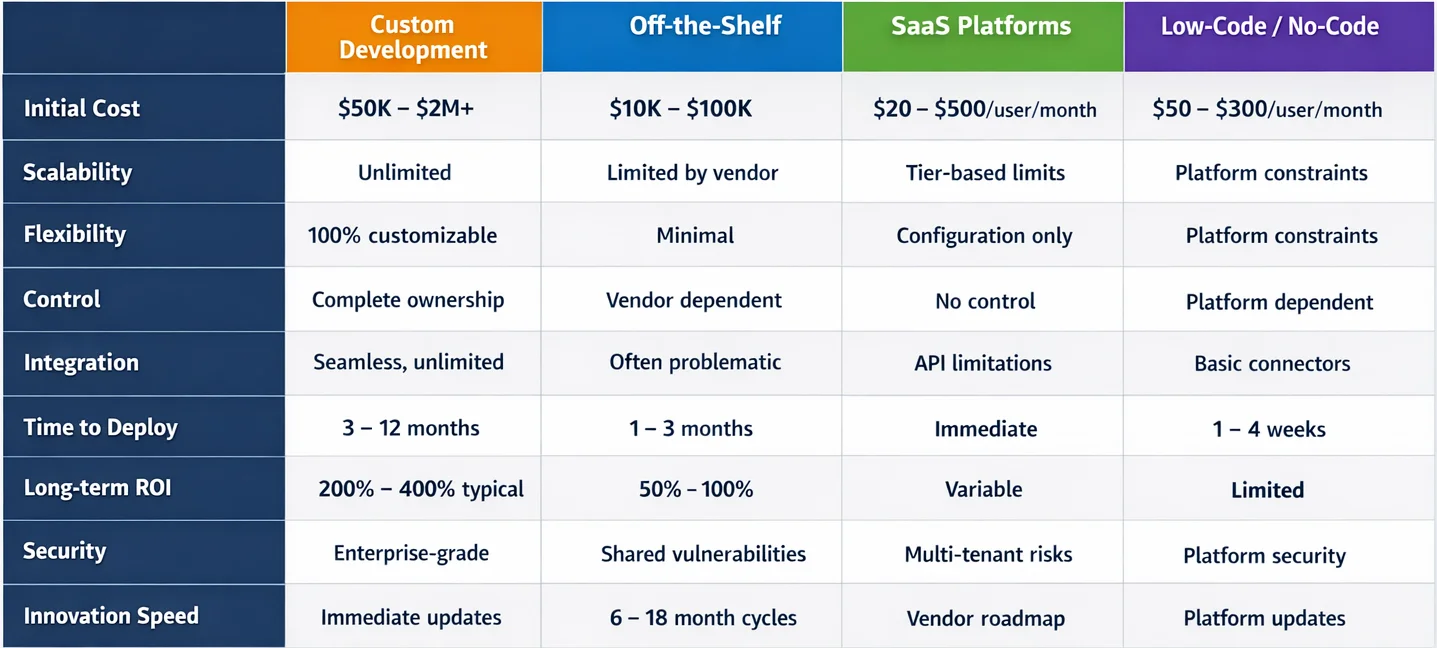
Sure, packaged software gets you up and running fast, but then you hit walls everywhere. The research shows that companies using generic stuff end up spending so much on workarounds that they could've just built custom from the start—usually happens within 18-24 months. And it gets worse—you've got integration headaches, people working more slowly, and you miss chances to innovate.
When you go custom for enterprise stuff, you get exactly what your business needs—no bloat eating up resources, you can pivot when markets shift, and you own your data completely. Your business changes? Your software changes with it—fast, precise, no begging vendors or waiting for their roadmap that might never happen.
It gets really obvious when you look at the competition. Your competitors are stuck waiting months or years, hoping vendors add what they need. Meanwhile, you update in weeks. They're fighting integration limits while your stuff just works together. They're paying more every year for features they don't even use, but you're investing in stuff that actually makes money.
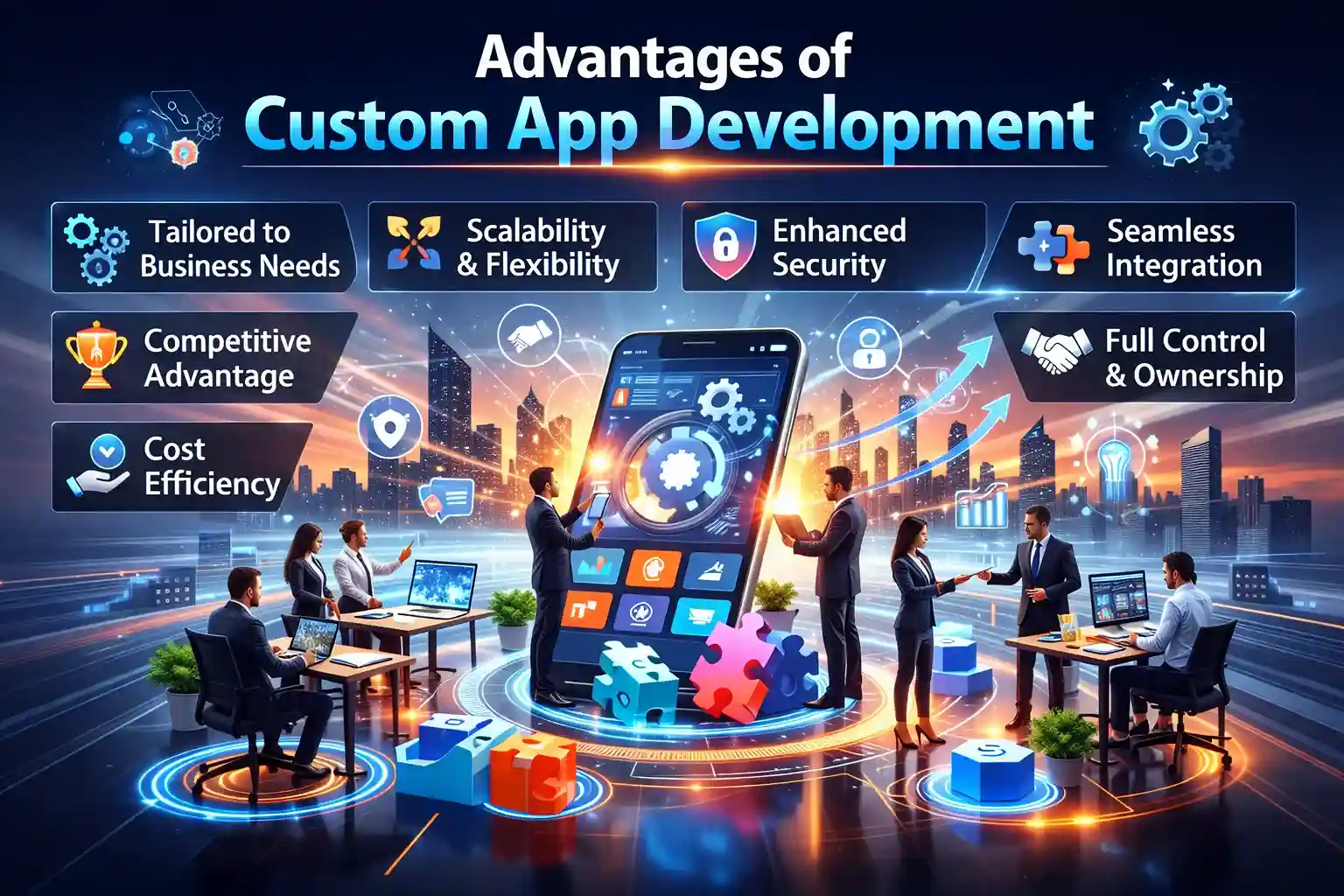
The biggest win with custom development? Your software works exactly how you work. No jamming square pegs in round holes, no friction from trying to make your proven methods fit someone else's idea of how things should work. And it's not just about features—it reflects how your company thinks, operates, and where you're headed.
Going custom gives you capabilities your competition literally cannot get their hands on. Your software becomes this collection of all the smart ways you've learned to do things over the years. It's like building a moat around your business. And here's the kicker—it keeps getting better based on what you learn, while everyone else is stuck with whatever their vendor decides to build.
You can scale forever. Seriously. The whole thing's designed with how you'll grow in mind, so whether you need to handle more orders, more customers, or expand into new places, it just works. Everything connects to everything else, too—no more data silos or copy-pasting between systems.
Speed matters, right? With custom, you push updates when YOU need them. Market opportunity pops up? You're on it. Customers want something new? Done. You're not sitting around hoping some vendor puts your request on their roadmap. Tech becomes your accelerator, not your speed limit.
Security gets built in from day one, designed for your specific risks—not some generic protection that thousands of other companies also use. Think about it—hackers can't use the same tricks on everyone when everyone's system is different. You can patch immediately, monitor everything, and actually reduce your risk big time.
Performance gets optimized for what you actually do. Instead of everything being equally slow, you make the important stuff lightning fast. I've seen companies achieve 10x improvements in their critical operations by focusing on optimization where it counts.
Compliance? It's just part of how the system works, not some Band-Aid slapped on later. HIPAA, SOX, GDPR—whatever rules you follow, they're built into the foundation. Your tech grows with you instead of becoming obsolete. You own everything—no vendor can hold you hostage or jack up prices. You control your own destiny.
Let's be honest—custom development costs more upfront than buying something ready-made. You need solid financial planning and a clear picture of your payback timeline. Sure, you'll usually make that money back and then some, but you've got to have the cash ready to go at the start. And it takes time—we're talking months, not days or weeks. If you're used to signing up for SaaS and starting immediately, this requires a mindset shift and some patience.
Another thing to consider: custom software needs regular attention to stay sharp. Unlike subscription services, where someone else handles all the technical stuff, you're responsible for keeping everything running well and locked down tight. That means having capable people on hand—maybe your own crew, maybe outside experts. And let me tell you, who you pick to build this matters enormously. Hire the wrong shop, and your whole project will crash and burn, no matter how much you spend. Terrible developers build terrible software, period. Then there's getting everyone to actually use the new system. Without a real game plan for teaching your people and supporting them through the switch, even great software can flop.
Sometimes custom isn't the answer. If you're doing things pretty much the same way everyone else in your industry does them—and that's working fine—why reinvent the wheel? Packaged software might be perfect. If money's tight and you can't clearly show how custom development pays for itself, it's probably too risky. Need something yesterday? Custom takes time, so that's out. Got basic needs that existing tools handle just fine? Save your money. And if your whole business model might flip upside down next year, hold off—you don't want to build something that becomes irrelevant.
For straightforward stuff—think automating a few workflows, connecting a couple systems, basic security—you're looking at $50,000 to $150,000 and about 3-4 months. These usually solve specific problems for one department or handle clear-cut processes.
Step up to medium complexity, and you're in the $150,000 to $500,000 range, with a 6-9 month timeline. This is where most enterprise projects land. You're connecting multiple systems, building in sophisticated business rules, meeting compliance standards—real meat-and-potatoes custom development.
The big transformational platforms? Budget $500,000 to $2,000,000+, and block out 12-18 months. These are the projects that fundamentally change how your company operates—mission-critical stuff that touches dozens of systems and handles sensitive data with military-grade security.
Calculating payback isn't just about one thing—you've got money flowing in from different directions. The quickest win usually comes from people getting more done in less time once workflows actually make sense. Then there's the money you stop bleeding on licenses and maintenance fees—this alone often covers your investment within two years. New features can open doors to customers you couldn't serve before. Having capabilities your competitors can't buy gives you pricing power and market share. And don't forget the disasters you avoid—fewer mistakes, staying compliant, and keeping hackers out save a fortune in avoided crises.
Picture this: a healthcare network running 12 hospitals, drowning in complexity. They had six different systems that couldn't talk to each other. Staff were typing the same info into multiple screens, wasting time and making mistakes. Doctors were ready to revolt. They needed their patient records, billing, and new telehealth platform to actually work together.
They went all-in on a custom solution—one unified platform that intelligently moved data where it needed to go and caught errors before they caused problems. The whole thing took 11 months from kickoff to full rollout. Price tag? $1.4 million.
But here's what they got back: admin work dropped by more than half. Billing errors fell by a third. Nine out of ten doctors actually liked using it (when was the last time you heard that?). They made their money back in just over a year.
What made it work? They spent serious time upfront understanding everyone's actual needs. They rolled it out in phases, tweaking as they went based on real feedback. And they kept users in the loop the whole way through. Now they're running smoother than ever and delivering better care—proof that custom development can transform both operations and outcomes.
Healthcare's a whole different animal when it comes to software. You can't just slap something together—HIPAA will eat you alive. So these places build systems where privacy isn't tacked on later, it's baked into every single screen and database from day one.
Hospitals need to share patient files, but can't let just anyone peek. Custom apps handle that dance perfectly. Then there's all the medical gadgets—heart monitors, IV pumps, you name it—feeding data straight to nurses' stations. Someone's vitals drop? Boom, instant alert.
Rural healthcare? That's where it gets interesting. Custom telehealth lets a farmer in Nebraska video chat with a brain surgeon in Boston. And those AI diagnostic tools? They're catching cancers doctors might miss on a tired Tuesday afternoon.
Wall Street runs on microseconds and custom code. These trading platforms are insane—they're scanning global markets, running calculations that would melt your laptop, and executing trades faster than you can blink.
Banks stopped just checking credit scores years ago. Now their custom systems dig through mountains of data to determine whether you're a good fit for that loan. They're tracking millions of transactions every hour, and if regulators change the rules tomorrow? The software will adapt by next week.
What really gets me is how they personalize everything now. Same bank, a million customers, but everyone sees their perfect banking experience. That's custom development earning customer loyalty in a world where switching banks takes five minutes.
Factories today? Nothing like your grandfather's assembly line. They've got sensors on everything, and I mean everything. Custom software watches all those sensors and goes, "Hey, that bearing's gonna fail Thursday afternoon." Maintenance fixes it on Wednesday. No downtime, no drama.
Supply chains are wild, too. These systems are juggling suppliers in fifty countries, weather delays, port strikes, whatever—and still getting parts where they need to be. The quality control stuff blows my mind. Cameras check thousands of products per minute, consistently catching defects that no human would ever see.
Best part? They test everything virtually first. Want to rearrange the factory floor? Run it in the digital twin. Saves millions in "oops, that didn't work" moments.
Alright, so you want custom software. First thing—and I mean very first—you gotta talk to everyone. Not just the bosses. The people actually doing the work every day. They'll tell you what really needs fixing.
You'd be amazed at what comes out. "Oh, we spend two hours every morning copying data between systems." Boom, there's your automation target. Look at the competition too. What are they doing that you're not? More importantly, what aren't they doing that you could?
Then comes the money talk. Real numbers, not wishful thinking. How much will this actually save? How much new business could it bring? If you can't answer that clearly, you're not ready to build.
Here's where most projects go wrong—they design for how they think people work, not how they actually work. Watch your users for a day. It's enlightening.
The technical stuff matters too. You're making decisions now that you'll live with for years. Pick the wrong database or framework, and you're screwed. But overengineer it, and you'll never finish. It's a balance.
Security can't be an afterthought. I've seen too many projects try to bolt on security at the end. Disaster. Build it in from the start or pay for it later.
Two-week sprints keep everyone sane. You see progress, catch problems early, and can pivot if needed. None of this "disappear for six months and hope for the best" nonsense.
Testing happens constantly. Not just "does it work?" but "does it work at scale?" and "what happens when someone does something stupid?" Because someone will.
Roll out features gradually. Give it to a small group first. They'll find every weird edge case before it hits everyone else. Trust me on this one.
Launch day isn't really launch day anymore. You ease into it. Maybe one department goes first. Iron out the kinks. Then another. By the time everyone's on board, you've solved the major issues.
Training matters more than most people think. Not just "here's which button to click" but "here's why we're doing this differently now." Get buy-in or watch your expensive new system collect dust.
After launch? That's when the real work starts. Watch how people actually use it. They'll do things you never imagined. Some brilliant, some baffling. Keep tweaking, keep improving. The best custom software gets better every month, not worse.
Look, there are tons of dev shops out there. But AD Infosystem? They actually give a damn about your business, not just your project.
Most developers show up, nod along in meetings, then build what they think you need. AD Infosystem flips that script. They'll grill you (in a good way) about your business model, your competition, and where you're headed. Only then do they start talking tech. Because what's the point of beautiful code if it doesn't help you crush your goals?
They've got serious street cred, too. We're talking Fortune 500 implementations where one screw-up means headlines. But also scrappy mid-market companies where every dollar counts. That range? That's rare. It means they've solved pretty much every problem you might throw at them.
And they build for the real world, not some textbook scenario. Cloud-native because that's table stakes now. AI hooks because even if you don't need machine learning today, you might next year. APIs on everything because your software needs to play nice with whatever comes next.
The kicker? They don't ghost you after go-live. I've worked with vendors who practically sprint away once they get the final payment. AD Infosystem hangs around, watching how things perform, suggesting tweaks, and sometimes calling you up, like, "Hey, there's this new tech that could save you 30% on processing costs." That's a partner, not a vendor.
Alright, let's wrap this up. Custom app development used to be this exotic thing only huge companies did. Not anymore. In 2026, if your software doesn't fit your business like a glove, you're competing with both hands tied.
We broke down what custom development really means—not buying someone else's idea of how to run your business, but building exactly what you need. Sure, the sticker shock is real ($50K minimum, often way more), and you're not getting instant gratification (minimum 3 months, probably longer). But here's the thing—companies regularly double or triple their investment back because finally, FINALLY, their tech works with them instead of against them.
The wins stack up fast. The weird but brilliant process that gives you an edge? Now it's automated. That integration nightmare between three systems? Gone. Need to scale up fast? No problem. Want to add a feature your biggest client is begging for? You control the timeline.
We looked at how different industries make this work. Hospitals are building systems that prioritize patient privacy. Trading firms are shaving microseconds off transactions. Factories predict breakdowns before they happen. Stores know what you want before you do. There's no industry that can't benefit—it's just about finding your angle.
Building this stuff follows a logical path. First, figure out what success looks like. Then design something people will actually want to use. Build it in chunks so you can adjust as you go. Launch carefully and keep improving it. Simple concept, tricky execution.
But hey, sometimes custom isn't the move. If you're happy being average, strapped for cash, needed it yesterday, have basic needs, or your whole business model is up in the air—maybe stick with off-the-shelf. No judgment. Well, maybe a little.
Bottom line on AD Infosystem: they're not just coders; they're businesspeople who happen to be really good at tech. They build stuff that lasts, think ahead, and stick around to make sure you're winning. In a world full of here-today-gone-tomorrow dev shops, that's gold.