
Electronic Data Interchange might sound intimidating, but it’s really just computers talking to each other—no humans playing phone tag. That purchase order you’d normally email? With EDI, it flows straight from your system to your supplier’s system in seconds. The invoice that would sit in your inbox for days? It’s processed automatically, matched against the order, and queued for payment without anyone lifting a finger.
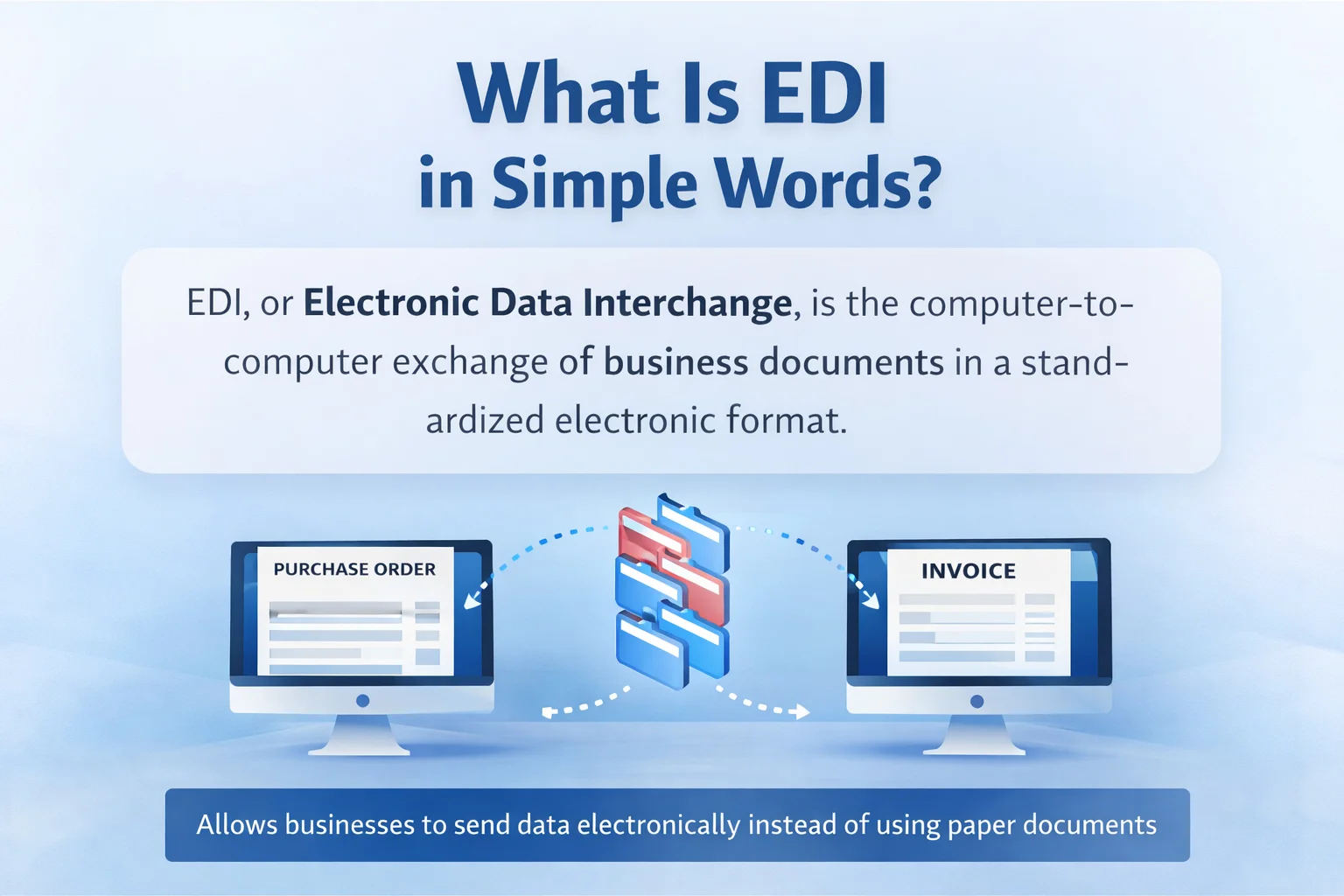
EDI is a system that allows businesses to exchange standard documents electronically between computer systems instead of using paper or email. In real supply-chain operations, buyers at major retailers can handle thousands of orders without touching a keyboard. An inventory system detects low stock—say, detergent at a retail store—and automatically generates a purchase order. That order is sent directly to the supplier’s system, which checks availability and confirms shipment within seconds. The entire exchange can take less than 30 seconds.
What many businesses overlook is the compound effect of these time savings. One sporting goods retailer was spending 20 hours each week on manual order processing. After implementing EDI, those same employees shifted their focus to negotiating better supplier terms and analyzing purchasing patterns. The result was a 40% reduction in stockouts and improved cash flow through early payment discounts that were previously missed.
EDI transaction sets are standardized electronic business documents, each identified by a three-digit code that defines the document type—such as 850 for purchase orders or 810 for invoices.
Where many companies struggle is understanding why this standardization matters. Every business wants to do things its own way, but EDI forces everyone to use identical formats. Think of it like international shipping containers—they’re all the same size, so any crane in any port can handle them. EDI documents work the same way.
This rigid structure enables something powerful: a small local retailer can send orders to massive suppliers using the same format as global enterprises. Computers don’t care about company size—they just read the codes and process the transactions. This standardization is what makes B2B integration services work at scale.
The 850 is where most B2B relationships begin—it’s the electronic purchase order that kicks off virtually every transaction.
What is the EDI 850 purchase order format? In most EDI projects, companies are surprised by how detailed the 850 needs to be:
This level of detail becomes critical when working with large retailers. A furniture distributor I consulted for discovered their manual process was causing missed delivery windows. Their purchasing manager spent four hours every morning creating orders, double-checking product codes, and emailing suppliers. After implementing EDI 850, reordering became automatic—inventory thresholds trigger instant orders. That manager now focuses on vendor relationships and cost negotiations instead of data entry.
The 856 revolutionized warehouse receiving. Before a shipment even leaves the dock, this document tells the buyer exactly what’s coming and when.
In real warehouse operations, the 856 is the difference between chaos and control. At one major distribution center, shipments used to arrive with no advance visibility. Staff scrambled to unload, sort, and decide where everything belonged—overtime costs were draining the budget.
The EDI 856 provides:
After implementing EDI 856, that same distribution center knows exactly what’s arriving and when. For example, a Tuesday 2 PM delivery might contain 40 pallets of paper goods for zone B. The right crew is scheduled, storage space is prepared, and the truck is processed in one hour instead of four. Within six months, receiving costs dropped by 60%.
The 810 electronic invoice is how money flows in the EDI ecosystem. Unlike paper invoices that create delays and inefficiency, the 810 integrates directly with payment and accounting systems.
Most businesses feel the biggest impact in accounts payable. One auto parts distributor had two full-time employees dedicated solely to invoice entry. Hundreds of invoices arrived daily by mail and email, were manually keyed in, matched to purchase orders, and routed for approval. Errors were common, vendors chased late payments, and early payment discounts were missed.
The EDI 810 changed everything. Invoices now flow directly into the ERP system, which automatically:
Those two employees now focus on vendor relationship management and dispute resolution—high-value work instead of repetitive data entry.
The most common EDI transaction codes used in retail supply chains are 850 (Purchase Order), 855 (Order Acknowledgment), 856 (Advance Ship Notice), 810 (Invoice), and 997 (Functional Acknowledgment).
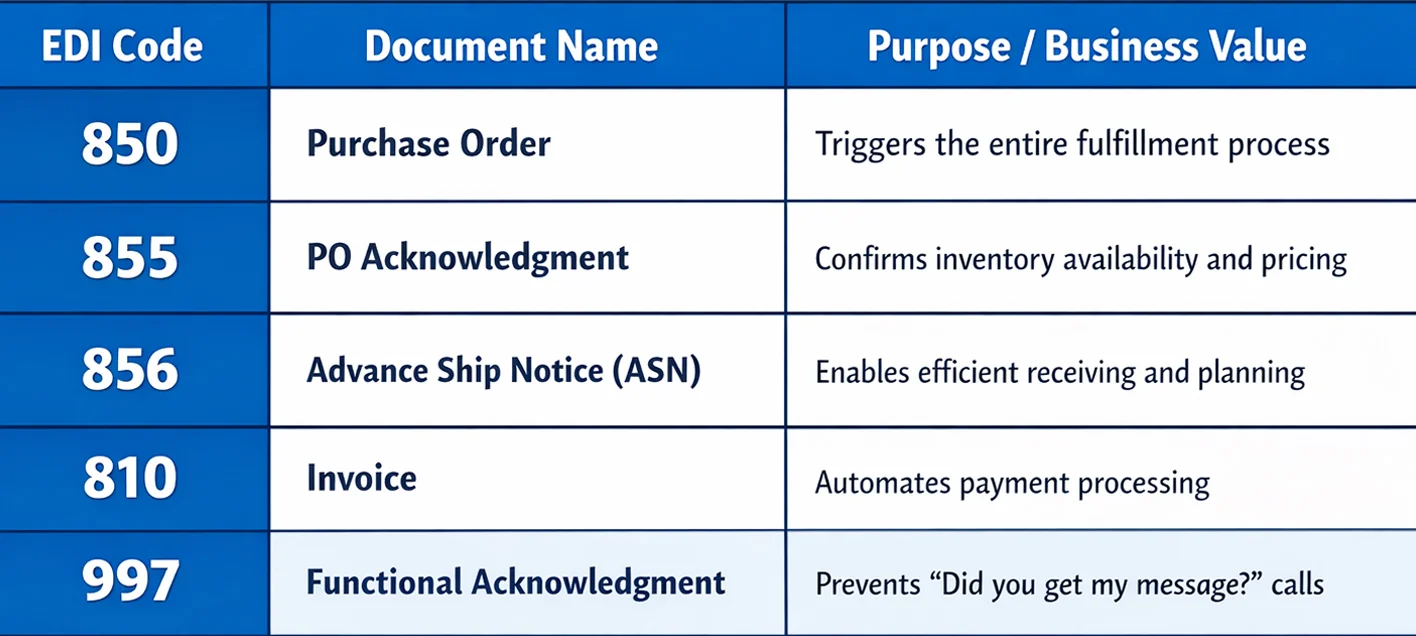
In most retail implementations, these five transaction sets handle nearly 90% of total volume. Larger retailers may require additional codes such as 860 (Purchase Order Change) or 846 (Inventory Inquiry), but mastering the core five comes first. Every major retailer—Walmart, Target, and Home Depot—starts new vendors here.
Let me walk you through a real transaction flow from last month at a major retailer.
Monday morning, the retailer’s inventory system hits a trigger point—down to 47 pairs of a popular shoe size. Without anyone touching anything, the system automatically creates an EDI 850 purchase order for 500 units and sends it to the supplier.
A few hours later, the supplier’s system receives the order, checks warehouse availability, confirms it can be fulfilled, and responds with an EDI 855 acknowledgment—essentially saying, “Order received, shipping on Wednesday.”
Wednesday afternoon, warehouse teams begin loading the shipment. As cartons are scanned, each scan feeds data into the EDI 856 advance ship notice. Before the trailer even leaves the dock, the retailer already knows exactly what’s coming—down to item quantities, carton numbers, and pallet locations.
Thursday morning, the truck arrives at the retailer’s dock. As the receiving team scans shipments, the system compares every item against the 856. Missing boxes are flagged instantly, extra items are caught immediately, and matched shipments update inventory across stores and eCommerce channels in real time.
On Friday, the supplier sends the EDI 810 invoice. The retailer’s system performs a three-way match—invoice versus the original purchase order and the actual received goods. Quantities match, prices match, terms are correct. Payment is scheduled automatically, and the transaction is complete without manual intervention.
Getting EDI operational requires four interconnected pieces working together.
Standards – This is where companies usually mess up by assuming they can customize things. You can’t. ANSI X12 in North America and EDIFACT internationally define exactly where every piece of data goes. There’s no creativity allowed—only compliance.
Translation Software – Your internal systems speak their own language. Maybe your database calls a product “NIKE_AM_10_BLK.” EDI expects something like “LIN01UP123456789,” where each segment has a specific meaning and format. Translation software acts as a smart dictionary that maps your internal data to EDI standards and remembers those mappings. Trying to manage this in spreadsheets is a fast path to failure.
Communication Protocols – How the data moves matters. AS2 is the most common for internet-based EDI. SFTP is often used for batch transfers. Some companies still rely on VANs (Value Added Networks)—more expensive, but extremely reliable.
System Integration – This becomes critical as volume grows. Purchase orders must flow automatically into your ERP, and shipments should trigger EDI 856 notices without manual effort. Poor integration means you’re still doing manual work—just with more expensive technology.
Businesses working with multiple trading partners often discover that managing EDI internally becomes complex without dedicated expertise.
Here’s what typically happens. You implement EDI for one major retailer. A few months later, another retailer comes on board with different document versions. Then another partner adds unique labeling rules and compliance checks. Before long, you’re juggling multiple rule sets, testing schedules, and retailer-specific standards.
Professional EDI integration services understand these retailer-specific requirements in detail. More importantly, they monitor transactions around the clock. When a retailer updates ASN requirements, changes chargeback rules, or when a transaction fails in the middle of the night—that’s when managed EDI services prove their value.
At AD Infosystem, our team has worked with businesses across retail, manufacturing, and distribution to streamline EDI operations—turning complex technical requirements into smooth, automated processes that scale as your business grows.