
Disconnected business applications cost companies thousands in manual work and delays. Enterprise Application Integration (EAI) fixes this. At AD Infosystem, we've implemented Dell Boomi integration services for hundreds of businesses, providing one of the fastest paths to connected systems. Let's examine what EAI is and how it transforms business operations.
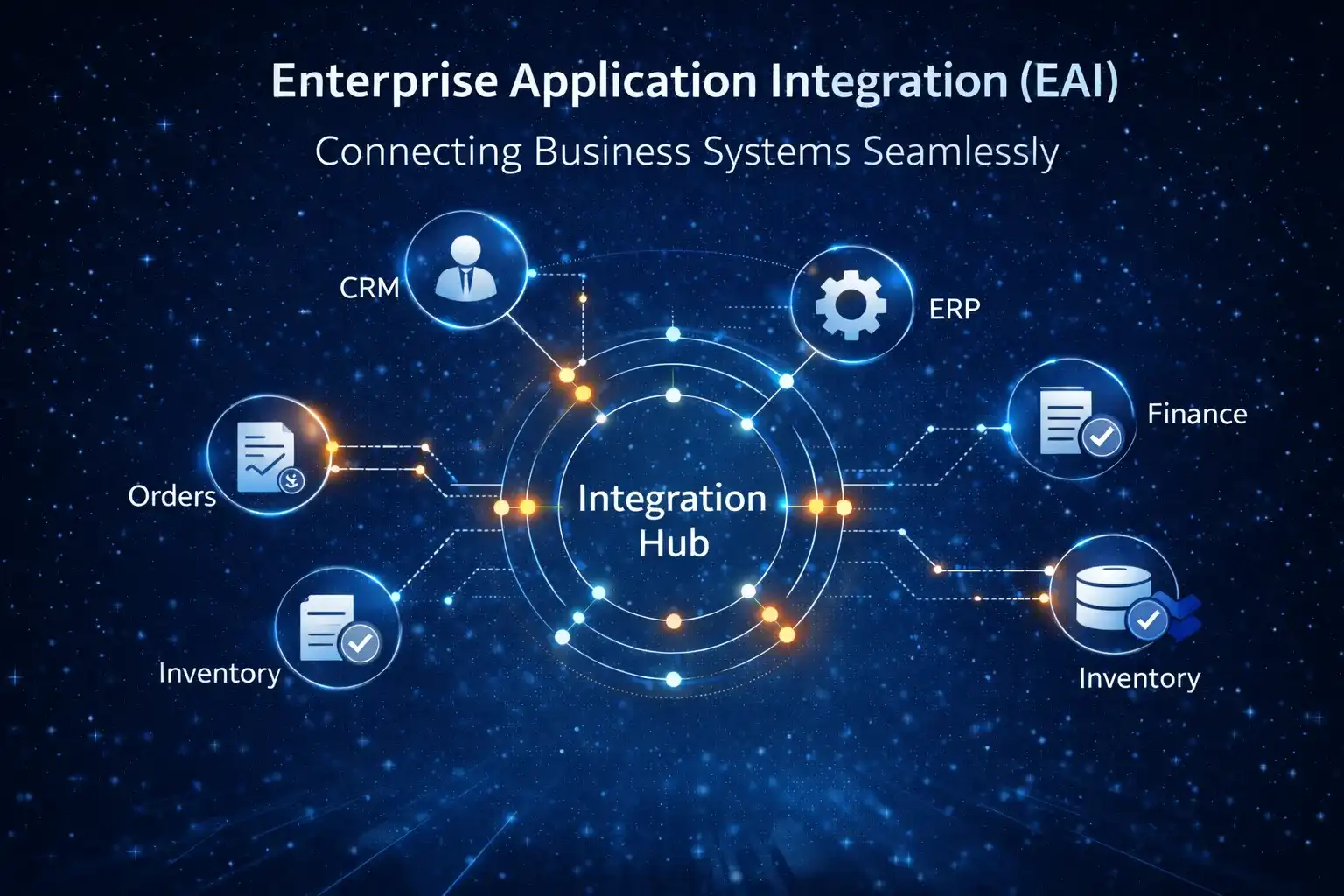
Enterprise Application Integration gets all your business software to talk to each other. Right now, your employees are probably copying and pasting data between systems all day. That's slow and error-prone. EAI builds automatic connections so data flows on its own.
Here's a real example. An electronics distributor had three disconnected systems: an online store, inventory software, and QuickBooks. Every order meant typing information three times. After setting up EAI, website orders automatically updated inventory and created invoices. Order processing dropped from 45 minutes to 6 minutes. Errors disappeared. That's what application connectivity solutions deliver.
EAI does three things: syncs your data (change a phone number once, and it updates everywhere), automates processes between applications, and makes separate systems work as one. Your team stops fighting technology and starts getting work done.
People confuse EAI with ERP. ERP systems like SAP want you to replace all current software with their platform. It's like demolishing your office because you need a bigger conference room. Expensive and usually unnecessary.
EAI is smarter. Keep the software your team knows—your customized CRM, that inventory system fitting your warehouse perfectly, your five-year-old accounting software with all its customizations. EAI connects them. We're talking hundreds of thousands instead of millions, months instead of years.
When should you consider ERP? Starting from zero or using stone-age systems. But if you've got decent software that doesn't communicate, EAI delivers faster, cheaper results. Most established businesses already have good software. They need those systems to automatically share data. Why replace everything when you can build bridges?
Another confusion—EAI versus ESB. EAI is your goal: connected applications. ESB is one specific method to achieve it.
Old EAI systems were connected directly—point A to point B. Simple but gets messy at scale. ESB created a sophisticated middle layer that all systems connect through. Sounds great until you realize you need specialists and expensive infrastructure to keep it running.
This shift is why many enterprises now adopt iPaaS platforms instead of traditional ESBs. Cloud platforms deliver ESB benefits without the headaches. No servers to maintain, no huge upfront costs, and they actually work without specialist teams. Modern integration architecture models adapt to your business instead of forcing you into rigid patterns.
Each integration pattern has its place. Understanding them helps you choose wisely:
Point-to-Point Integration directly connects applications. Great when you have three systems. But 10 applications need 45 different connections—a maintenance nightmare waiting to happen.
Hub-and-Spoke Pattern routes everything through a central hub. Much cleaner than point-to-point, easier to monitor. But when that hub fails, your entire business comes to a halt. We've seen companies lose millions during hub crashes.
Enterprise Service Bus (ESB) builds a sophisticated data highway. Honestly? ESB is like buying a Ferrari to drive to the grocery store. Sure, it's impressive and handles everything you throw at it. But unless you're Walmart or Bank of America, you're paying for power you'll never use. Plus, you need a whole team to keep it running.
Modern Cloud Integration platforms like Dell Boomi took a different approach. They asked, "What if integration were actually easy?" Pick your apps from a menu, drag some arrows between them, configure a few settings—boom, you're integrated. No PhD required. The best part? When your business doubles next year, the platform handles it. No midnight server upgrades, no capacity planning meetings.
Here's what happens when EAI actually works:
Manufacturing: Picture this—an auto parts company taking two full days to get a customer order to their factory floor. SAP ran production, Salesforce handled orders, and some ancient system tracked inventory. Nobody talked to anybody. We connected everything with EAI. Now? Order comes in, factory knows in 20 minutes, parts ship same day. They're beating competitors by days, not hours.
Healthcare: Hospital nightmare—15 different systems, none connected. Does the doctor need your medical history? That's 30 minutes of clicking through screens while you sit there in a paper gown. We unified everything with EAI. Now, doctors pull up everything with one click. Patients get treated faster, fewer mistakes happen, and everybody wins.
Retail: An Online retailer had three people doing nothing but copying and pasting orders all day. Shopify order here, warehouse pick there, NetSuite invoice somewhere else. Total waste of talent. EAI made it automatic—customer clicks Buy, warehouse starts packing, and the invoice generates itself. Those three people? Now they're growing the business instead of being human copy machines.
Every industry, same story—too much manual work, too many mistakes, too slow to compete. EAI fixes all of it.
Traditional integration is a pain. You hire expensive programmers who speak both systems' languages. They code for months. Then you test, fix bugs, test again. Finally, go live and pray nothing breaks when either system updates. It's why integration projects have such a bad reputation.
Boomi provides pre-built connectors for over 200 business applications. Need Salesforce talking to NetSuite? There's a connector ready. QuickBooks to Shopify? Got that covered. Instead of coding for months, you literally draw lines between systems. Visual development replaces complex programming.
The platform automatically handles all technical complexity. Data format differences? Boomi translates. Connection drops? Boomi retries. Processing millions of records? Boomi scales up automatically. You focus on business logic, not technical plumbing. Built-in monitoring and governance ensure integrations remain reliable at scale.
Here's the speed difference that amazes everyone: Traditional integration projects routinely take 6-12 months minimum. With Dell Boomi integration services, companies connect entire system landscapes in 6 weeks. One distribution client linked 12 critical applications in just two months. Their competitor spent two years and millions attempting traditional integration—still not finished.
The integration software platforms market splits into two camps:
Traditional tools include IBM WebSphere, Oracle Fusion, and Microsoft BizTalk. They're powerful, proven, and require significant resources. You'll need servers, licenses, consultants, and expanded IT budgets like buying a semi-truck for your daily commute.
Modern iPaaS solutions such as Dell Boomi, MuleSoft, and Informatica have revolutionized integration. Cloud-based, no infrastructure required, pay monthly like any SaaS. Business users can actually build integrations without constantly calling IT.
Speed and simplicity. After 15 years, they've seen every oddball system and crazy requirement you can imagine. Their approach? Make it visual so regular people can build integrations. Let the platform worry about the technical gymnastics. While you're connecting systems, they're handling the boring stuff—keeping everything secure, running fast, and backing up your work. You focus on business, they hold the plumbing.
Enterprise Application Integration connects your disconnected business systems into one smooth operation. Forget expensive ERP replacements—EAI makes your current software work together seamlessly. Dell Boomi simplifies the entire process with visual tools, pre-built connectors, and cloud delivery. No more manual data entry, no more disconnected departments, no more information silos. Just business that flows naturally. Ready to assess your integration readiness?