IT Maintenance Services Company After Cyberattack: Recovery & Hardening Guide

Published for CIOs, IT Directors & Security Leaders | Estimated Read: 14 min


Introduction

The breach has happened—but the real risk begins now. Most organizations underestimate what comes next. The post-attack phase is where systems either become stronger or remain vulnerable to repeat breaches. This is where an IT maintenance services company plays a critical role, handling recovery, system hardening, and long-term IT security maintenance to prevent future attacks.

Studies show that over 60% of organizations experience a second cyberattack within a year if post-breach remediation is incomplete.

The average cost of repeat breaches is significantly higher due to compounded system vulnerabilities and operational downtime.

According to IBM's Cost of a Data Breach Report, organizations that fail to fully remediate after an attack face a 26% higher likelihood of a repeat breach within 24 months. The recovery phase is where long-term security is won or lost.

This guide is built for CIOs, IT Directors, and Security Leaders who need a precise, actionable roadmap — not generic advice. From Week 1 stabilization through long-term hardening, we cover every phase of post-breach IT maintenance with the depth your decisions require.


Post-Breach Summary

  • Immediate: Validate complete threat removal
  • Week 1-2: Rebuild identity and access systems
  • Month 1-3: Harden infrastructure end-to-end
  • Ongoing: Monitor continuously with SIEM/EDR

Table of Contents

  1. What Does an IT Maintenance Services Company Do After a Cyberattack?
  2. What Happens After a Cyberattack (Reality Check)
  3. Post-Breach IT Maintenance by an IT Maintenance Services Company
  4. Why an IT Maintenance Services Company Is Critical After a Cyberattack
  5. Benefits of Hiring an IT Maintenance Services Company After a Breach
  6. Cyber Recovery Services Breakdown
  7. Post-Breach IT Maintenance Checklist
  8. System Hardening Strategy (Step-by-Step)
  9. Ongoing IT Security Maintenance Framework
  10. When Should You Hire an IT Maintenance Services Company?
  11. How to Choose the Right IT Maintenance Services Company for Cyber Recovery
  12. Common Mistakes After a Breach
  13. Why Businesses Get Attacked Again
  14. FAQ
  15. Conclusion & CTA

What Does an IT Maintenance Services Company Do After a Cyberattack?

An IT maintenance services company manages post-breach recovery by validating threat removal, rebuilding compromised systems, implementing system hardening, and establishing continuous monitoring. Their role ensures organizations not only recover from cyberattacks but also reduce the risk of repeat incidents through ongoing IT security maintenance.

Not all IT support providers are equipped for this work. A specialist, reliable IT maintenance company brings dedicated post-breach engineering capability, structured recovery frameworks, and embedded security operations — far beyond what a standard helpdesk or generalist MSP can deliver.
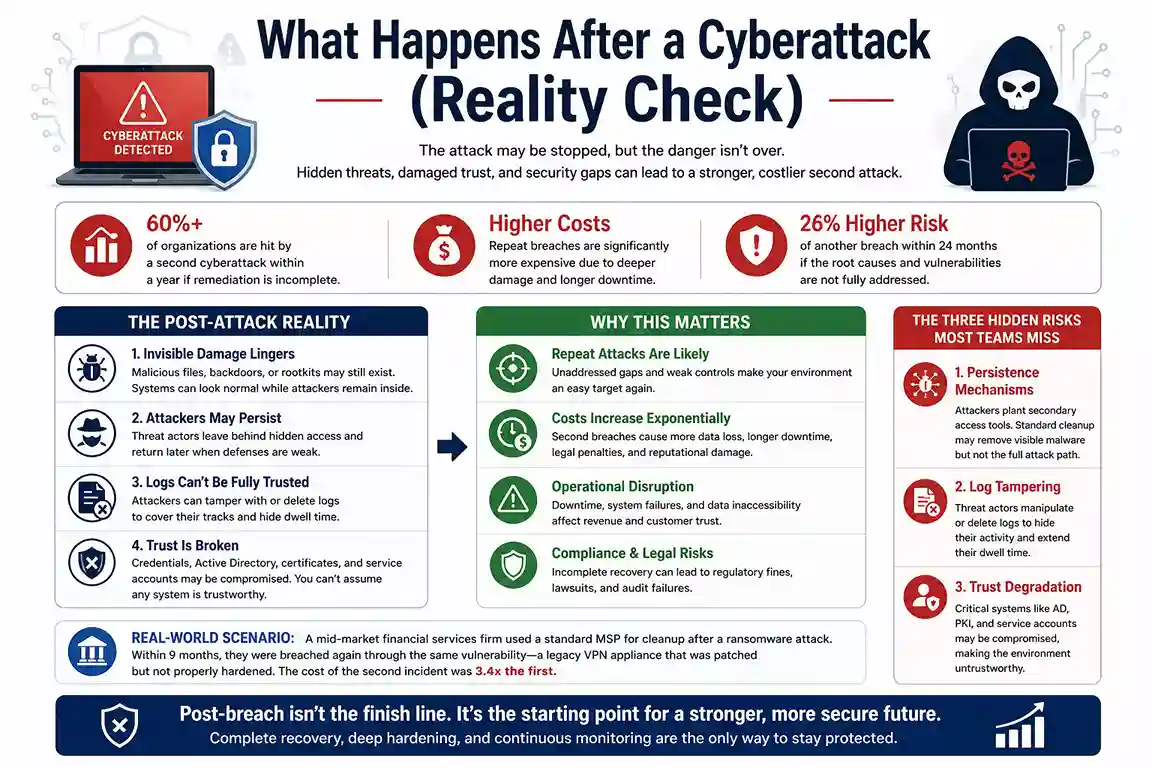

Cyberattack aftermath infographic showing risks, hidden threats, and post-breach recovery challenges

What Happens After a Cyberattack (Reality Check)

Most executives assume the hard part is over once the attacker is expelled. That assumption is catastrophically wrong.

Cyberattacks — whether ransomware, supply chain compromise, or credential-based intrusions — leave invisible damage across your infrastructure. Systems appear functional but may be running compromised binaries. Credentials appear rotated, but backdoors may remain. Endpoints appear clean, but rootkits can survive standard reimaging.

The Three Hidden Risks Most Teams Miss

  1. Persistence mechanisms: Attackers routinely plant secondary access tools before detection. Standard incident response clears the visible malware but rarely validates the full attack path.
  2. Log tampering: Sophisticated threat actors manipulate or delete logs to hide dwell time, which can extend weeks or months before discovery.
  3. Trust degradation: Active Directory, PKI infrastructure, and service accounts may be compromised at a level that makes your environment fundamentally untrustworthy until fully rebuilt.

This is the reality that separates organizations that fully recover from those that become repeat victims. The post-breach environment cannot be treated as "mostly fixed" — it must be treated as compromised until proven otherwise through rigorous IT security maintenance.

Real-World Scenario: A mid-market financial services firm engaged a standard MSP for cleanup after a ransomware event. Within 9 months, they experienced a second breach via the same initial access vector — a legacy VPN appliance that had been patched but not fully hardened. The cost of the second incident was 3.4x the first.

Quick Recovery Checklist

  • Validate complete threat removal across all systems.
  • Rebuild all identity and access controls.
  • Harden endpoints and network infrastructure.
  • Deploy continuous monitoring tools immediately.
  • Document everything for legal and compliance review.

Post-breach IT maintenance phases respond, recover, harden, monitor, and improve systems

Post-Breach IT Maintenance by an IT Maintenance Services Company

Post-breach IT maintenance is a structured, multi-phase discipline that addresses five distinct infrastructure layers: endpoints, identity, network, applications, and data. It is fundamentally different from both standard IT operations and incident response.

Focus Contain the attack Rebuild & validate systems Maintain uptime
Goal Remove the attacker Harden the environment Routine operations
Activity Preserve forensic evidence Establish continuous monitoring Helpdesk & service desk
Timeline Days to weeks Months to ongoing Perpetual cycle
Owner IR/forensics firm IT maintenance services company Internal IT / MSP

Understanding how IT maintenance during business hours differs from after-hours incident response is critical for continuity planning. Structured post-breach maintenance spans both windows and cannot be limited to a standard support schedule.


Why an IT Maintenance Services Company Is Critical After a Cyberattack

General IT support teams are built for operational continuity — not for the forensic rigor and security engineering discipline that post-breach environments demand. Here is why a specialist IT maintenance services company is non-negotiable after a significant breach:

  1. They possess structured frameworks (CIS, NIST, DISA STIGs) and apply them systematically rather than reactively.
  2. They maintain continuity between the recovery and long-term hardening phases — closing the dangerous knowledge gap when the incident response team departs.
  3. They operate embedded security functions (SOC, SIEM, EDR, vulnerability management) rather than outsourcing detection to disconnected vendors.
  4. They deliver executive-level reporting tied to risk reduction metrics, not just uptime percentages.
  5. They retain institutional memory of your environment post-breach, enabling faster detection and response when the next threat emerges.

Organizations with a retained IT security maintenance partner detect follow-on threats 74% faster than those relying on ad-hoc incident response engagements.

Why Generalist IT Support Fails Post-Breach

  • No forensic validation methodology
  • No structured hardening framework
  • No 24/7 threat monitoring capability
  • No post-breach institutional continuity
  • No board-level security risk reporting

Benefits of Hiring an IT Maintenance Services Company After a Breach

Engaging a dedicated IT maintenance services company after a cyberattack delivers measurable, sustained advantages that in-house teams and generalist providers cannot replicate.

Faster Recovery Structured phase-gated methodology reduces time-to-stable from months to weeks
Lower Repeat Breach Risk Systematic hardening closes the attack vectors that enabled the original incident
Continuous Threat Visibility 24/7 SOC and SIEM monitoring detects follow-on threats before they escalate
Regulatory Compliance Maintained security controls support HIPAA, PCI-DSS, ISO 27001, SOC 2 requirements
Reduced Total Cost Early engagement and ongoing maintenance costs far less than a second breach
Board-Level Confidence Executive reporting translates technical security posture into risk metrics leadership understands
Institutional Memory Your provider retains full context of the breach, recovery, and hardening — critical for future response

Partnering with the right provider is not a cost center decision — it is a risk management investment with a quantifiable return.


Cyber Recovery Services Breakdown

Cyber recovery services encompass the technical and strategic activities required to restore full, verified operational capability following a security incident. Here is how a structured IT maintenance services company phases the engagement:

Week 1-2: Containment Verification & Stabilization

  1. Threat actor eviction validation — confirm no persistent access remains across all vectors.
  2. Forensic environment snapshot — preserve pre-cleanup state for legal and insurance purposes
  3. Critical system triage — prioritize revenue-generating and compliance-critical systems first
  4. Emergency access controls — implement temporary privileged access management (PAM) policies.
  5. Out-of-band communication — establish secure channels for IT operations during remediation

Key Deliverable (Week 1-2): A validated clean baseline image for all Tier 1 systems, confirmed via EDR tooling and independent hash verification.

Month 1-3: System Rebuilding & Validation

  1. Active Directory rebuild or forensic audit — determine whether AD can be trusted or must be fully rebuilt.
  2. Service account audit — enumerate, rotate, and enforce least-privilege on all non-human identities.
  3. Endpoint rebuild from known-clean media — never restore from potentially compromised backup images.
  4. Application security testing — validate the integrity of all business-critical applications post-restoration
  5. Backup validation — test restoration procedures and confirm integrity against clean baselines
  6. Network segmentation review — enforce micro-segmentation to contain future lateral movement

Long-Term: Hardening & Continuous Monitoring

  1. Deploy 24/7 SOC monitoring or managed SIEM/XDR services.
  2. Establish a vulnerability management program with defined remediation SLAs
  3. Implement zero-trust network access (ZTNA) architecture.
  4. Conduct regular penetration testing and adversarial simulation (red team exercises)
  5. Establish board-level security reporting and KPI dashboards.

Post-Breach IT Maintenance Checklist

Use this checklist to confirm all critical activities are complete before declaring your environment stable:

Immediate Actions (Week 1)

  • Validate complete threat removal across all endpoints, identities, and network segments.
  • Preserve the forensic state before any cleanup activity.
  • Establish out-of-band secure communications for the IT team.
  • Initiate emergency PAM controls on all privileged accounts.

Rebuilding Phase (Month 1-3)

  • Rebuild identity and access systems — Active Directory, service accounts, MFA.
  • Verify backup integrity before any restoration against known-clean checksums.
  • Rebuild endpoints from clean media — not from potentially compromised images.
  • Conduct application security testing on all business-critical systems.

Hardening Phase (Ongoing)

  • Harden all endpoints and network infrastructure to CIS Benchmark standards.
  • Deploy continuous monitoring tools: SIEM, EDR, XDR, with 24/7 alert coverage.
  • Implement zero-trust architecture — network segmentation, least-privilege, ZTNA.
  • Conduct a post-hardening penetration test to validate control effectiveness.

Governance (Ongoing)

  • Complete Post-Incident Review (PIR) and update the IR plan accordingly.
  • Establish ongoing vulnerability management with a defined SLA cadence.
  • Confirm the board-level security reporting framework is operational.
  • Schedule semi-annual tabletop exercises and backup validation.

System Hardening Strategy: A Step-by-Step Framework

System hardening is the most technically demanding phase of post-breach recovery — and the one most organizations shortcut. A dedicated IT maintenance services company applies CIS Benchmarks, NIST SP 800-53, and DISA STIGs as structured frameworks, not suggestions.

Step 1: Asset Inventory & Classification

You cannot harden what you cannot see. Conduct a full asset discovery sweep across on-premises, cloud, and hybrid environments. Classify every asset by sensitivity, criticality, and attack surface exposure before any hardening work begins.

Step 2: Vulnerability Assessment

Run authenticated vulnerability scans across all discovered assets. Prioritize using CVSS scores combined with real-world exploitability context — a high-CVSS finding with no external exposure ranks lower than a medium-CVSS finding on an internet-facing service.

Step 3: Configuration Baseline Enforcement

  1. Disable all unnecessary services, ports, and protocols.
  2. Remove default credentials from every network device and application.
  3. Apply OS-level security benchmarks — CIS Level 1 minimum, Level 2 for high-value assets.
  4. Enable audit logging on all systems and forward to a centralized, tamper-resistant SIEM

Step 4: Identity & Access Hardening

  1. Enforce MFA on all privileged accounts and all remote access pathways.
  2. Implement tiered administration — separate credentials for daily use vs. administrative tasks.
  3. Audit and remove all stale accounts, excess permissions, and service accounts with interactive logon rights.
  4. Deploy organization-wide password management with enforced complexity requirements.

Step 5: Network Architecture Hardening

  1. Segment all networks by function and trust level — user, server, OT/IoT, management
  2. Deploy next-generation firewall (NGFW) with application-layer inspection.
  3. Implement DNS filtering and a web proxy for all outbound traffic.
  4. Disable all legacy protocols: SMBv1, NTLM, Telnet, FTP

Step 6: Patch Management Optimization

Establish a risk-based patch management cadence: critical vulnerabilities within 24-48 hours, high-severity within 7 days, medium within 30 days. Automate wherever operationally feasible. This discipline directly addresses technical debt challenges that accumulate in under-resourced IT environments and become the next breach's entry point.


Validation & Certification

Hardening without validation is theater. Conduct post-hardening penetration testing to verify every control is effective against real-world attack techniques. Document the hardened state as a new certified baseline for all future change management processes.

Quick Hardening Reference

  • Assets inventoried and classified.
  • Vulnerability scan completed and prioritized.
  • Configuration baselines are enforced on all systems.
  • Identity and access controls rebuilt and hardened.
  • Network segmentation validated
  • Patch cadence automated and documented.
  • Post-hardening penetration test completed

Ongoing IT Security Maintenance Framework

Recovery is a milestone, not a destination. The organizations that avoid repeat breaches are those that transition from reactive cleanup to proactive IT security maintenance, sustained continuously by a dedicated IT maintenance services company.

The 5-Pillar Continuous Security Maintenance Model

Monitoring SIEM alerting, EDR threat hunting, anomaly detection 24/7 continuous
Vulnerability Management Authenticated scanning, CVE tracking, risk scoring Weekly scan / Monthly review
Patch Management OS, application, firmware patching with rollback Per-severity SLA
Identity Governance Access reviews, PAM audit, MFA enforcement checks Quarterly
Incident Readiness Tabletop exercises, IR plan updates, backup validation Semi-annual

Enterprise cyber recovery maintenance services integrate all five pillars under a unified framework with defined SLAs, escalation paths, and executive reporting — not as disconnected point solutions.

Our DevOps consulting services integrate security maintenance directly into CI/CD pipelines and operational workflows, ensuring resilience is built into the development lifecycle — not retrofitted afterward.

For organizations navigating digital transformation failure risks, security maintenance must be incorporated into the rebuild architecture from day one — not added after systems go live.

Ongoing Security Maintenance Checklist

  • 24/7 SIEM and EDR monitoring is active and alerting.
  • Weekly vulnerability scans are scheduled and reviewed.
  • Patch SLAs are defined and tracked by severity tier.
  • Quarterly access and identity governance reviews conducted.
  • Semi-annual tabletop exercises and IR plan updates completed.

When Should You Hire an IT Maintenance Services Company?

Organizations should engage an IT maintenance services company immediately after a cyberattack, during major system upgrades, or when recurring vulnerabilities are detected. Delaying post-breach maintenance increases the risk of repeat attacks, data loss, and compliance failures.

Engage Immediately When:

  1. Any confirmed security incident occurs — even if the scope appears limited.
  2. Your current IT provider lacks a documented post-breach recovery or hardening capability.
  3. A cloud migration, infrastructure modernization, or ERP implementation is expanding the attack surface.
  4. A penetration test or vulnerability assessment reveals systemic unresolved findings.
  5. A compliance audit identifies material security control gaps.
  6. Internal IT staff cannot sustain a security-first maintenance posture alongside daily operations.

The earlier an IT maintenance services company is engaged post-breach, the lower the total remediation cost. Delaying engagement by 30 days can double remediation complexity and significantly extend the exposure window.
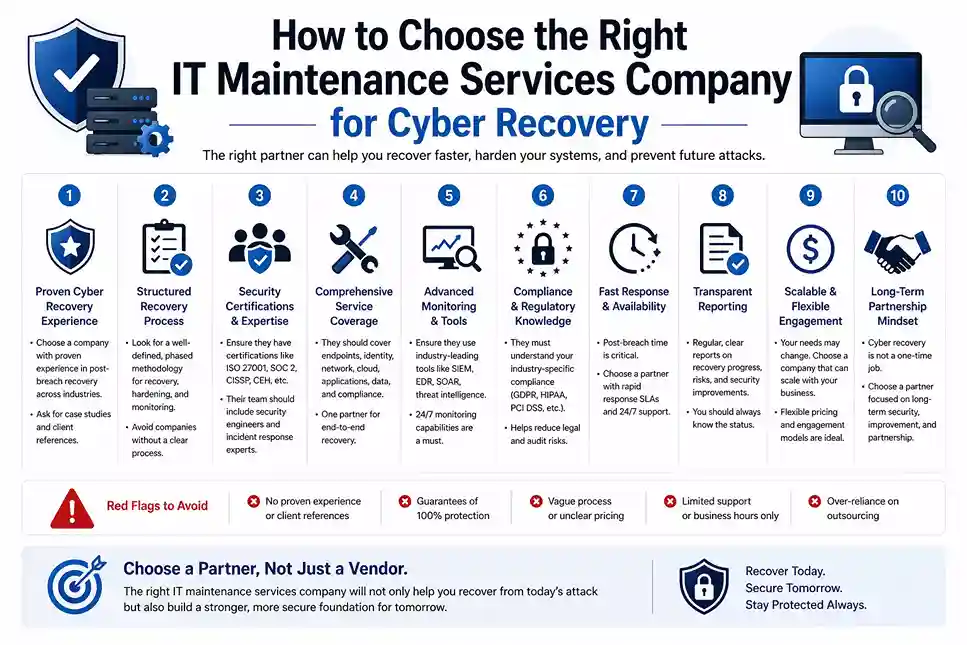

How to choose IT maintenance company for cyber recovery with key factors and red flags infographic

How to Choose the Right IT Maintenance Services Company for Cyber Recovery

Not every IT provider is equipped for post-breach work. Use these criteria to evaluate candidates with the rigor the decision deserves.

Technical Capability

  1. Documented expertise with CIS Benchmarks, NIST SP 800-53, or ISO 27001 frameworks
  2. In-house or deeply integrated SOC/MDR capability — not outsourced detection
  3. Proven Active Directory rebuild and forensic recovery experience.
  4. Verified penetration testing and red team capabilities for post-hardening validation

Operational Maturity

  1. Defined SLAs for critical, high, and medium vulnerability remediation
  2. Structured post-breach recovery methodology with documented phase gates and deliverables
  3. 24/7 monitoring coverage — not business-hours-only support
  4. Dedicated incident response retainer capability with guaranteed response times

Business Alignment

  1. Executive-level reporting tied to risk metrics, not purely technical indicators
  2. Transparent pricing model without hidden escalation costs post-breach
  3. Verifiable references from organizations of comparable size and industry vertical
  4. Long-term partnership orientation — not a transactional project mentality

Critical Red Flag: Any provider who proposes to "clean" a compromised Active Directory environment without first establishing the full forensic scope of the compromise. This single shortcut is the most documented driver of repeat breaches.


Common Mistakes After a Breach — And How to Avoid Them

Mistake 1: Restoring from Compromised Backups

Backups created during or after the attacker's dwell period may contain malware or backdoors. Always validate backup integrity against known-clean checksums before any restoration. Establish backup immutability using WORM (write-once, read-many) storage going forward.

Mistake 2: Trusting the Patched Environment

Patching removes known vulnerabilities. It does not remove attacker-planted tools, hidden backdoors, or compromised credentials. Post-breach environments must be rebuilt or forensically validated — patching alone is never sufficient.

Mistake 3: Treating Active Directory Compromise as Reversible

Active Directory compromise is frequently total. If forensics cannot confirm the precise scope of AD access, assume full compromise and rebuild from scratch. Attempting to "clean" a compromised AD forest typically fails and extends the exposure window significantly.

Mistake 4: Under-investing in Detection

Organizations consistently spend the majority of post-breach budgets on prevention and almost nothing on detection capability. Without a functioning SIEM or MDR service, the next attacker will operate undetected for weeks before discovery.

Mistake 5: Siloing IT and Security Teams

Post-breach recovery requires embedded collaboration between IT operations and security engineering — ideally unified under a single IT security maintenance consulting provider. Neither team succeeds in operating in isolation post-breach.

Mistake 6: Skipping the Post-Incident Review

The post-incident review (PIR) is the single highest-value activity after any breach. It documents the timeline, root cause, contributing gaps, and corrective actions required. Organizations that skip it are statistically likely to repeat the same mistakes.


Why Businesses Get Attacked Again: The Recurrence Pattern

Critical Insight: Repeat breaches are not bad luck. They are predictable outcomes of incomplete remediation. Understanding the recurrence pattern is the first step to breaking it.

Root Cause 1: Incomplete Threat Actor Eviction

Without full attack path reconstruction, persistence mechanisms — scheduled tasks, WMI subscriptions, compromised firmware — survive standard incident response and reactivate weeks or months later.

Root Cause 2: The Same Attack Surface Remains

Remediation that does not address the initial access vector leaves the same door open. Attackers frequently share or sell access to previously compromised environments on criminal forums and darknet marketplaces.

Root Cause 3: Monitoring Gaps and Alert Fatigue

Post-breach organizations temporarily intensify monitoring, then relax as operational pressures return. Without sustained managed monitoring from a retained IT maintenance services company, the detection window widens, and attackers find renewed opportunity.

Root Cause 4: Deferred Technical Debt

Many organizations address the immediate breach impact but defer underlying technical debt challenges — legacy systems, unpatched appliances, shadow IT assets — due to budget or operational constraints. These deferred items consistently become the next breach's initial access vector.

Root Cause 5: No Retained Security Partner

Organizations that engage a one-time IR firm and then revert to their pre-breach provider lose all continuity of context. Retaining an ongoing IT maintenance services company with security embedded in scope eliminates this gap entirely — and provides the institutional memory that makes faster future response possible.


Frequently Asked Questions

Ans. An IT maintenance services company validates threat eviction, rebuilds compromised systems, hardens attack surfaces, and establishes continuous monitoring. They bridge the gap between one-time incident response and long-term operational security — providing sustained protection rather than episodic fixes.

Ans. Initial stabilization typically requires 1–2 weeks. Full system rebuilding and validation extends to 1–3 months, depending on environment complexity. Long-term hardening and continuous monitoring are ongoing indefinitely. Organizations that rush this timeline dramatically increase their risk of a repeat breach.

Ans. Incident response focuses on containing and ejecting an active threat. Cyber recovery services begin after the attacker is expelled, focusing on rebuilding infrastructure to a validated, hardened state. Incident response is the emergency surgery; cyber recovery is the rehabilitation.

Ans. Engage an IT maintenance services company immediately after any confirmed incident — ideally before the incident response team departs. The earlier the engagement, the lower the total remediation cost and the shorter the window of residual exposure.

Ans. Look for providers with documented CIS Benchmark, NIST SP 800-53, or DISA STIG expertise, verifiable post-breach case studies, and embedded security operations capability. Avoid generalist MSPs positioning themselves as security specialists without dedicated personnel and tooling.

Ans. IT security maintenance consulting delivers ongoing strategic and operational guidance to keep your environment resilient between incidents — including vulnerability management, compliance assurance, hardening roadmap execution, and security architecture advisory.

Ans. Ongoing IT protection reduces dwell time for undetected threats, closes newly discovered vulnerabilities before exploitation, and continuously reduces attack surface through hardening. It quantifiably reduces breach probability and impact for organizations that sustain the investment.

Secure Your IT Environment Today

If your organization has experienced a cyberattack — or wants to ensure it never happens again — partner with a trusted IT maintenance services company. From cyber recovery services to system hardening and continuous monitoring, the right partner ensures long-term protection and operational resilience.

The organizations that break the breach cycle share one common characteristic: they retained a specialist who treated post-breach recovery as a structured engineering program — not a cleanup project. They invested in hardening, monitoring, and continuous improvement rather than returning to the status quo that enabled the breach.