
Think of Boomi integration services as the universal translator for your business systems. They're cloud-based tools that make all your different software applications actually talk to each other—in real-time. Whether you've got customer data in Salesforce, orders in SAP, or inventory in some ancient database, Boomi connects them all without requiring an army of programmers. The platform uses drag-and-drop tools and ready-made connectors, so you can stop waiting months for IT to build custom integrations and start syncing data in days.
Most companies today are data-rich but insight-poor. Why? Because their information is scattered across dozens of systems that don't communicate with each other. The Boomi platform fixes this mess by creating real-time connections between everything—your CRM, ERP, legacy databases, cloud apps, you name it. This blog shows how Boomi's event-driven approach helps businesses stop operating in silos and start competing at the speed of 2026's always-on marketplace.
Your customer just clicked "buy now" on your website. But your warehouse system won't know about it for another hour. Your finance team? They'll find out tomorrow morning. Meanwhile, your competitor already shipped their order because their systems talk to each other instantly.
This is the reality for thousands of companies still stuck with yesterday's integration methods. When customers expect Amazon-speed everything and Netflix-instant updates, running your business on delayed batch processing isn't just slow—it's business suicide.
Here's the kicker: your data is everywhere. Customer info lives in Salesforce. Orders flow through AWS. Analytics run on Google's cloud. Your trusty old inventory system still sits in the server room. Each system speaks its own language, runs on its own schedule, and protects its data like a jealous ex. Those old-school integration methods—custom APIs, point-to-point connections, overnight batch jobs—they can't handle this mess anymore.
That's where Boomi integration services stop being just another tech tool and become your competitive lifeline. By making real-time data sync work across every environment—cloud, on-prem, hybrid, whatever—Boomi helps businesses actually operate at the speed their customers demand.
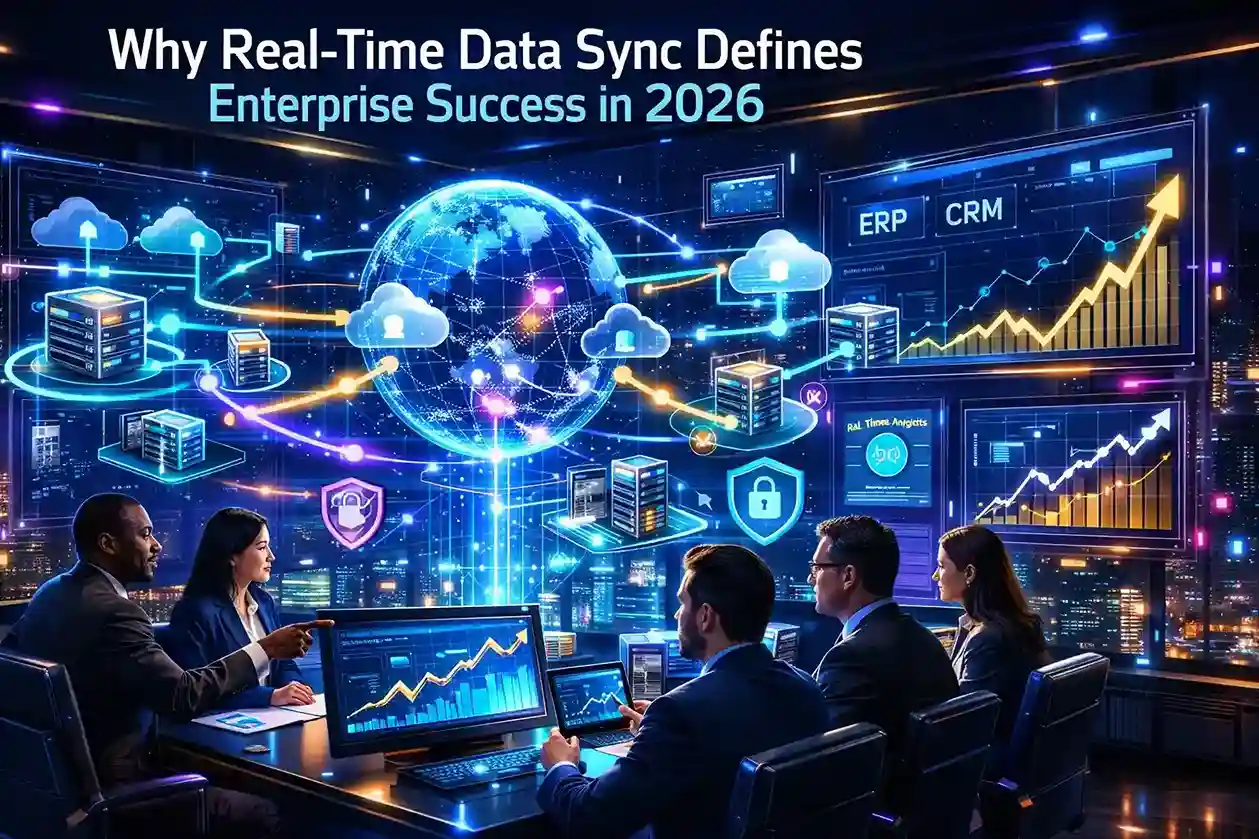
The difference between real-time and "pretty fast" has become the difference between winning and losing. Markets shift in seconds. Customers bail if your page takes three seconds to load. Yet I still meet executives whose companies run on data that's hours or even days old.
Think about what happens in those gaps. Your inventory system shows 100 units available, but you actually sold out an hour ago—hello, angry customers. Your service reps are looking at yesterday's customer data while the customer is telling them what happened five minutes ago. Marketing just sent a promotion for a product that went out of stock this morning. Every delay creates another crack where revenue leaks out and customers slip away.
But here's what actually matters: real-time isn't about being fast for the sake of being fast. It's about your entire company working from the same playbook at the same moment. When data flows instantly, those departmental walls come down. Sales knows what marketing is doing. Finance sees what's happening in operations. Everyone makes decisions based on what's actually happening right now, not what happened last week. This is exactly what AD Infosystem helps enterprises achieve through their Integration services—turning disconnected departments into unified, real-time operations.
Boomi threw out the old integration playbook. Instead of creating a spider web of brittle connections between systems, it builds an intelligent network that connects everything to everything else—without the usual nightmare of complexity.
The platform runs on events, not schedules. Change a customer's address in Salesforce? Your ERP knows instantly. So does shipping. And billing. Process a payment? Inventory updates, accounting records it, and the warehouse starts packing—all within seconds, not hours.
This magic happens because Boomi went low-code. Teams build integrations visually by dragging components around rather than writing thousands of lines of code. What used to take months of development now happens in days. Sometimes hours.
The real beauty is in Boomi's AtomSphere platform. It doesn't care where your data lives. Cloud? Sure. That ancient server in the basement? No problem. It speaks every system's native language—SAP talks to Salesforce, Oracle chats with Workday, your 20-year-old mainframe shares data with the latest microservices. All in real-time, without anyone writing custom translation code.
But Boomi does more than move data around. It's built-in smarts handle the messy stuff that trips up other platforms. Data mapping, transformation, and cleaning—it all happens automatically. When things go wrong (and they always do) built-in monitoring shows you exactly what's flowing where.
Here's what real-time actually looks like: A customer clicks "buy" on your website (running on Magento). Instantly—and I mean instantly—Boomi triggers a cascade of actions. SAP checks if you have the inventory. Oracle Financials runs a credit check. Salesforce sends a confirmation email. Your warehouse management system prints pick labels. The shipping carrier gets tracking info. Finance updates the books. All of this happens in literally seconds, not the hours or days it used to take with manual handoffs and batch processing.
Multi-cloud reality brings headaches that old integration tools never imagined. Every cloud provider—AWS, Azure, Google—has its own way of doing things. Different APIs, different security models, different everything. Then add data sovereignty laws that say certain information can't leave certain countries. Mix in network delays between clouds. Top it off with security nightmares when data crosses all these boundaries.
Boomi tackles these problems with a distributed architecture. Instead of forcing everything through a single central hub (which becomes a bottleneck and failure point), it processes integrations where it makes sense. Atoms—Boomi's runtime engines—deploy anywhere: specific clouds, on-premises, edge locations. This approach eliminates latency, respects data-residency laws, and maintains tight security.
Scale is another beast entirely. Real-time sync means handling millions of transactions without breaking a sweat. Boomi scales horizontally—add more processing power as needed. Load balancing is automatic. If one atom dies, others pick up the slack instantly.
Salesforce is where most companies keep their customer gold mine, but connecting it to other systems can be a nightmare. Between API limits, governor limits, and Salesforce's quirky data structure, simple integrations can turn into month-long projects.
Dell Boomi integration services for Salesforce come with Salesforce-specific superpowers. The platform respects Salesforce's limits while maximizing performance. Bulk operations efficiently handle massive data volumes. Real-time sync uses platform events and change data capture—no constant polling that eats up your API calls.
Common Salesforce patterns become simple with Boomi. When Salesforce and your ERP actually sync both ways, magic happens. Your sales rep updates a customer's billing address in Salesforce, and boom—accounting sees it in SAP instantly. Does Finance process a credit limit change? Sales knows immediately. No more embarrassing moments where sales promise what finance can't deliver.
Things get really interesting when you're dealing with messy real-world situations. Got multiple Salesforce orgs after a merger? Boomi routes data between them without creating duplicates or conflicts. Need to sync with marketing automation? Whether you're using Marketo, HubSpot, or something else, Boomi keeps lead scores, campaign data, and customer interactions flowing both ways instantly. Your sales team sees what marketing is doing right now, not what they did last week.
Look, Boomi's platform is impressive, but let me save you some pain: without someone who's been there before, you'll burn months learning lessons the hard way. Bringing in a specialized Boomi integration company isn't waving a white flag—it's like hiring a guide who knows every shortcut through the jungle.
Here's what experience really means in the integration game. Every company has that one weird system from 2008 that somehow runs half the business. Or data fields that mean different things in different departments. Or that executive who insists everything must sync with their favorite spreadsheet. Experienced partners have seen your exact mess before, just with different logos. They know which integration patterns actually work versus which ones sound good in meetings but fail spectacularly in production. They've already discovered that your "standard" SAP installation has 47 custom modifications that will break normal connectors. This isn't their first rodeo.
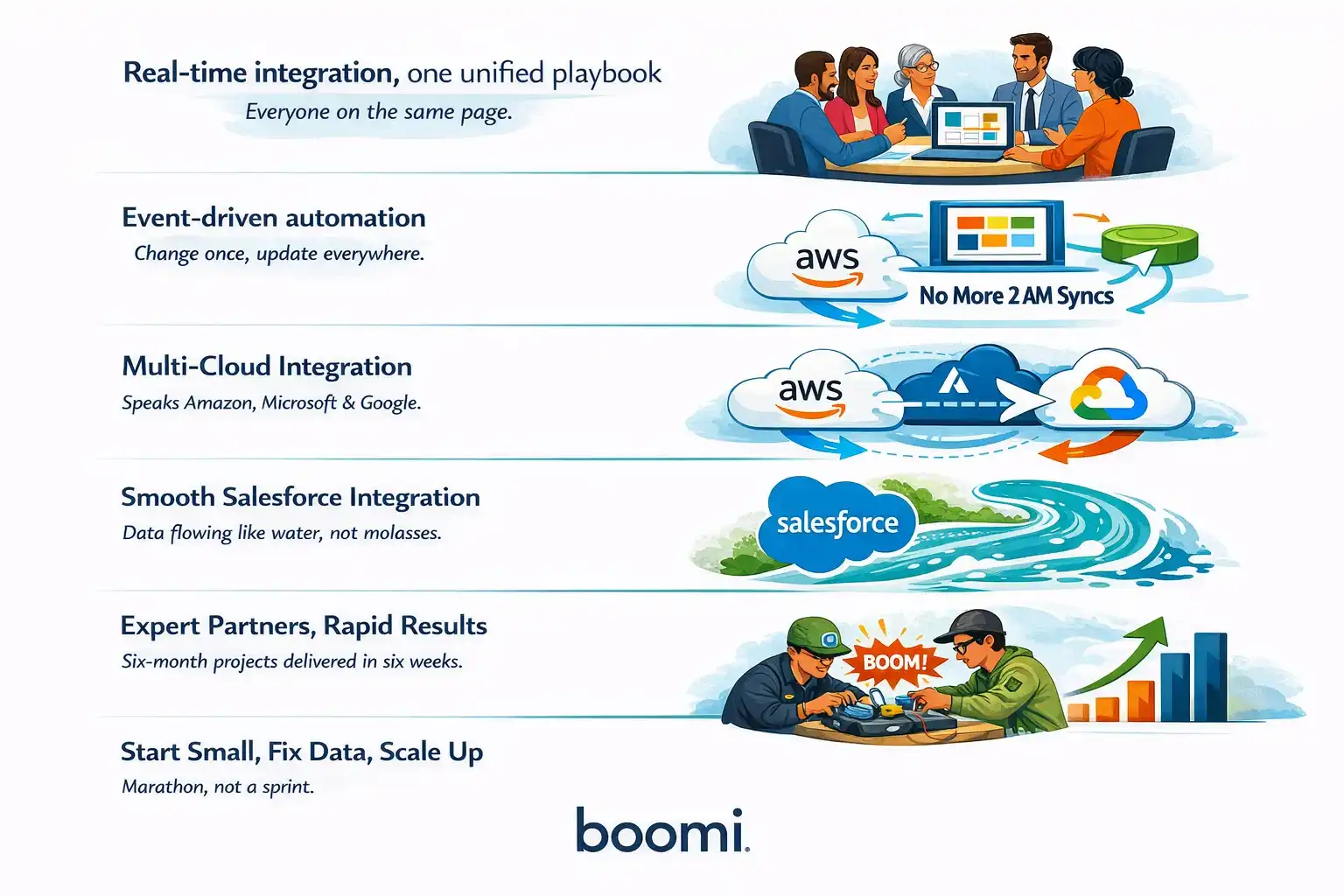
Here's the reality check you didn't ask for: companies still shuffling data around in overnight batches, and Excel attachments aren't just slow—they're dying. They don't know it yet. Real-time isn't bleeding-edge anymore. It's baseline. Your competitors aren't beating you because they're brilliant. They're beating you because their inventory system talks to their website, talks to their warehouse, talks to their customer service—all instantly. At the same time, you're still playing telephone with spreadsheets.
The Boomi integration platform provides the technical foundation. Cloud-native architecture, pre-built connectors, and intelligent processing remove traditional barriers. Technology alone is like buying a Ferrari without knowing how to drive a stick. Sure, Boomi's platform is powerful, but without the right approach, you'll stall out in first gear.
The companies crushing it combine three things: Boomi's tech, partners who've done this before, and a real commitment to changing how they work. They start with one integration that matters—maybe getting orders to flow automatically from web to warehouse. They nail that, learn from it, then tackle the next one. They clean up their messy data instead of hoping integration will magically fix it. They prepare their people for instant information rather than weekly reports.
Why bother? Because the payoff is huge. Real-time companies spot opportunities while others are still running reports. They ship orders while competitors are still processing them. They fix problems before customers even complain.
Want to join the real-time club? Here's your game plan: Look at your current integration mess (and yes, it's probably a mess). Pick the one connection that would make the biggest difference if it worked instantly. Find Boomi experts who've solved your exact problem before. Start there, get it working, then build on that win.
The future is already here—it's just not evenly distributed yet. Companies operating in real time are playing a different game than those stuck in batch-processing land. With the Boomi iPaaS solution and the right approach, that future is available today.
Boomi integration services connect all your business systems—cloud, on-premises, hybrid—enabling instant data flow between applications. This solves the killer problem of modern business: critical information trapped in departmental silos while decisions need to be made in real time. The platform turns multi-cloud chaos into unified operations by connecting everything from Salesforce to legacy systems without custom coding. Companies using Boomi typically see 15-20% revenue jumps from better customer experience and operational efficiency. But success demands more than software—you need implementation partners who know both the technical architecture and how to transform organizations. Master real-time integration, and you'll respond to markets instantly, eliminate information delays, and operate as one unified business instead of disconnected departments.