
You invested in Salesforce to streamline operations. Instead, your team created workarounds. Sales tracks deals in spreadsheets. Service manages tickets via email. Finance pulls reports manually. Sound familiar? This is what goes wrong when you buy enterprise software and try to force-fit it to how your business actually works.
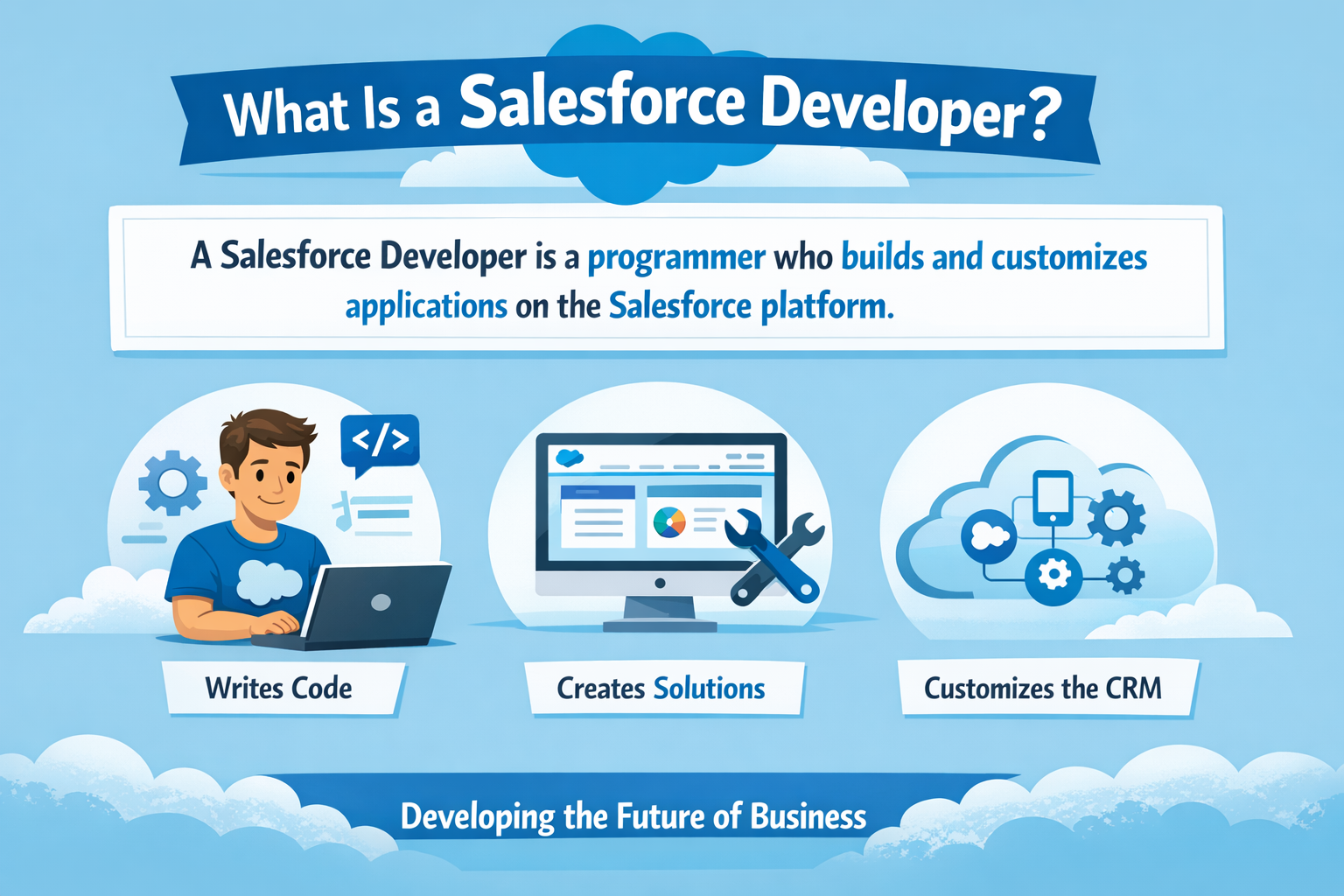
A Salesforce developer is someone who rewrites the rules—they take Salesforce's platform and bend it to match exactly how your company operates, using custom code, smart automation, and connecting it to your other systems.
These frustrations are why companies end up desperately googling for Salesforce developers at 2 AM. But beyond the technical definition, what do these developers actually do all day? And how do they turn your daily headaches into competitive advantages that make your competitors nervous?
If you're a business leader deciding whether you need developer talent, or you're thinking about becoming a developer yourself, I'll walk you through everything that actually matters.
I truly understood what Salesforce developers do when a retail client called in a panic. They had spent $200,000 on Salesforce but were still tracking inventory on whiteboards. “Salesforce can’t handle our warehouse rotation system,” they said. Three weeks later, a developer at AD Infosystem had built custom logic that ran their entire supply chain. The whiteboards disappeared.
That’s when it clicked—Salesforce developers don’t just write code. They act like translators, converting business chaos into technical reality. Complex pricing models, unusual commission rules, or workflows that change by the day—developers make Salesforce understand and execute all of it.
Many companies confuse Salesforce developers with administrators, and that mistake is expensive. Administrators are like expert mechanics who tune your car to run perfectly. Developers are the custom builders who drop a high-performance engine into it. Both are valuable—but one fundamentally expands what’s possible.
True story: A medical device company called me in desperation. Their approval process looked like someone dropped spaghetti on a flowchart. Sales reps literally printed orders, walked them to managers, who emailed other managers, who called regional directors. Four hours minimum. Per order.
Their developer spent three weeks diving into this mess. Not coding—just understanding. Mapping out which products needed which approvals, when regional overrides kicked in, and how emergency orders worked. The actual coding took another two weeks.
Now? Orders flow like water. The system knows who approves what, sends alerts to phones, and escalates automatically after set timeframes. Those four-hour delays? Down to 30 minutes average. They recovered $2.3 million in previously stuck orders within half a year.
But coding is 40% of the job. The rest? Sitting with frustrated users, watching them work, asking, "Why do you do it that way?" Good developers become temporary experts in your business. They learn your industry's quirks and your company's special sauce, then translate that into working technology.
Companies constantly burn money on this confusion. They hire admins expecting custom apps, or pay developer rates for basic setup work. Let me clear this up.
Administrators live in the clicks. They set up fields, adjust layouts, create reports, manage users, and build basic automation. Everything through Salesforce's interface. No code needed. They keep your system running smoothly day to day.
Developers live in the code. When clicks can't cut it, they step in. Complex calculations? Custom interfaces? Connecting to that ancient inventory system from 1987? That's developer territory. They write in languages like Apex and JavaScript to build what doesn't exist.
Sure, some folks do both. Plenty of developers started as admins. Some admins pick up coding. But if you need deep customization, system integration, or anything where Salesforce says "that's not possible," you need a developer mindset.
The gap between what companies think Salesforce can do and what it actually can do would shock you. I audit businesses weekly, and the pattern never changes: Salesforce for basic stuff, spreadsheets for everything important.
Commission calculations? "Too complex for Salesforce." Territory management? "Our rules are special." Contract renewals? "We have a unique process." Every time, they're wrong. Every time, a developer proves it.
Take this financial services firm. They tracked client portfolios in Salesforce but calculated fees in Excel because their structure included 47 variables. Their developer built it in Salesforce in four days. Not only did errors vanish, but they added automatic fee optimization. Clients got better rates, and the firm made more money. Win-win.
The competitive advantage is real. While their competitors email spreadsheets back and forth, this firm's clients log into a portal, see real-time positions, and model different scenarios. They're stealing clients left and right. All because they stopped accepting "Salesforce can't do that."
Raw coding ability barely scratches the surface. I've hired brilliant programmers who failed miserably because they couldn't grasp business context.
Technical foundation starts with Apex—Salesforce's own programming language. Then Lightning Web Components for user interfaces, SOQL for data work, plus web standards like JavaScript and HTML. API knowledge is huge since everything connects to everything these days.
Platform expertise matters more than general programming. Salesforce has quirks. The governor limits the runaway code. Security models get complex fast. Every release changes something. Developers who don't stay current quickly become dinosaurs.
But soft skills make or break developers. Can they explain technical concepts without technobabble? Do they push back when requirements make no sense? Will they admit when they don't understand your business process? The best developers I know ask more questions than they answer.
Five years ago, developers coded directly in Salesforce's web interface. Stone age stuff. Today's tools would blow your mind.
Salesforce DX changed everything. Command-line tools, source control, automated deployment—real software engineering finally came to Salesforce. Visual Studio Code replaced clunky web editors. Git tracks every change. Scratch orgs let developers experiment without breaking anything.
Integration tech is where things get interesting. MuleSoft handles enterprise-grade connections. REST APIs enable real-time data flow. Middleware platforms transform data between systems. Modern developers juggle multiple integration approaches depending on needs.
Testing deserves special mention. Salesforce demands 75% code coverage, but smart developers go further. Unit tests, integration tests, performance tests—quality matters more than quantity. Nobody wants to explain why their code broke the quarterly close process.
Salesforce expanded into so many areas that developers now specialize in. Core platform developers do the heavy lifting in Sales and Service Cloud—that's your everyday CRM stuff. Commerce Cloud developers? They're building the online stores where you buy everything from socks to server equipment. Marketing Cloud folks live in a world of email campaigns and figuring out why customers ghost you.
Integration specialists are the unsung heroes. Got SAP from the 90s? They'll make it talk to Salesforce. An Oracle database that nobody wants to touch? They're on it. That mainframe your IT director pretends doesn't exist? Yep, they'll connect that too. Industry specialists are a different breed—they speak fluent healthcare compliance or know exactly why your financial services processes are weird. They charge accordingly because they save you from expensive mistakes.
Red flags are everywhere if you look. Shadow IT is like business weeds—spreadsheets popping up everywhere, random Access databases hiding in departments, mystery web apps that "Steve from accounting built." When this stuff spreads, it's screaming that Salesforce isn't doing its job. Same with manual processes that eat up half your team's day.
Proactive hiring beats reactive scrambling. Planning a customer portal? Get developers involved early. New ERP implementation? Developers from the start. Market expansion with new requirements? You get the pattern.
Money talks loudest. Add up what inefficiency costs—wasted hours, lost deals, delayed decisions. One client spent $400,000 yearly on manual quote approvals. Custom automation costs $60,000. Two-month payback. Math doesn't lie.
Clear communication beats detailed specifications. Don't say "build an approval process." Explain who approves what, when, why, and what happens during vacations. Real-world scenarios beat abstract requirements every time.
Forget six-month death marches where you see nothing until the big reveal (that usually disappoints). Modern development works in two-week chunks. You see real progress, give feedback, and course-correct. Might feel strange if you're used to traditional IT projects, but the results will convert you.
Don't skimp on the basics either. Developers need proper testing environments, realistic test data, and access to integrated systems. I've seen projects stall because developers couldn't properly test. Penny-wise, pound-foolish.
Need a quick fix? They've got you. Complete overhaul? They do that too. Custom apps that work exactly how your business works. Connecting all your systems so they actually talk to each other. Speeding things up when Salesforce feels like dial-up internet. Moving your data from that system you've been meaning to replace since 2015.
How you work with them depends on what you need. Got a specific project? Hire them for that. Need ongoing help? Hourly or retainer work. Want them to basically become part of your team? Dedicated developers do that. Need the whole package with support? Managed services cover everything.
AI integration accelerates daily. Einstein's features grow stronger. Developers build predictive models, intelligent routing, and automated insights. Low-code tools blur traditional boundaries. Flow Builder handles more complex cases, including moving code.
Industry solutions proliferate. Healthcare, financial services, and manufacturing—all are getting specialized components. Developers customize rather than build from scratch. Career prospects stay hot. Supply can't meet demand. Good developers write their own tickets.
Salesforce developers bridge the gap between platform potential and business reality. They eliminate workarounds, automate drudgery, and connect isolated systems. These aren't just code monkeys—they're business fixers who happen to know technology.
The right developer turns Salesforce from that expensive thing gathering dust into the engine that drives your business forward. Drowning in spreadsheets and manual work? They'll throw you a lifeline. Planning to double your business? They'll build the infrastructure to handle it without breaking a sweat.
Want to see what Salesforce can really do? Work with developers who care more about solving your business problems than showing off their coding skills. Your competitors are already moving—what are you waiting for?