IT Consulting Services Company: What Separates Strategic Partners from
Expensive Help Desks
People throw around "moving to the cloud" like it just means storing files somewhere else
instead of on your own servers. That's like saying a Tesla is just a car that plugs into the
wall.
A retail chain thought cloud computing services
meant taking their inventory system and putting it online instead of running it locally. What
they discovered blew their minds: predictive analytics that cut their overstock problem by 35%,
systems that automatically handle traffic spikes during sales, and backup systems that kick in
so fast you don't even notice when something goes wrong.
Their IT bills went down 40%. Sales went up 60%. The reason? They could finally respond to
market changes at the speed customers expect instead of waiting weeks for IT to catch up.
What cloud really gives you: freedom from worrying about the technical stuff. When's the last
time you wondered if Gmail's servers were working? That's exactly what good cloud services do
for your entire business - they handle the complicated technical parts so you can focus on what
actually makes you money.
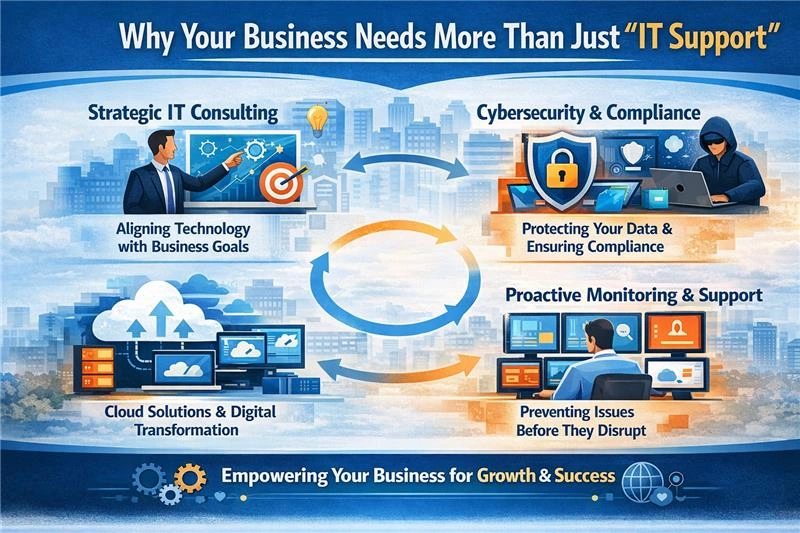
Why Your Business Needs More Than Just "IT Support"
I was in a client meeting last month when their CFO said something that stopped me cold: "We're
spending $2 million a year on IT, but I have no idea what we're getting for it."
Sound familiar?
The thing—most businesses treat IT like plumbing. It's there, it works (hopefully), and you only
think about it when something breaks. But while you're treating technology as a cost
center, your competitors are using cloud computing services to slash expenses by 40% and
launch products three times faster.
The Dirty Secret About Modern IT Services
Let me share something most IT
consulting services companies won't tell you: 80% of what they sell you is outdated the
moment you sign the contract. They're pushing yesterday's solutions for tomorrow's problems.
I watched a Fortune 500 company spend $5 million on a "digital transformation" that was
basically moving their mess to the cloud. Same problems, fancier server bills. Their competitor?
Built a cloud-native infrastructure from scratch for half the cost and now runs circles around
them.
Traditional IT maintenance services companies want to keep you dependent. They profit from
complexity. But the best partners? They make things so simple you almost forget they're
there—until you see your competitors struggling with problems you solved months ago.
Cloud Computing: The Revolution Hidden in Plain Sight
People throw around "moving to the cloud" like it just means storing files somewhere else
instead of on your own servers. That's like saying a Tesla is just a car that plugs into the
wall.
A retail chain thought cloud computing services meant taking their inventory system and putting
it online instead of running it locally. What they discovered blew their minds: predictive
analytics that cut their overstock problem by 35%, systems that automatically handle traffic
spikes during sales, and backup systems that kick in so fast you don't even notice when
something goes wrong.
Their IT bills went down 40%. Sales went up 60%. The reason? They could finally respond to
market changes at the speed customers expect instead of waiting weeks for IT to catch up.
Here's what cloud really gives you: freedom from worrying about the technical stuff. When's the
last time you wondered if Gmail's servers were working? That's exactly what good cloud services
do for your entire business - they handle the complicated technical parts so you can focus on
what actually makes you money.
Finding an IT Consulting Partner (Not Another Vendor)
How to spot the difference between a real IT consulting services company and a glorified help
desk:
Vendors ask: "What's broken?" Partners ask: "Where do you want to be in three years?"
I've seen too many businesses hire IT consultants who speak in acronyms and leave behind
200-page reports nobody reads. Real consulting isn't about impressing you with jargon—it's about
making complex things simple and impossible things possible.
Ask any IT consulting firm these three questions:
- Show me a client who cut IT costs while growing revenue.
- How do you measure success beyond uptime?
- What happens when we outgrow your solution?
If they stumble, keep looking.
IT Maintenance: From Necessary Evil to Competitive Weapon
Old-school thinking says IT maintenance services companies keep your systems running. Modern
reality? The best ones keep you ahead of problems that haven't happened yet.
A logistics company I know had its warehouse system crash during peak season. Cost them $100,000
in one day. Their new IT maintenance approach uses AI to predict failures before they happen.
Last peak season? Zero downtime.
Your competitors aren't waiting for things to break. They're using smart maintenance to prevent
problems, optimize continuously, and turn maintenance windows into innovation opportunities.
While you're fixing yesterday's problems, they're preventing tomorrow's.
Real Stories from the IT Transformation Trenches
The Bank That Became a Tech Company
A regional bank came to us, spending 70% of its IT budget on maintenance. We flipped their
model: cloud-first architecture, automated maintenance, proactive monitoring. Now they spend 70%
on innovation. They launched a mobile app that acquired 50,000 customers in six months.
The Manufacturer That Deleted "Downtime"
The manufacturing company had "planned maintenance" every weekend, resulting in $50,000 in lost
production weekly. We implemented predictive maintenance using IoT sensors and cloud analytics.
Maintenance happens during natural breaks. Production up 15%. Costs down 40%.
The Retailer That Scaled Without Hiring
The e-commerce startup went from 1,000 to 100,000 daily orders. Traditional approach? Hire 20 IT
staff. Our approach? Cloud computing services that scale automatically. They kept their 3-person
team and invested the saved money in marketing. Revenue grew 400%.
Building Your Modern IT Strategy
Forget the consultants' frameworks. Here's what actually works:
- Start where it hurts most. What keeps you up at night? Customer complaints about slow
service? Inability to scale? One retailer couldn't handle Black Friday traffic. We built an
auto-scaling cloud infrastructure. Next Black Friday? They handled 10x traffic with half the
stress.
- Think ecosystem, not applications. Your IT isn't a collection of tools—it's a living system.
The best IT consulting services company shows you how everything connects, how CRM data
predicts maintenance needs, how cloud analytics spots trends before competitors.
- Measure what matters. Uptime is table stakes. Modern success means faster
idea-to-implementation, lower cost per transaction, and more business opportunities enabled.
Your 30-Day IT Reality Check
Week 1: Audit Your Pain List every IT-related delay. Calculate downtime costs.
Map where technology blocks business goals.
Week 2: Benchmark Reality What are competitors doing? Where are you spending
vs. investing? Which systems would hurt most if they failed?
Week 3: Test the Waters Pick one process to cloudify. Run a proof of concept.
Measure results.
Week 4: Make Decisions Choose partners, not
vendors. Set 90-day transformation goals.
Summary
Most businesses still treat IT like a necessary expense—something that keeps the lights on but
never actually drives growth. That mindset is exactly why they're losing ground to competitors
who figured out the real game years ago.
Cloud computing services changed the rules completely. Companies that embraced cloud
infrastructure didn't just save money on hardware. They gained the ability to launch products
faster, handle massive traffic spikes without breaking a sweat, and scale operations without
proportionally growing their IT headcount. A retail chain cut IT costs by 40% while increasing
sales by 60%. An e-commerce startup went from 1,000 to 100,000 daily orders with a three-person
team. These aren't hypothetical scenarios—they happened because these companies stopped viewing
technology as plumbing and started treating it as a competitive weapon. At AD
Infosystem, we've helped businesses make exactly this shift, turning IT from a budget
line item into the thing that actually drives revenue and competitive advantage.
The IT consulting services company you choose matters enormously. Vendors sell you products and
disappear. Real partners understand your business direction and build technology strategies
around where you're headed, not just where you are today. They challenge bad ideas, simplify
complexity, and measure success beyond basic uptime metrics.
Predictive IT maintenance has replaced the old break-fix model entirely. Organizations using
AI-driven monitoring and analytics catch problems days or weeks before they become expensive
outages. Downtime isn't just inconvenient anymore—it's a competitive death sentence when your
rivals never go offline.
The technology exists. The expertise is available. Companies that act now build advantages that
compound over time. Companies that wait keep falling further behind. In a market moving at
digital speed, indecision is the most expensive choice you can make.
Frequently Asked Questions
Ans.
An IT consulting services company evaluates your current technology setup,
identifies gaps and inefficiencies, and builds a strategy that aligns IT with your
business goals. Good consultants don't just recommend software—they redesign
processes, plan cloud migrations, implement automation, and ensure your technology
investments deliver measurable returns. The difference between a consultant and a
vendor is simple: vendors sell products, consultants solve problems.
Ans.
Cloud computing services deliver computing resources—servers, storage, databases,
networking, analytics—over the internet instead of running them on local hardware.
You access what you need on demand and pay based on usage. This eliminates massive
upfront infrastructure costs and gives you the flexibility to scale resources up
during busy periods and down during slow ones. Everything from email to enterprise
applications can run in the cloud.
Ans.
IT support fixes things when they break. IT consulting prevents things from breaking
and builds strategies for growth. Support is reactive—something goes wrong, someone
calls, it gets patched. Consulting is proactive—analyzing your technology landscape,
planning upgrades, identifying automation opportunities, and aligning everything
with business objectives. Most companies need both, but consulting delivers the
strategic value that actually moves the needle.
Ans.
Savings vary depending on your current setup, but companies typically see 20-40%
reduction in overall IT spending after moving to cloud infrastructure. The savings
come from eliminating hardware purchases and maintenance, reducing energy costs,
cutting down on IT staff needed for routine server management, and paying only for
resources actually consumed. Beyond direct cost savings, cloud enables faster
deployments and reduced downtime, which translate into revenue gains that often
exceed the cost savings themselves.
Ans.
If your team complains about slow systems, you're constantly buying new servers,
scaling requires months of planning, or remote work feels like a nightmare—you're
more than ready. Honestly, most businesses that think they're "not ready" are
actually just overthinking it. Start with one pain point. Move one application or
process to the cloud. Measure the results. You don't need a massive transformation
plan to get started.
Ans.
Honestly, every industry gets something out of it, but some see results that are
almost unfair. Healthcare companies finally get their patient data and compliance
mess under control. Banks stop being held hostage by systems built in the 90s and
actually start shipping digital products their customers want. Manufacturing floors
go from "we lost three hours of production because something broke" to catching
failures before they cost a dime. Retail? Anyone who's watched their website melt
during a holiday sale knows exactly why they need cloud consulting. If your business
runs on complex operations and mountains of data, IT consulting pays for itself
faster than almost anything else you'll spend money on.
Ans.
Think about your car for a second. Would you rather have the check engine light come
on while you're driving to a critical meeting, or get a notification three weeks
earlier saying "your alternator is showing wear, schedule a replacement"? Same idea.
Predictive maintenance watches your systems constantly—temperatures creeping up,
network traffic acting strange, hard drives filling faster than usual. It catches
the weird stuff early. One logistics company I mentioned in the blog lost $100,000
in a single day when their warehouse system went down during peak season. After
switching to predictive monitoring? Zero downtime the following year. That's not a
small difference. That's the difference between a terrible quarter and your best
one.
Ans.
Depends entirely on how messy your current situation is. Moving your email and file
storage to the cloud? That's a few weeks, maybe a month. Migrating your entire
operation—ERP, customer databases, inventory systems, the whole thing—expect 3-6
months of serious work. Got legacy systems from 2005 that nobody fully understands
anymore? Compliance requirements stacked on top of each other? You might be looking
at closer to a year. The smart move is doing it in phases. Move the easy stuff
first, prove it works, build confidence internally, then tackle the harder
migrations. Companies that try to move everything at once usually regret it. The
ones that go step by step actually finish faster because they're not dealing with
cascading problems from trying to do too much simultaneously.
Ans.
This is the question that keeps getting dodged because the answer is uncomfortable.
Every month you sit on outdated infrastructure, the bill gets bigger. Old systems
need more babysitting, more patches, more emergency weekend fixes. Security holes
multiply because vendors stop supporting ancient software. Try hiring a talented
developer and telling them they'll be working on a platform from 2008—watch how fast
they take another offer. Meanwhile your customers expect faster responses, smoother
experiences, instant everything. Your competitors running modern cloud setups
deliver exactly that while you're still waiting on a server reboot. Doing nothing
feels safe. It's actually the most expensive option on the table, you just don't get
the invoice all at once. It shows up as lost customers, missed opportunities, and
talented people who chose somewhere else.
Ans.
AD Infosystem isn't the kind of firm that drops a 200-page recommendation document
on your desk and disappears. The team digs into what's actually going wrong in your
business before suggesting any technology. That matters because most IT problems
aren't really technology problems—they're business problems wearing a technology
disguise. AD Infosystem has walked companies through cloud migrations that cut IT
spending by 40%, built predictive maintenance systems that eliminated peak-season
downtime completely, and helped small teams scale to handle 100x more volume without
hiring proportionally. The approach is practical—solutions that work on Monday
morning, not just in a PowerPoint presentation. And the thinking extends beyond the
current project. Everything gets built with growth in mind, so you're not ripping
things apart and starting over when your business doubles in size.