
I've signed off on digital transformation budgets that failed spectacularly. $20M down the drain at a Fortune 500. Another $8M wasted at a mid-market manufacturer. But I've also seen transformations return 300% ROI. The difference wasn't the technology or consultants—it was how we structured the money. This guide shares those expensive lessons so you don't repeat them. Whether you're allocating millions or managing a modest budget, these principles from AD Infosystem's experience will help you avoid the 70% failure rate plaguing most initiatives.
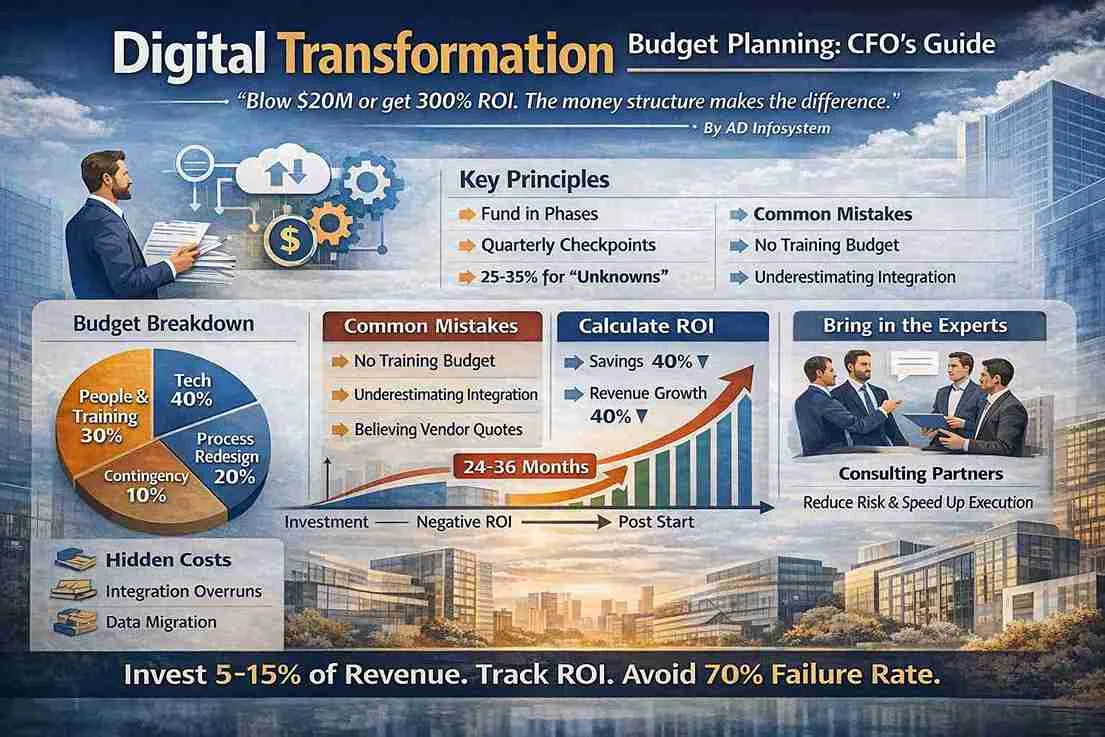
Here's what nobody tells you about digital transformation cost: the technology is the cheap part. You'll spend millions on fancy platforms, then realize you need millions more to actually make them work. That's why smart companies bring in digital transformation consulting services early—they've seen this movie before and know where the real costs hide.
Take a typical $10M transformation. Maybe $4M goes to technology. Another $3M disappears into training. Then $2M for redesigning processes that should've been fixed years ago. That last million? Your contingency fund.
Your IT transformation budget gets murdered by technical debt. That ancient warehouse system needs $500K worth of digital duct tape to talk to anything modern. Those Excel sheets in accounting? Each costs $50K to replace properly.
Small businesses face different challenges. You're looking at $500K-$2M total, but that's 10-15% of revenue—double what enterprises spend proportionally.
Real breakdown: Cloud migration runs $150-300K. Customer platforms cost $100-200K. Analytics setup is $50-150K. Employee training? Budget $100-200K unless you enjoy watching people use new systems exactly like old ones.
The good news? SMBs see money back faster. We watched a retailer spend $750K on e-commerce and recover it in 18 months. A consulting firm dropped $400K on automation and cut costs 30% within two years.
Smart small businesses invest quarterly, prove value, then reinvest profits. Better than begging banks for millions upfront.
You need a template that tracks what matters:
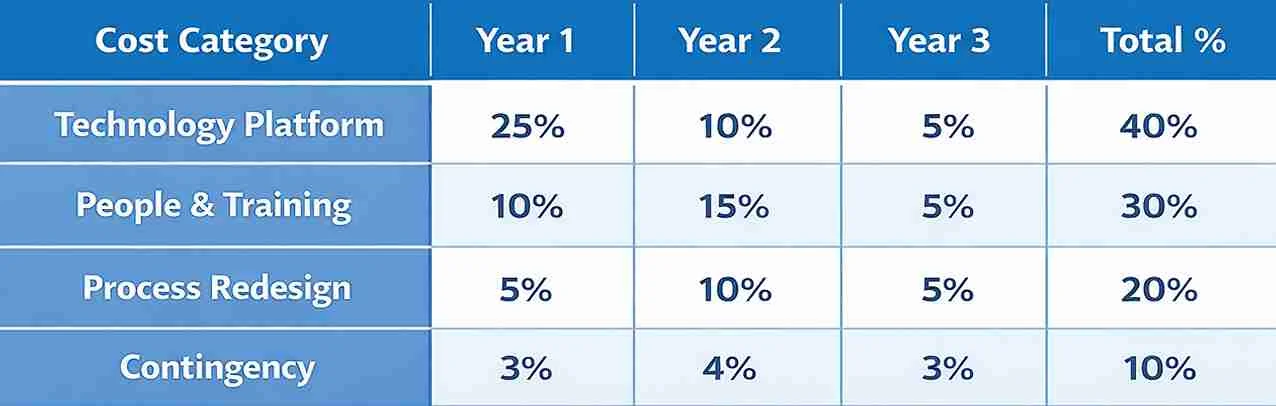
Technology front-loads but people costs persist. Build quarterly checkpoints. Money flows only when milestones hit. This saved one manufacturer $3M when their platform couldn't handle actual volume.
ROI calculations are tricky. The formula looks simple: (Gain - Cost) / Cost. But defining "gain" gets messy.
Start with operational savings. Insurance company spends $5M automating claims, saves $2M annually. But they also cut errors 80% and freed staff for customer service. Real value? $4M annually.
Revenue impact beats cost savings. Digital channels run 20-40% higher margins. One B2B distributor invested $3M in e-commerce. Spreadsheet showed 15% ROI. Reality? Online revenue exploded 300% at 35% margins. Actual ROI passed 50%.
Weight your calculation: 40% hard savings, 40% revenue growth, 20% strategic value.
Three mistakes kill budgets:
First, change management shock. That $1M software needs another $500K to get humans using it. Retail chain budgeted $2M for POS systems, zero for training. Result? Six months of chaos and $800K emergency training.
Second, integration nightmare. Your CRM needs to connect with 47 systems. Each connection costs $50-200K. Budget 30-40% extra for integration.
Third, believing vendor quotes. That $500K software? Add $200K implementation, $100K maintenance, $50K training, $150K customization. Real cost doubles the sticker price.
Data migration is expensive. Bank budgeted $100K, spent $1.2M after discovering garbage data.
Productivity tanks during transition. People work 20-30% slower while learning. For 500 employees, that's like paying 100-150 people to be confused.
Compliance adds 10-15%. New systems need security audits, testing, certifications. Healthcare company's $2M project became $2.5M after remembering HIPAA.
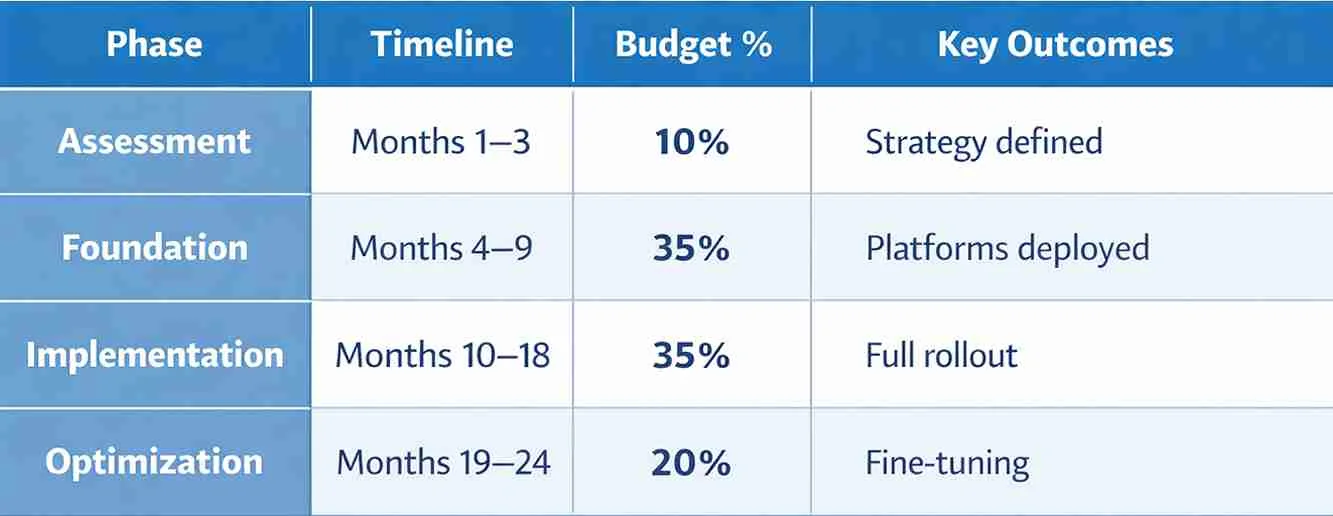
Expect the J-curve. Months 6-12 show negative ROI as costs spike. Month 18 brings light. Full payback takes 24-36 months.
Digital strategy consulting saves money if done right. They spot pitfalls that cost millions.
Good consultants bring battle scars from 50+ transformations. They compress timelines 20-30% and reduce risk.
Structure engagements carefully. Try hybrid models—fixed price for phases, hourly for optimization. Demand knowledge transfer.
Best digital transformation consulting services become partners, not vendors. They'll push back on your bad ideas and fight for what actually works—even if it means less money for them.
Here's the scary part: 7 out of 10 digital transformations crash and burn. So yeah, you need that 15-20% contingency fund. Scope creep will eat 10-30% extra (it always does). Your vendor might implode, costing you 20-50% more to switch. And half your team will resist the new systems, burning another 15-25% on change management you didn't plan for.
Create kill switches. 10% overrun triggers review. 20% requires board approval. 30% means pull the plug. One company saved $5M killing a failing ERP at 25% overrun.
Portfolio approach beats all-in bets. Run five $2M projects instead of one $10M transformation.