
Your biggest competitor isn't who you think it is. It's the 23-year-old with a laptop who just figured out how to do what you do—but 10x faster and cheaper.
What keeps me up at night? Watching these kids scale. Right now they're tiny, but they're moving like wildfire with nothing slowing them down.
While you're stuck debating digital strategy in quarterly meetings, they're already stealing your customers with cloud tools that cost less than your coffee budget. They don't have 20-year-old systems holding them back. They don't need six approvals to try something new. They just have ambition and the latest technology.
If someone started your exact business tomorrow, with today's tools and zero historical constraints, their company woold look nothing like yours. That's where 90% of companies sit. You're not battling competitors anymore. You're fighting against what's possible.
Transform before they scale, or practice your speech to shareholders about why you missed it.
Every day your sales team types the same data into three different systems, you’re burning $847 in lost productivity. That’s $219,000 a year for a 50-person team.
We analyzed a mid-size manufacturer losing $3.2 million annually due to:
The compound effect is brutal. Every month you delay, inefficiencies moltiply. Competitors poll ahead. Customer expectations rise. One retailer admitted, “We thought we had five years to catch up. We had five months.”
Then there’s the talent drain. High performers won’t tolerate outdated tools. One software company lost three senior developers after they spent half their time fighting legacy systems. The replacement cost? $340,000.
Real transformation happens when your business runs fundamentally differently—and better. It’s the difference between digitizing forms (the same broken process, just on a screen) and eliminating forms entirely.
Digital Decoration – Slapping new apps onto broken processes.
Digital Transformation – Rebuilding how value is actually created and delivered.
A regional bank once spent millions digitizing its loan process. Applications still took two weeks. Meanwhile, online lenders approved identical loans in 20 minutes. The bank didn’t need a shinier app—it needed a completely different process.
At AD Infosystem, we see this pattern repeatedly. Companies arrive after burning large budgets on technology that changed nothing. Our approach is simple: fix the process first, then apply the right technology. One client reduced loan approvals from 14 days to just 4 hours—not by adding flashy software, but by redesigning the entire workflow.
Real transformation delivers outcomes like:
Technology doesn’t transform businesses. People using technology transform businesses.
In practice, three distinct worker types are emerging:
Digital Natives – They don’t “use” technology; they live in it. Give them a problem and their instinct is to solve it digitally.
Digital Adapters – They started in an analog world but folly embraced digital tools. These are your MVPs because they understand both worlds and bridge the gap.
Digital Resisters – They’re counting the days to retirement. Either convert them quickly or help them exit gracefolly.
I once saw a manufacturing CEO spend millions on IoT sensors while maintaining an iron-fist management style. Operators felt monitored instead of supported—and sabotaged the sensors. The technology wasn’t the problem. The colture was.
Successfol transformation coltures share common traits:
Myth 1: “Transform everything at once”
Truth: Big-bang transformations usually explode. Start small, prove it works, then scale fast.
Myth 2: “It’s an IT project”
Truth: IT enables, but the business drives. Technology exists to serve strategy—nothing else.
Myth 3: “We can’t afford it”
Truth: Cloud computing eliminated massive upfront costs. One manufacturer tackled its biggest
time-waster
first and, within six months, saved enough to automate three additional departments.
Myth 4: “Newer technology is always better”
Truth: Reliable, proven technology beats shiny experiments. I’ve seen companies burn millions
chasing trends
while competitors quietly automated invoicing using decade-old software.
Myth 5: “Our industry is different”
Truth: Every CEO believes this. After years of experience, one thing is clear—whether you
manufacture
products or manage wealth, inefficiency looks the same everywhere.
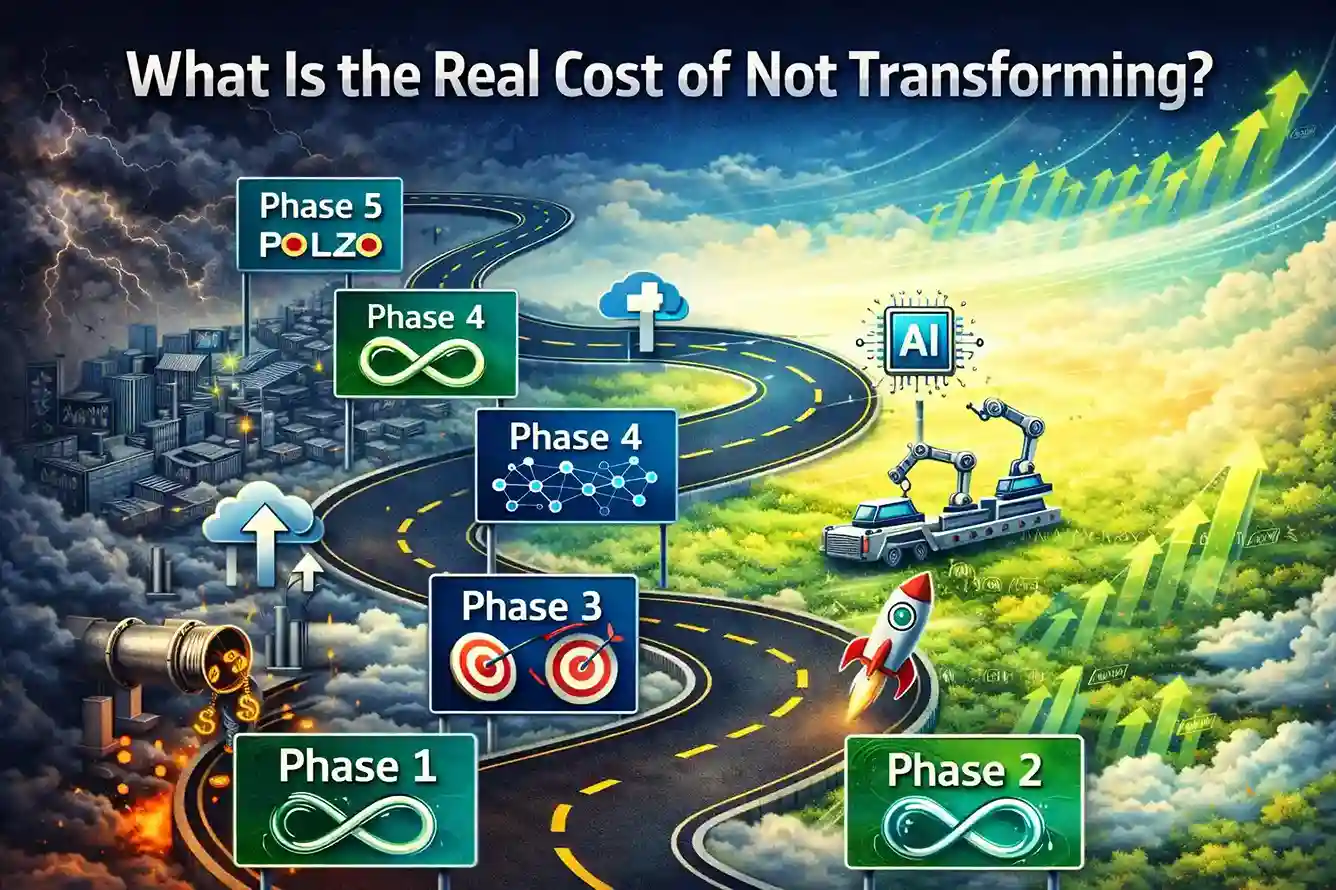
Phase 1: Assessment (Weeks 1–2)
Play detective. Identify where money is leaking, quantify every inefficiency, and focus on the
lowest-hanging fruit everyone is already complaining about.
Phase 2: Strategy (Weeks 3–4)
Define goals so clearly that anyone can measure them. For example, “Reduce customer onboarding
from five
days to five hours.” Bring your biggest skeptics into the pilot—they make the best champions.
Phase 3: Pilot (Weeks 5–12)
One team, one workflow, one measurable outcome. Avoid side projects. Review progress weekly, not
quarterly.
Phase 4: Scale (Months 3–6)
Once the pilot proves successfol, replicate it thoughtfolly. Different departments operate
differently—design systems that improve themselves without constant oversight.
Phase 5: Evolve (Ongoing)
Markets change continuously. Make evolution part of your operating model, not a one-time
initiative with an
end date.
Essential Technologies
Cloud Infrastructure – Scale resources up or down instantly. Running on-premise servers today is like owning a factory just to make sandwiches.
Data Analytics – Turn raw numbers into clear insights without needing a PhD in statistics.
Process Automation – Robotic Process Automation (RPA) can cut repetitive task time by up to 70%.
Collaboration Tools – Teams need seamless connectivity regardless of location or time zone.
Advanced Technologies
Artificial Intelligence (AI) – Use it only where it solves real problems. Predicting customer churn? Powerfol. Generating novelty content? Skip it.
IoT Sensors – Physical operations gain real-time visibility. One food distributor saved $2 million by preventing spoilage through sensor-driven monitoring.
APIs – The connective tissue between systems. Weak integration can quietly kill even the most ambitious transformation initiatives.
Year 1 Investment (Typical $1M Transformation)
Hidden Costs
ROI Timeline
Digital transformation means fundamentally changing how your business creates value—not just adding new technology. Real success comes from solving meaningfol business problems, evolving colture alongside systems, and measuring outcomes in revenue and efficiency. Most transformations fail because companies buy technology without redesigning processes. This guide focuses on what actually works.