The tech world faces an unprecedented crisis. While businesses race to implement artificial intelligence, there aren't enough qualified developers to go around. IT staff augmentation services have become the secret weapon for companies that need rapid AI workforce scaling.
Think of IT staff augmentation as your talent emergency response team. Instead of spending 4-6 months hunting for AI developers who might not even exist in your local market, you can plug specialized experts directly into your team within days—sometimes literally overnight. The skills gap in artificial intelligence has reached critical levels—industry reports estimate the number of production-ready AI professionals remains far below global demand. Meanwhile, the tech talent shortage costs the U.S. economy $162 billion annually, according to McKinsey and global labor reports.
This comprehensive guide reveals how companies can grow AI capacity from 3 to 30 developers in under two weeks, why traditional hiring can't keep pace with AI innovation, and how flexible AI staffing models bridge the massive skills gap threatening digital transformation initiatives.
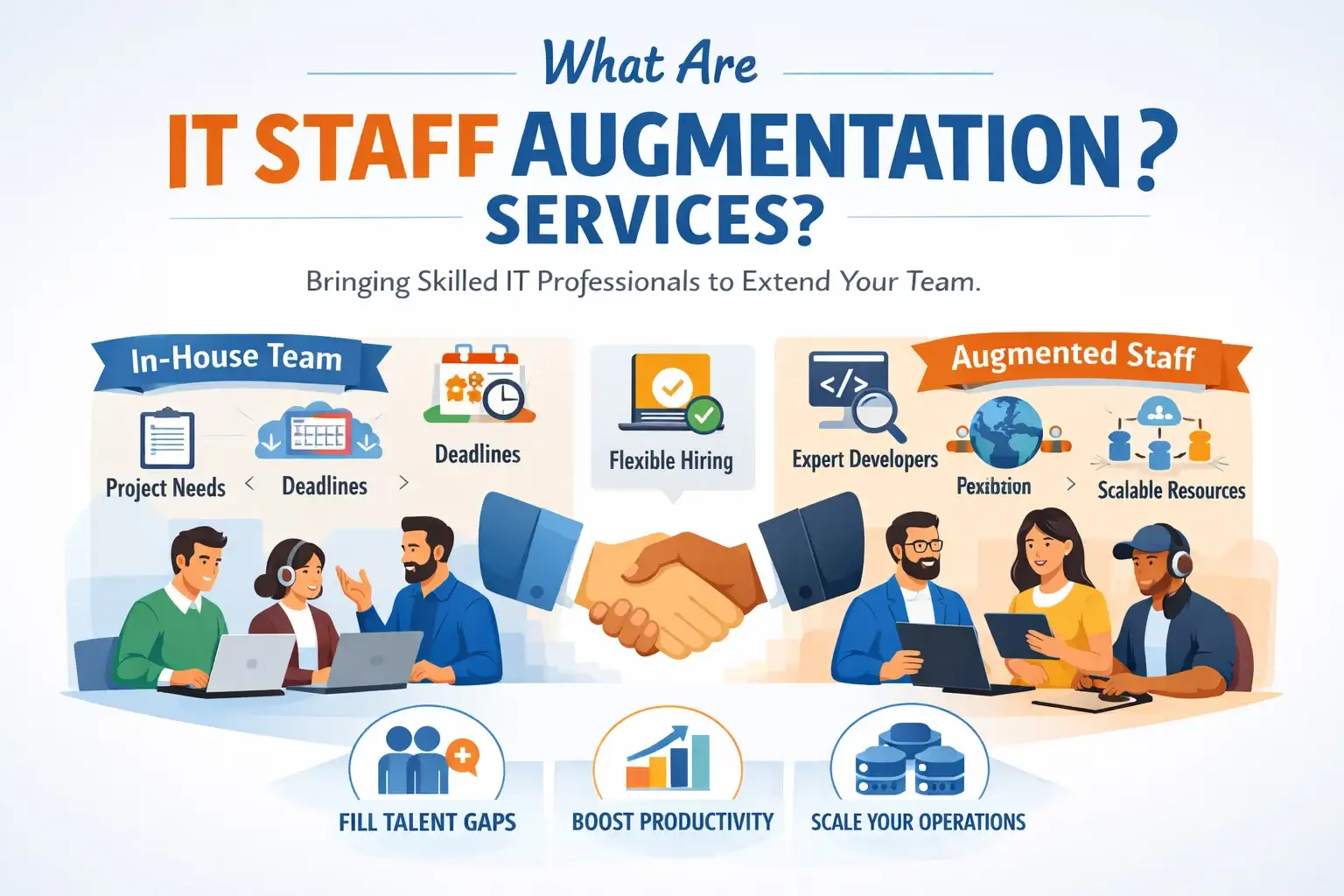
IT staff augmentation is fundamentally a team extension model that gives you on-demand access to specialized talent—think of it as instant scaling for your AI initiatives.
IT staff augmentation basically lets you borrow top-tier developers when you need them. You keep full control of your projects and processes, but these experts work temporarily as part of your team—like having specialized contractors who actually understand your business.
The key distinction lies in speed and integration. Contract AI experts mesh with your workforce almost immediately.
They fit right into how you work—using your tools, joining your meetings, taking direction from your managers. It's completely different from shipping work to some random offshore team and crossing your fingers. These folks become real members of your team; they're just on contracts instead of salaries. When deadlines are breathing down your neck, this setup can save your business.
Require ML engineers for a six-month sprint? They're operational within days. Pivoting from text analysis to visual recognition systems? Fresh talent arrives next week. Given how rapidly AI evolves, this nimbleness often determines which companies thrive and which fall behind.
Peak effectiveness comes with targeted, duration-specific needs. Picture a health technology firm creating FDA-approved diagnostic tools. They need imaging algorithm experts plus compliance specialists, but only through product development. Why commit to permanent salaries for temporary requirements? This method matches exact capabilities to exact timelines.
The data tells a brutal story. AI job postings exploded by 450% over five years, but there's nobody to fill them. "It takes half a year to find just one decent AI developer these days. Post a job, and you'll be lucky to get even one-third of a qualified candidate—basically, nobody is worth interviewing. In San Francisco or New York, these folks demand a base salary of $350-400K. Then add benefits and everything else on top, and your budget is toast before you've even started."
The old hiring playbook doesn't work anymore. You post a job, screen resumes for weeks, run candidates through endless interviews, finally make an offer—and they've already accepted three other positions. This isn't just annoying; it's killing companies that need AI capabilities to compete.
But here's what really challenges AI engineering scale-up: the skills you need today might not exist in your local market. Need someone who's deployed large language models in production? That expertise is rare outside major tech hubs. Want a computer vision expert who understands manufacturing applications? That talent pool might be extremely limited in your geographic area. The global tech talent pool isn't growing fast enough to meet exploding demand.
Universities make the problem worse, not better. Their AI programs teach frameworks that the industry abandoned two years ago. Fresh graduates need months of retraining before they can contribute anything meaningful. By graduation, their knowledge is already stale—the field moves that fast.
AI doesn't follow normal software timelines. When OpenAI drops a new model, first movers capture the market. When competitors launch AI features, you have weeks—not quarters—to respond. Healthcare AI has regulatory windows that close whether you're ready or not.
This reality demands a different approach to talent. You need people in days, not months. You need access to specialists globally, not just locally. You need flexibility to pivot as technology shifts. Companies that get this win. Those stuck in traditional hiring lose.
Let's get real about your options for building AI teams.
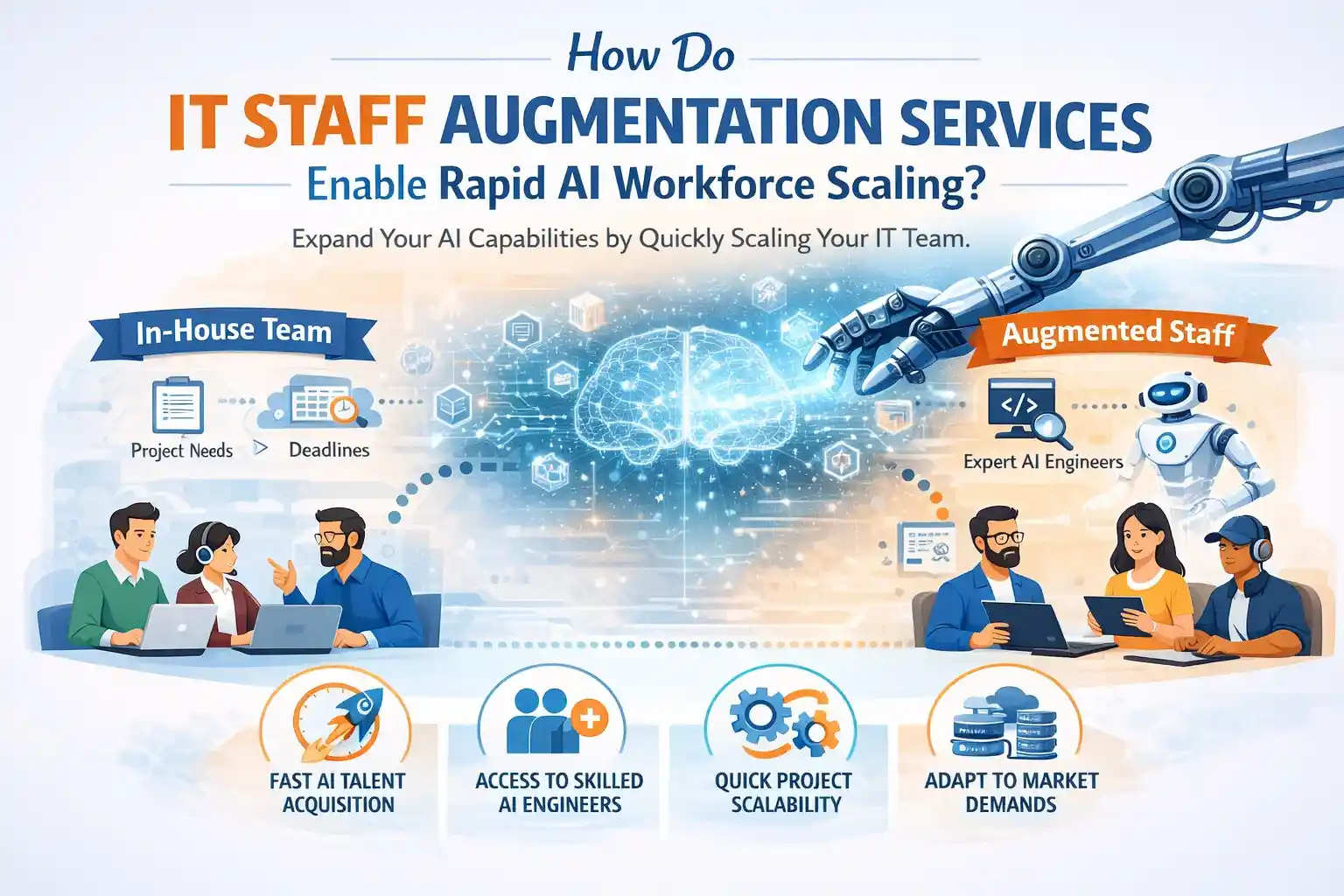
Augmentation gets developers working in 1-2 weeks. You maintain complete control while they integrate with your team. Knowledge stays with you through documentation and training. Scale up for big pushes, down when things slow. Pay only for productive hours. Risk stays low because you can adjust quickly.
Traditional hiring takes those painful 4-6 months we mentioned. Yes, you get permanent employees and full control. But you're locked into headcount whether you need it or not. Every hire costs salary, benefits, and overhead, productive or not. Bad hires hurt badly when they take half a year to replace.
Outsourcing seems fast at 2-4 weeks, but you sacrifice control. Those developers work on their schedule, not yours. Knowledge walks out the door when projects end. Communication suffers across time zones and cultural gaps. You get what you pay for—and sometimes less.
Picture the traditional timeline: two months of writing job descriptions and getting approvals. Two more months sorting resumes and scheduling interviews. Another two months on technical tests and salary negotiations. Two final months left in the notice period. Eight months total before anyone writes a single line of code.
Now, the augmentation timeline: on day one, you describe exactly which skills you need. Days two and three, you review pre-screened candidates who match perfectly. Days four and five, quick technical conversations confirm fit. Days six and seven, paperwork done. Day eight, your new team members are pushing code.
This speed changes everything about AI development. When requirements shift—and they always shift in AI—you adapt immediately. No more being locked into decisions made months ago.
Generic "AI developers" don't cut it anymore. Real projects need PyTorch experts who've scaled recommendation engines to millions of users. Computer vision engineers who are familiar with medical device regulations. NLP specialists who've dealt with financial compliance. MLOps pros who can squeeze milliseconds from edge deployments.
These augmentation companies keep tabs on super-specific experts. Looking for someone who's actually built transformer models for factory automation? They know three people who've done it. Need a developer who understands privacy-preserving AI for healthcare? They've got names and numbers ready to go.
Regular hiring doesn't even come close to finding these niche skills. You'd burn months hunting for that one person who's solved your exact problem before. But these services already know where they are—they've already checked their skills and can connect you this week, not next quarter.
Remote work and near shore partnerships blow open your talent options. That São Paulo AI researcher who cracked e-commerce personalization? On your team tomorrow. The Krakow computer vision expert who solved problems just like yours? Starting Monday. The Bangalore MLOps guru who handles billions of requests? Already looking at your architecture.
You're done fighting every startup in town for the same handful of AI people. Your competitors are still limiting themselves to whoever lives nearby, but you're pulling talent from anywhere on the planet. Each region has its own superpowers, too. European developers are killers at privacy-focused AI because they've been dealing with GDPR forever. Teams in Asia have figured out how to make AI work for billions of users. Latin American developers are breaking new ground in financial AI.
If you're thinking about scaling fast, first figure out exactly what's slowing you down. Maybe your ML models are solid, but deployment sucks. You may need computer vision, but your team only knows NLP. Once you nail down the specific gaps, picking the right augmentation approach gets much easier.
One fintech startup received a 30-day notice: implement fraud-detection AI or lose its biggest client. Six months of traditional hiring meant business death. Through augmentation, they moved fast. Two days to define needs. Eight days to onboard fifteen AI professionals. By day 30, they had a working system that cut false positives 73% while catching 95% of actual fraud. Contract saved, $50M preserved, and a competitive edge gained.
A major retailer needed to prevent Black Friday disasters. Previous inventory problems cost them $8M. Starting with two AI developers in September, they needed twenty-five by October. Week by week, they added specialists: demand forecasting experts first, then computer vision for warehouses, finally NLP for customer service. Black Friday results? Stockouts down 40%, revenue up $12M, customer satisfaction through the roof. After the holiday rush, they scaled back to normal levels.
This stuff happens all the time, not just in these two examples. When companies get stuck between crazy deadlines and super-specific skill needs, augmentation works where normal hiring would crash and burn. I've seen the same story play out everywhere—some urgent project hits, traditional hiring is way too slow, so they bring in augmented talent, and suddenly they're ahead of the game instead of going under. What could have killed the company becomes their biggest win.
Fast growth creates friction. Multiple developers joining simultaneously can lead to different coding styles clashing. Varying problem-solving approaches. Unfamiliarity with existing systems. Smart companies prevent chaos by enforcing coding standards automatically, running thorough onboarding that covers culture and tech, and adding people in waves rather than in floods.
Communication channels overflow as teams expand. Fifteen-minute standups become hour-long marathons. Decisions slow to a crawl. Information gets lost. Fix this by setting communication rules early, using a sync updates for routine stuff, and breaking into smaller feature teams.
Knowledge walks out when contracts end. Your recommendation engine expert leaves, taking crucial knowledge with them. Prevent this by requiring documentation from day one, scheduling weekly knowledge-transfer sessions, and consistently pairing augmented staff with permanent employees.
The biggest mistake? Treating augmentation like outsourcing. Augmented developers aren't independent contractors who work in isolation. They need immediate integration into standups, full system access from day one, inclusion in architecture decisions, and treatment as real team members.
Vague requirements waste everyone's time. "We need AI help" gets you random developers. "We need three PyTorch developers with manufacturing computer vision experience, available full-time for six months, comfortable with Python/Docker/Kubernetes" gets you exactly what you need.
Bad onboarding kills productivity. Set up dev environments before arrivals. Prepare all system access. Update documentation. Define week-one deliverables. Assign dedicated guides. Good onboarding means contributions in 48 hours. Bad onboarding means weeks of frustration.
Traditional hiring for 10 AI developers would incur catastrophic costs. Salaries alone hit $3.5-4 million annually. Add 30% for benefits. Throw in $300,000 for recruiters. Don't forget the equipment. You're over $5 million in year one. Plus six months of lost productivity while hiring. Plus replacement costs for the inevitable bad hires.
Augmentation for the same team over six months runs $1.5-2 million total. But you're productive in one week, not six months. You scale down when the project ends. No bad hire risks. No ongoing costs.
The real ROI comes from speed. Launch your AI feature two months early and capture first-mover advantage. Every week of delay costs market share. Augmentation pays for itself through velocity alone.
First, honestly assess your gaps. List every AI initiative planned. Identify exactly which skills you need and when. Separate permanent needs from temporary ones. Get specific about technical requirements.
Second, pick the right partner. Find providers who specialize in AI talent, not generic staffing. Check their vetting process. Verify their depth of talent in your specific areas. Look for advisory capabilities, not just body shops.
Third, prepare for arrivals. Set up environments completely. Document everything. Assign mentors. Define initial wins. The faster people become productive, the better your ROI.
Fourth, optimize continuously. Track metrics. Gather feedback. Fix bottlenecks. Build relationships with star performers. Create repeatable processes for future scaling.
Look, the AI talent game has changed completely. The old rules don't work anymore. You've got millions of companies chasing a few hundred thousand AI developers, and the math doesn't add up. Traditional hiring is broken—taking half a year to find one person while your competitors ship products using augmented teams.
Here's what smart companies figured out: you don't need to own all the talent, you need access to it when it matters. Keep a small, tight core team that really gets your business. Then, when you need to move fast—and in AI, you always do—bring in specialists through augmentation. Need computer vision for three months? Get an expert on Monday. Project pivots to NLP? Swap them out next week.
The biggest winners are those who mix permanent and contract talent like a DJ mixing tracks. Maybe 60% permanent for stability, 40% augmented for flexibility. Or 80/20 when things are calm, flipping to 50/50 during big pushes. The ratio doesn't matter as much as having the option to change it.
This isn't some future trend—it's happening right now. While you're reading this, companies are scaling from 5 to 50 AI developers in two weeks. They're launching products while competitors are still arguing about job descriptions. They're accessing world-class talent from São Paulo to Singapore without dealing with visas or relocation packages.
The infrastructure is all there. Networks of pre-screened AI experts. Proven onboarding processes. Security figured out. IP protection handled. The only thing missing is companies willing to try something different instead of banging their heads against the traditional hiring wall.
Bottom line: the talent shortage isn't going away. But it doesn't have to be your problem if you're smart about it. The question isn't whether augmentation works—thousands of companies already proved it does. The question is whether you'll adapt fast enough to stay competitive.