
Your next technology decision will either optimize operations or transform your market position. The difference? IT strategy vs digital transformation. One reduces costs and improves efficiency. The other creates new revenue streams and business models. Most leaders confuse the two, investing transformation budgets for optimization results. This guide ensures you choose the right approach.
An IT strategy is the comprehensive plan that aligns technology infrastructure with business objectives. Think of it as your technology roadmap—showing how systems, software, and processes support your company's goals.
At its core, IT strategy planning makes your existing technology work better. It's not about starting from scratch. You take what you have and make it run like a well-oiled machine. Maybe your servers are creaking under the load, or your sales team wastes hours copying data between systems. IT strategy fixes these pain points.
Most IT departments chase the same targets: do more with what you've got, spend less on licenses and hardware, and keep the lights on 24/7. When done right, technology fades into the background. People stop complaining about slow systems and start focusing on their actual jobs.
Good IT consulting partners spot problems before they blow up. They've seen your issues at a hundred other companies. They know which upgrades pay off and which are just expensive headaches.
Digital transformation throws out the rulebook and starts fresh. This isn't tweaking and tuning—it's asking whether your entire business model still makes sense in a world where customers expect everything instantly.
Here's the mindset shift: IT strategy wonders, "How do we speed up order processing?" Digital transformation questions whether you should be taking orders at all, or if customers should configure products themselves online. One improves processes; the other eliminates them entirely.
What pushes companies toward transformation? Usually, it's customers voting with their wallets. They've gotten used to Netflix and Amazon. Now they expect every business to read their minds, remember their preferences, and deliver instantly. Digital transformation consulting services help traditional companies compete with tech-native startups.
Digital transformation solution rollouts flip entire industries upside down. Traditional stores suddenly fight for attention with TikTok creators selling from their bedrooms. Your local bank now competes with Venmo and Cash App. Industry boundaries don't exist anymore.
Understanding these distinctions helps organizations invest wisely. Here's how they contrast:
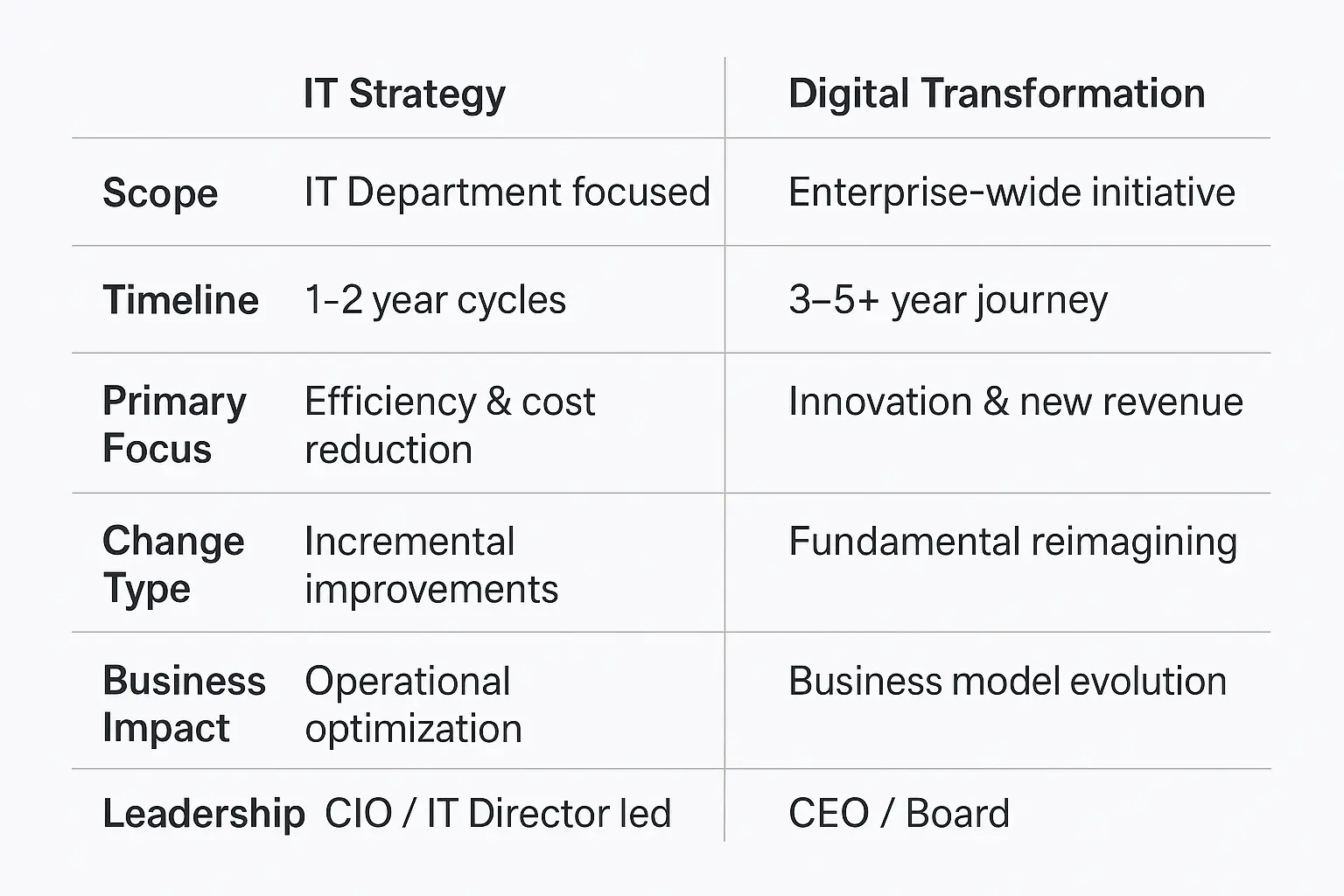
Investment approaches show major contrasts. Traditional technology improvements need steady, predictable budgets. Complete business overhauls require massive spending across departments, and nobody knows if it'll work at first.
Risk tolerance separates the two completely. IT strategy sticks with what's tested and safe—nobody loses their job buying Microsoft. Digital transformation bets big on unproven ideas that might fail spectacularly.
The core distinction boils down to ambition. One perfects existing operations; the other invents entirely new ways of creating value.
Smart companies don't pick sides—they play both games. You need stable technology to run today's business while building tomorrow's competitive advantage.
At AD Infosystem, we learned this lesson by helping a manufacturer stay relevant. They came to us for Digital Manufacturing Consulting, dreaming of AI-powered factories. But their servers couldn't handle basic email reliably. We started with basics—moved them to the cloud, secured networks, and got data flowing smoothly. Only then could we add sensors tracking every machine, algorithms predicting breakdowns, and quality checks running themselves. Downtime dropped 40%, efficiency jumped 25%, and they started selling predictive maintenance as a service.
A retailer taught us another angle. They wanted Amazon-like shopping but had inventory scattered across systems. We built them a single view of stock everywhere, then added real e-commerce capabilities. Customers now browse online, buy in-store, and return by mail. Average sales jumped 35%.
These wins show why IT consulting matters for business growth. Any IT consulting services company can install software. The good ones know which foundations enable which transformations.
Modern platforms serve dual purposes—operational efficiency and transformational capability. Cloud infrastructure company offerings from AWS, Azure, and Google Cloud exemplify this duality.
Infrastructure as a Service (IaaS) solutions reduce expenses through scale while enabling rapid experimentation. Organizations optimize existing workloads and build next-generation applications on the same platforms.
Integration platforms like MuleSoft and Boomi bridge old and new. Legacy systems keep running while new capabilities come online. Keeping these platforms healthy requires constant attention. Updates roll weekly. Security threats evolve daily. Skip IT maintenance services and watch transformation halt.
Getting IT strategy right means walking a tightrope. Keep operations humming while leaving room to experiment. Map what you have against where you're going—gaps show priority investments.
Modern technology stacks need flexibility built in. Pick platforms solving today's problems but adapting to tomorrow's opportunities. Cloud-native designs and API-first thinking give you options.
The human side matters more than the technical. IT folks must shift from keeping servers running to enabling business innovation. New skills, new attitudes, new org charts—everything changes.
Success metrics tell the story. Count traditional stuff like uptime and costs, but also track innovation velocity and new revenue streams. When the IT strategy enables the digital transformation strategy, both numbers improve together.
IT strategy optimizes existing technology for efficiency and cost reduction—it's about doing things better. Digital transformation reimagines your entire business model using technology—it's about doing better things. Smart organizations need both: solid IT foundations enable transformation, while transformation goals guide IT investments. Choose an IT strategy for operational excellence; choose digital transformation for market disruption. Most successful companies orchestrate both approaches. Ready to align your technology with business transformation? AD Infosystem's consulting services help you navigate this journey effectively.