
"Will our cloud strategy survive 2026?" That question keeps CTOs awake. New AI workloads, stricter data laws, edge computing—the cloud landscape is shifting fast. Companies picking between multi-cloud and hybrid cloud today are really choosing their future flexibility. Make the wrong call now, pay for it later. I've watched too many businesses burn money on the wrong approach. So let me show you what actually works and help you pick the cloud computing services that'll still make sense in 2026.
Choose Multi-Cloud if: You're building fresh, want to cherry-pick the best tools, and hate being stuck with one vendor. Startups and tech companies love this for good reason.
Choose Hybrid Cloud if: You've got data that can't leave your building but still need cloud power for everything else. Banks, hospitals, and big enterprises live here.
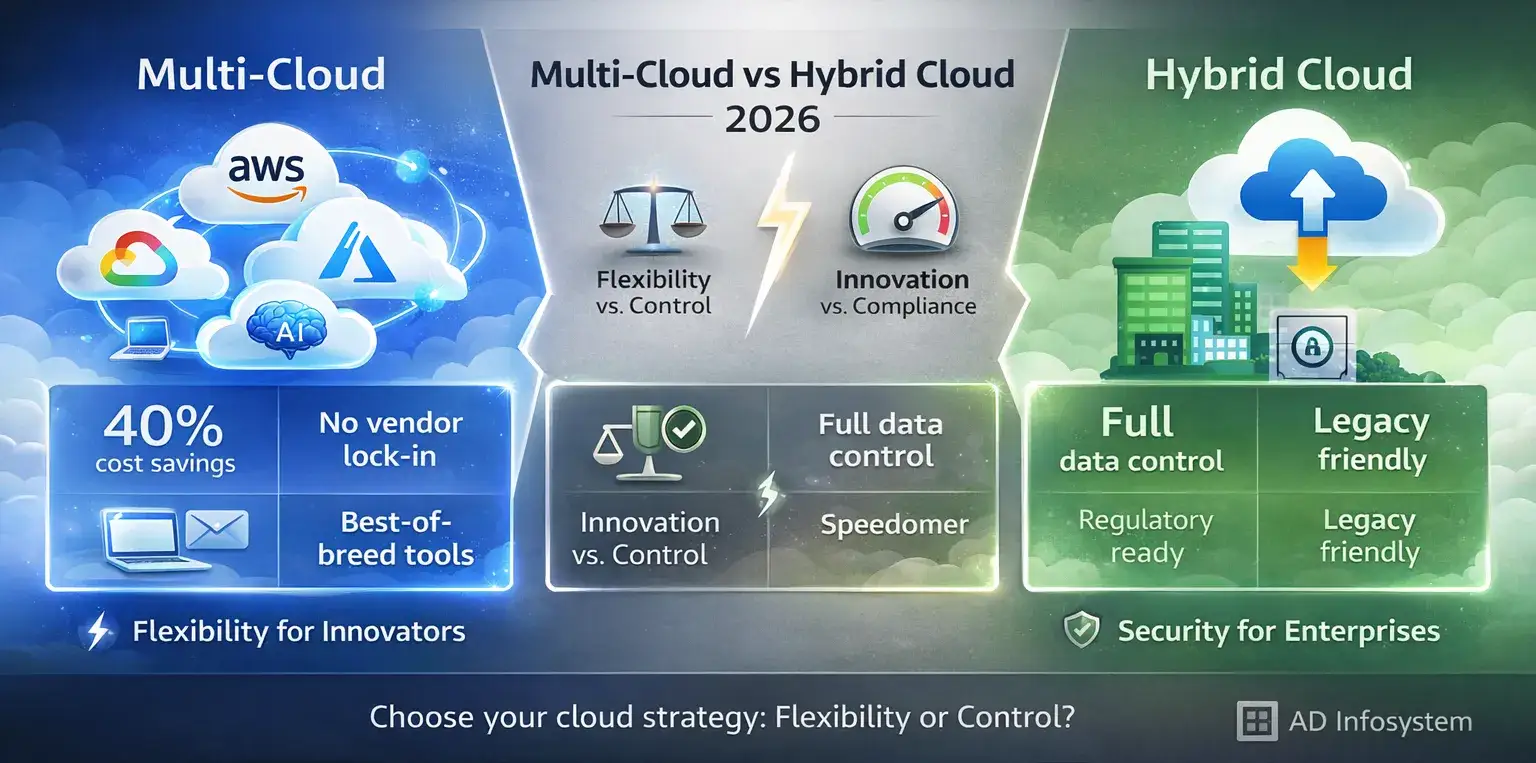
Multi-cloud is simple—you use AWS for one thing, Google for another, maybe Azure for something else. Like using Uber for quick trips but renting a car for road trips. Different tools, different strengths.
Hybrid cloud mixes your on-premise infrastructure with public cloud services. Keep sensitive data in your data center while sending heavy computing to AWS during busy periods. It's one connected environment.
Here's the real difference: Multi-cloud is about spreading your bets across different providers. Hybrid is about keeping one foot in your own data center. Multi-cloud guys chase the best features. Hybrid folks need control over their data.
Multi-cloud is like having accounts at different banks—checking at one (great mobile app), savings at another (better rates), investments at a third (lower fees). Each serves a specific purpose.
Netflix nails this—streaming from AWS, analyzing on Google Cloud, using regional providers for local delivery. Spotify does the same, mixing providers to optimize performance and costs.
Public cloud means you're all-in with one provider—AWS, Azure, or Google. Everything lives in their ecosystem. You get simplicity but also dependency. Multi-cloud? You're spreading the love. Maybe AWS handles your main app because their uptime is rock solid. Google runs your AI stuff because their machine learning tools are killer. Microsoft handles your corporate email because, well, everybody uses Office.
The beauty? When AWS has an outage (and they will), your Google services keep humming. When Microsoft jacks up prices, you shift workloads elsewhere. You're never held hostage. That flexibility comes with complexity, though—managing multiple platforms isn't for everyone.
Hybrid cloud is living in the suburbs but working downtown—control of your space (on-premise) with city resources (public cloud) when needed.
Banks love this. Transactions stay in their vaults, but mobile apps run in the cloud. Hospitals keep patient records locally while using the cloud for research computing.
Cloud bursting is a hybrid's superpower. Normal days run smoothly, but Black Friday? Your servers automatically overflow to the cloud. Expand when needed, shrink when quiet. No waste, no crashes.

Distributed cloud spreads public services across locations while managing them centrally. Hybrid specifically marries your data center with the public cloud. Distributed = "cloud everywhere," hybrid = "cloud plus your building."
Same thing, different marketing. Stick with multi-cloud, ignore the buzzwords.
Multi-cloud wins. Move fast, experiment cheaply, avoid traps. The multi-cloud vs. hybrid cloud strategy comparison shows that startups save 40% by mixing providers. One fintech moved ML to Google (better AI) while keeping apps on AWS (better uptime).
Hybrid makes sense. This is where hybrid really pays off—your mission-critical stuff stays in your control while customer-facing apps get cloud superpowers. Retail client kept inventory local, moved online store to the cloud. Handled Black Friday without new servers.
Use both. Multi-cloud and hybrid cloud adoption meet different needs. Finance uses a hybrid for banking, and marketing runs campaigns across clouds. Manufacturing client: SAP on-premise, Salesforce in the cloud, analytics on Azure, developers on AWS.
Skip with tiny IT teams or zero cloud experience. Two developers juggling three clouds equals disaster—security holes, surprise bills, and integration nightmares.
Pure startups avoid hybrid. Why buy servers while finding product-market fit? Skip if your team can't handle complex networking.
AI/ML Revolution: Cherry-pick AI tools—train on Google TPUs, deploy on AWS. Innovative companies spread AI workloads by performance, not loyalty.
Data Sovereignty: Europe’s stricter, Asia following. German data stays in Germany. Hybrid looks genius for compliance.
Cost Intelligence: New FinOps tools are game-changers. They watch prices across all clouds and move your stuff to whoever’s cheapest right now. I’ve seen 40% savings without lifting a finger.
Edge Computing: The cloud’s getting closer—literally. 5G towers, smart cameras, even your car. You can’t ignore edge anymore, whether you’re multi or hybrid.
Sustainability: Run workloads where renewable energy is cheapest. Carbon neutrality drives provider selection.
No perfect answer exists. Choice depends on data sensitivity, regulations, architecture, and goals. Startups thrive on multi-cloud flexibility. Enterprises need hybrid control. Many use both. At AD Infosystem, we guide businesses through this decision based on real needs, not trends. The winning strategy fits your actual requirements.