Medical practices are caught in a real bind right now. Your patients have gotten used to depositing checks with their phone and booking dinner reservations in seconds – then they show up to your office and hit a wall of clipboards and fax machines. Meanwhile, you're juggling HIPAA compliance, complex treatment protocols, and workflows that generic business software simply can't handle.
Salesforce Health Cloud fixes this problem by being the first CRM built specifically for how healthcare actually works. It gives your teams the modern tools they need without forcing them to compromise on medical standards or security. This shift is changing how medical practices handle patient relationships and get different departments to work together effectively.
There's never been more pressure to go digital. Patients shop around for healthcare like they do for anything else now, and new payment models reward better coordination and proven results. If you don't keep up, you'll watch your patients leave for practices that offer online scheduling, text reminders, and patient portals that actually work - all capabilities that proper Salesforce development can deliver for your practice.
Health Cloud brings all your patient data together in one place that everyone can access. No more calling three departments to get a complete picture or making decisions based on half the story. Your staff saves hours every week that used to disappear into phone calls and duplicate data entry.
The platform helps you stay connected with patients through automated messages and online tools they can use themselves. It connects with your existing EHR so you get the full picture without messing up how your clinical staff already works. Best part? HIPAA compliance is built in from the start – you won't need to spend a fortune trying to make a regular CRM secure enough for healthcare.
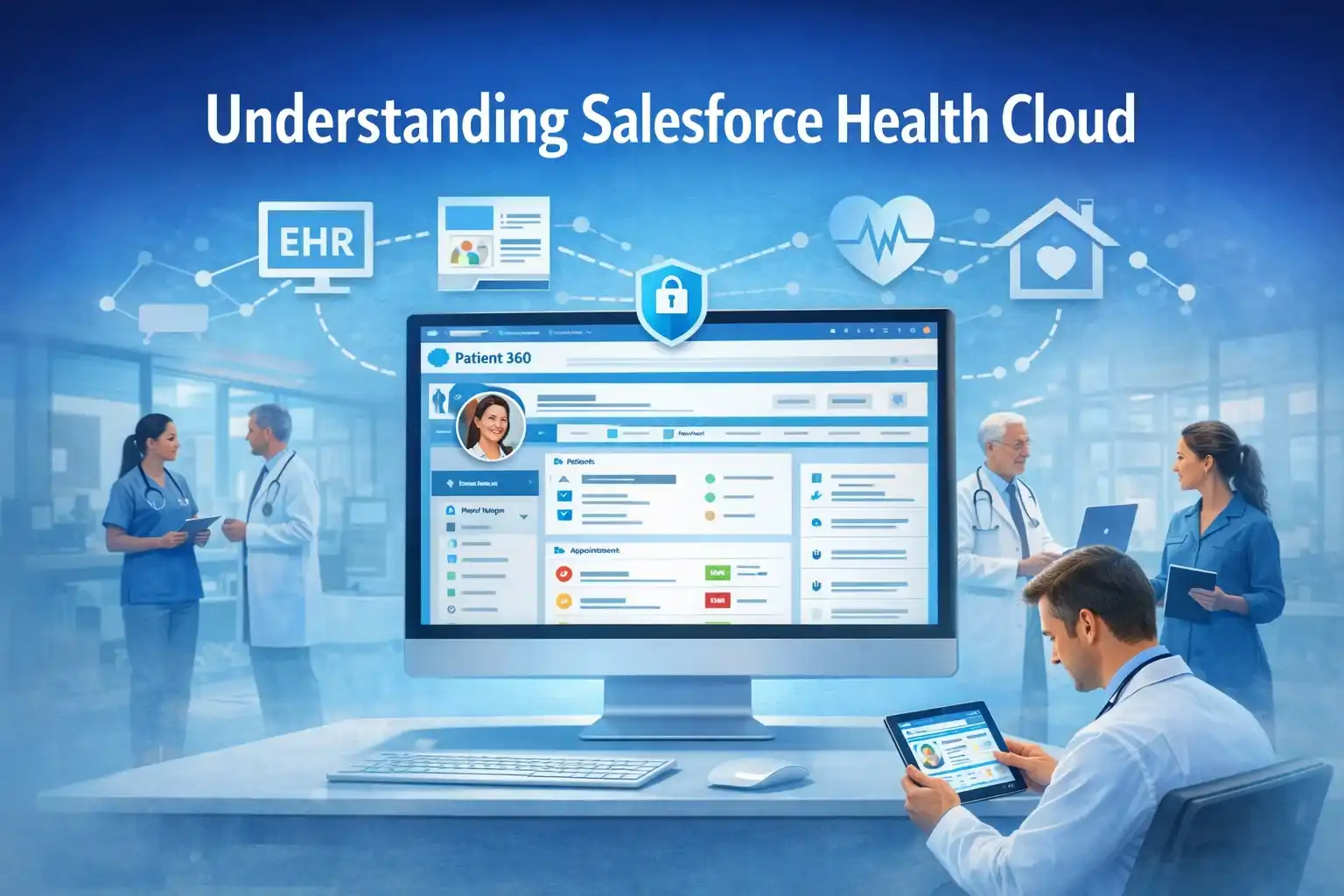
Think of Health Cloud as a CRM that finally speaks your language. Regular CRMs make nurses enter "sales opportunities" and force doctors to think about "conversion rates." Health Cloud uses actual medical terms and workflows because it was built by people who understand healthcare.
It works alongside your EHR, not against it. Your electronic health records handle the clinical documentation, while Health Cloud takes care of everything else – scheduling, patient communications, care planning, and making sure everyone on the care team knows what's happening. Both systems do what they do best and share information smoothly.
Every screen and feature uses healthcare language. Nurses document patient visits, not "customer interactions." Care coordinators manage referrals, not "leads." The whole system reflects real medical workflows instead of trying to squeeze healthcare into a sales framework.
The technology understands healthcare's quirks too. It knows patients might have different ID numbers in different systems. It tracks which family members can access what information. It handles the reality that a single patient might have a primary doctor, three specialists, a physical therapist, and a case manager who all need to coordinate.
Health Cloud takes scattered patient information from all your different systems and brings it together in one clear view. Your teams can finally work from the same information, automate the boring stuff that burns people out, and communicate with patients in ways that actually improve their health.
The system creates a central hub for all patient information across your organization. Gone are the days when radiology doesn't know what cardiology is doing, or when the discharge planner has to track down home health to see what's scheduled. Everyone sees the same up-to-date information.
You get complete patient profiles that show more than just medical history. See their medications, sure, but also understand their living situation, whether they have transportation, and what might stop them from following treatment plans. This fuller picture helps you provide better care that addresses root causes, not just symptoms.
Automation takes care of the mind-numbing tasks. Appointment reminders go out based on each patient's preferred contact method. Referrals route to the right specialist with all the necessary information attached. When lab results come back abnormal, the right people get notified immediately. Your staff spends less time on administrative work and more time actually helping patients.
Field staff love the mobile access. Home health nurses update records from the patient's kitchen table. Community health workers check care plans between visits. Everything syncs in real-time, so the office knows what's happening in the field and vice versa. Security stays tight without making the technology hard to use.
Business CRMs assume simple relationships – a salesperson sells to a customer, end of story. Healthcare relationships last decades, involve multiple providers, and mistakes can literally be life-threatening. You can't manage this complexity with software built for tracking widget sales.
Healthcare involves a web of relationships. There's the patient, sure, but also their spouse who makes decisions when they can't, their adult child who lives across the country but wants updates, their insurance company, their primary doctor, two specialists, and a visiting nurse. Each person needs different information and different levels of access. Generic CRMs just aren't built for this.
Then there's compliance. Regular CRMs treat security like a nice-to-have feature you can add later. In healthcare, one data breach can destroy your practice. You need rock-solid security in every feature from day one, not something cobbled together after the fact.
The worst part about generic CRMs? They force medical professionals to work in ways that don't make sense. When your nurse has to translate "patient needs wound care twice weekly" into sales terminology, you've already lost. When staff spend more time fighting the software than helping patients, that's not a training issue – it's a fundamental mismatch between the tool and the job.
The impact shows up everywhere. Staff waste time on workarounds. Errors creep in from duplicate data entry. Important information gets lost in translation. Compliance becomes a constant worry instead of a given. That's why healthcare needs healthcare-specific solutions from experienced partners like AD Infosystem – anything else just creates expensive headaches.
Multi-site hospitals and health networks rely on Health Cloud to keep patient care consistent across locations. When you're running multiple hospitals, outpatient centers, and rehab facilities, patient information needs to flow smoothly between them all. The platform makes this happen while keeping everyone working from the same playbook and pulling reports that actually make sense across the entire system.
Specialty practices have unique needs that cookie-cutter software can't handle. Cancer centers need different workflows than cardiology practices, and mental health clinics operate nothing like orthopedic surgeries. Health Cloud lets each specialty set up their specific processes and meet their particular compliance requirements without creating separate data silos. Everyone gets what they need without breaking the overall system.
Telehealth has exploded, and virtual care providers need more than just video chat. They're using Health Cloud to manage the entire remote care experience – from that first online appointment request through ongoing monitoring and follow-ups. When you connect it with video platforms and remote monitoring devices, virtual visits can be just as effective as sitting in the exam room.
Insurance companies are finally bridging the gap between the clinical and business sides of healthcare. When payers and providers can actually share information effectively, prior authorizations get approved faster, claims process smoother, and everyone can work together on keeping patients healthy. It's a win for everyone involved – especially the patients.
Most healthcare organizations deal with the same headaches. Information lives in a dozen different systems, so getting a complete picture of any patient takes forever. This mess leads to ordering the same tests twice because nobody knew they were already done. Diagnoses get missed because the right information wasn't available when it mattered. Patients get frustrated repeating their medical history to every single person they see.
Then there's the engagement problem. Patients miss appointments, throwing off carefully planned schedules. They don't take their medications properly, which makes everything worse and costs more in the long run. Too many end up back in the hospital because nobody followed up after discharge. These aren't just statistics – they're real problems that hurt both patients and bottom lines.
Don't even get started on compliance nightmares. One violation can wipe out a small practice or seriously damage a large system's reputation. The constant worry about meeting regulations while trying to provide good care wears everyone down.
Regular CRMs think in terms of sales opportunities and revenue potential. Everything revolves around moving leads through a sales funnel to close deals. Health Cloud starts with patients and care plans. It understands that healthcare involves multiple providers working together over months or years, not a single salesperson trying to hit quarterly targets.
In healthcare, relationships don't have neat endpoints. A diabetic patient doesn't get "closed" like a sales deal. They need ongoing care from their primary doctor, endocrinologist, nutritionist, and maybe a dozen other providers over their lifetime. Health Cloud gets this. It tracks these complex, overlapping relationships and helps everyone involved stay coordinated.
Security isn't an afterthought here. While regular CRMs might add encryption as an optional feature, Health Cloud bakes it into everything. Every piece of data is encrypted whether it's sitting in storage or moving between systems. Every time someone looks at patient information, there's an audit trail. Access controls match how healthcare actually works – nurses see nursing information, billing sees billing information, and everyone stays in their lane.
The integration story is completely different too. Generic CRMs make you build custom connections to every other system, and those connections break whenever either system updates. Health Cloud comes with pre-built connections to Epic, Cerner, and other major EHR systems. It speaks healthcare languages like HL7 and FHIR natively, so data flows reliably without constant maintenance.
The unified patient view is everything. Instead of logging into five systems to understand one patient, everything comes together in a single screen. Previous treatments, current medications, recent lab results, scheduled appointments – it's all there. Care teams make better decisions faster when they have complete information at their fingertips.
The numbers tell the story. Within a year of implementing Health Cloud, organizations typically cut administrative work by about 30%. That's real time given back to patient care. Patient satisfaction jumps by around 25% because they're not repeating themselves constantly and their care feels more coordinated. Care teams work 20-30% more efficiently when they're not hunting for information or waiting for callbacks.
These improvements hit the bottom line hard. Fewer readmissions mean avoiding Medicare penalties while actually helping patients stay healthier. Better patient engagement translates to loyalty in competitive markets. Fewer errors mean lower malpractice costs and better sleep at night. More efficient operations let you help more patients without burning out your staff or building new facilities.
Healthcare changes constantly – new regulations, payment models, treatment approaches. Organizations using Health Cloud can adapt without ripping out their entire technology foundation. Need to add a new service line? The platform scales with you. Opening new locations? Same system works everywhere.
The analytics tools help you catch problems before they blow up. You start seeing which patients might skip their medications or which ones are heading toward readmission. Armed with that information, you can actually do something about it – maybe a quick phone call or an extra appointment prevents a crisis. This is exactly the kind of preventive care that new payment models reward. You're not scrambling to keep up anymore – you're actually ahead of the curve.
The platform gets better all the time without those painful system overhauls we all dread. New features just show up based on what healthcare organizations are actually asking for. No more sitting through vendor presentations about features that sound cool but nobody will use. What you buy today will be even more valuable in a few years as the technology keeps evolving. That's a rare thing in healthcare IT.
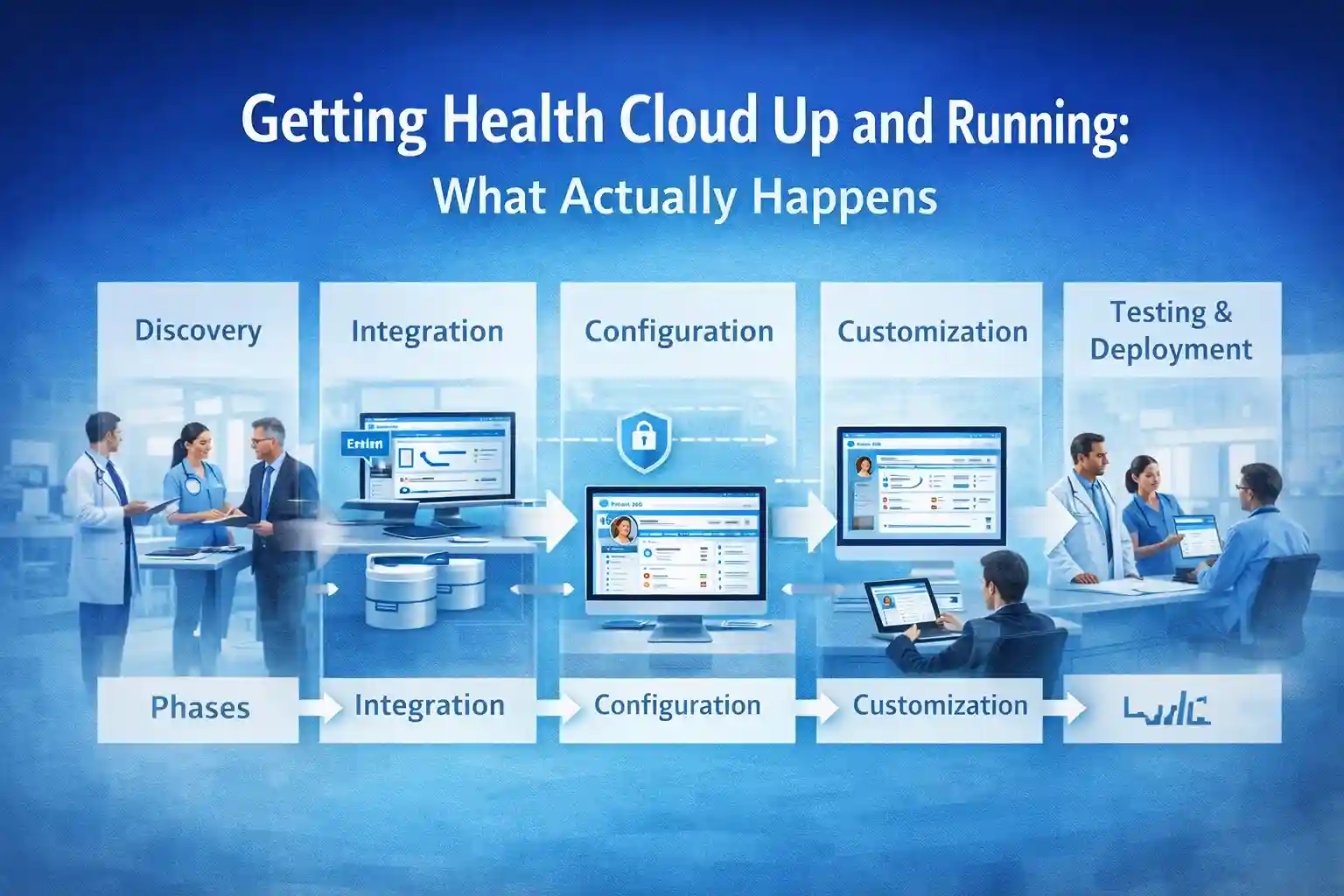
We've helped hundreds of healthcare organizations implement Health Cloud, and there's a method to avoiding madness. Here's how it really works – not the sales pitch version, but what you'll actually go through.
First, we need to understand how your organization actually operates – not what the procedure manual says, but what really happens day to day. We'll follow patients from their first call through their entire care journey. Where do things get stuck? What drives your staff crazy? Where are patients getting frustrated?
Our consultants will shadow your teams, both clinical and admin. We document how different departments do things differently (because they always do), and spot the workflows that work great and shouldn't be touched. Too many tech projects fail because they force people to change good processes to fit bad software. We're not doing that.
Next comes the integration puzzle. You've got your EHR, billing system, lab systems, imaging – they all need to connect. We figure out which system should be the boss for different types of information. Your EHR probably owns clinical data, billing owns financial data, but what about scheduling? Patient demographics?
These decisions matter because they affect everything downstream. Get it wrong and you'll fight data conflicts forever. Get it right and information flows smoothly without anyone doing double entry.
Now we configure the foundation. Security comes first – encryption, passwords, who can see what. This isn't exciting work, but it's like pouring concrete for a house. Everything else builds on top of it. We make sure you're HIPAA compliant from day one, not scrambling to fix security holes later.
We customize workflows to match how you actually work. Your cardiology department needs different screens than pediatrics. Your intake process is unique to your organization. We build custom reports for your specific requirements – maybe you report to the state differently than the hospital across town.
The trick is customizing enough to be useful without painting yourself into a corner. Every customization needs to survive system updates without breaking.
Testing isn't just clicking buttons. We run real scenarios – what happens when Dr. Smith needs to transfer a complex patient to Dr. Jones? Can the night shift access what they need? Does the system slow down at 8 AM when everyone logs in?
We also pound on security. Can someone access data they shouldn't? Are audit trails capturing everything? Better to find problems now than during a real audit.
Launch day doesn't have to be chaos. Smart organizations roll out in phases – maybe start with one department or location. Train people in small groups so they can actually ask questions. Have support staff walking the floors those first few weeks.
The key is planning for the human side. Technology usually works fine. It's people who struggle with change. Good training and visible support make all the difference.
Small practices can be up and running in 3-4 months if they keep it simple. Most mid-sized organizations need 6-9 months to do it right, including integrations and customizations. Large hospital systems? Plan on 12-18 months, rolling out location by location.
Yes, vendors will promise faster. They're usually wrong. Better to plan realistically than rush and create a mess.
We worked with a 15-hospital system that was drowning in disconnected information. Patients would show up at hospital B, and nobody knew what hospital A did last week. Dangerous and frustrating for everyone.
After implementing Health Cloud, they cut readmissions by 18% in the first year. How? Nurses get alerts when high-risk patients miss appointments or don't fill prescriptions. Instead of waiting for these patients to show up in the ER, they call them. Simple, but it works.
Oncology practices have incredibly complex needs. Chemo cycles, radiation schedules, coordinating between multiple oncologists, managing brutal side effects – generic software can't handle this.
One cancer center we worked with built the whole treatment protocol into Health Cloud. The system now automatically schedules the next appointment based on where patients are in their treatment. It sends different reminders for different treatments (chemo reminders are very different from follow-up reminders). Small touches that make a huge difference when you're dealing with cancer.
A cardiology group improved follow-up compliance by 35% just by automating their reminder system. But here's the smart part – they customized reminders based on the medication. Patients on blood thinners get different messages than those on statins. The system knows who needs monthly blood work and schedules it automatically.
Home health used to mean mountains of paper. Nurses would document visits on paper, drive back to the office, type everything in. Half the time, important details got lost.
Now they document everything on tablets right in the patient's living room. The office knows immediately if something's wrong. No more playing phone tag or waiting for paperwork. One agency cut their travel time by 23% because the system actually understands traffic patterns and creates smart routes. Their nurses see more patients while driving less.
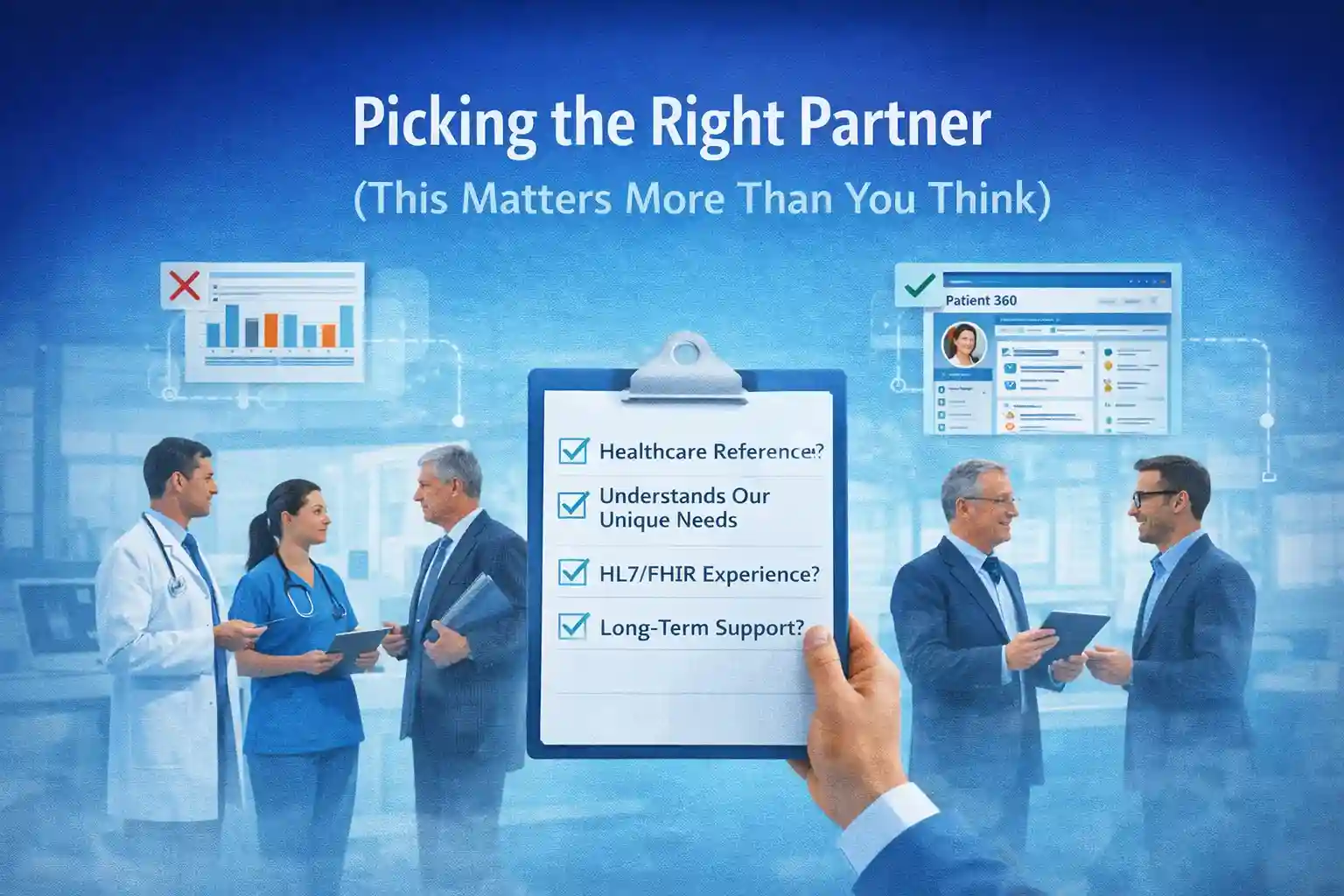
Choosing who helps you implement Health Cloud might be the most important decision you make. Plenty of companies know Salesforce. Far fewer understand healthcare.
You need partners who've been in the trenches with organizations like yours. If you're a community hospital, don't hire someone who's only worked with huge academic medical centers. They won't get your challenges.
Ask for real references and actually call them. Did they stick around when things got complicated? (Things always get complicated.) Did they train your staff to handle things independently, or create dependence on expensive consultants?
The best partners teach while they build. They document everything. They make sure your team can handle routine changes without calling for help. They think about what you'll need next year, not just next month.
Watch out for partners who speak only in tech jargon or seem surprised by healthcare's complexity. If they don't know what HL7 is or look confused when you mention prior authorizations, run. You need someone who speaks both healthcare and technology fluently.
Finally, the tech is catching up to the promises. You know how every conference for the past five years has been all "AI this" and "machine learning that"? Well, it's actually starting to work now. Not perfectly, but good enough to make a real difference.
I've been watching some of our early adopter clients, and they're doing things we only dreamed about a few years ago. They're catching problems while they're still small – like noticing a patient's lab results are drifting toward diabetes months before it would normally get flagged. One practice told me they prevented three heart attacks last year just by having their system analyze patterns the doctors would never have time to spot.
Think about it – you've got thousands of patients generating millions of data points. No human can spot all the patterns. But machine learning can flag that Mrs. Johnson's vitals from her home monitor are trending toward trouble, or that three patients on the same medication cocktail all had similar complications. The system learns what matters and gets your attention when it counts.
The really cool stuff is happening with clinical notes. For years, valuable information has been buried in doctor's notes that nobody has time to read. Now, natural language processing pulls out the important bits automatically. Instead of digging through dozens of documents, you get a summary: "Patient mentioned financial concerns about medication costs" or "Multiple mentions of dizziness in recent visits." It's like having someone highlight the important parts of every chart.
Remember when everyone got excited about fitness trackers? That was just the beginning. Now patients have blood pressure cuffs, glucose monitors, even smart scales sending data continuously. The challenge isn't getting the data anymore – it's making sense of it.
Future Health Cloud setups will treat this flood of information intelligently. Your diabetic patients' glucose patterns get tracked automatically. If someone's blood pressure starts creeping up over weeks, you know about it before they have a crisis. The ER visit that would have happened next month? You prevented it with a medication adjustment today.
Here's what's really game-changing: the system will adapt to each patient automatically. Your 80-year-old patients get simple, large-print appointment reminders by phone. Your 30-something tech workers get text messages with links to reschedule online. Spanish-speaking patients get communications in Spanish without anyone having to remember to check a box.
The AI assistants coming online can handle the routine stuff that clogs up your phone lines. "What time is my appointment?" "Can I refill my prescription?" "Do I need to fast for this test?" Patients get instant answers at 2 AM on Sunday. Your staff handles the complex issues that actually need human judgment.
Let's be straight – Health Cloud is a big decision. It's not just buying software; it's choosing how you'll deliver care for the next decade. But that's exactly why it matters. Healthcare isn't getting simpler. Regulations aren't getting looser. Patients aren't getting less demanding.
Small practices use Health Cloud to punch above their weight class. You can offer the same connected experience as big hospital systems without their massive IT departments. Large health systems use it to finally get their chaos under control – one platform instead of 50 different systems held together with digital duct tape.
The path forward isn't really a mystery. Patients expect Amazon-level service. Payers demand better outcomes. Regulators want everything documented. You can either cobble together solutions and hope they work, or build on a platform designed for where healthcare is heading.
Healthcare is transforming whether we're ready or not. Value-based care isn't a fad – it's the future. Patients shopping for healthcare like they shop for everything else isn't going away. The organizations thriving five years from now won't be the ones who adapted fastest to yesterday's changes. They'll be the ones who built for tomorrow.
Health Cloud isn't perfect. No system is. But it's built by people who understand healthcare is different. It grows with you. It connects with the systems you already have. Most importantly, when implemented by experienced partners like AD Infosystem, it positions you to take advantage of what's coming next instead of always playing catch-up.
The question isn't whether to modernize your patient relationship management. It's whether you'll do it with tools built for healthcare or keep trying to make generic business software work in an environment it was never designed for. The organizations making the switch now are the ones who'll wonder why they waited so long.