For years, "cloud first" wasn't really a strategy — it was a habit. Companies moved to Amazon and Microsoft because everyone else was, and because the pitch was genuinely compelling: stop worrying about infrastructure, move fast, scale cheap. A lot of us bought into it.
The reality was messier. If you were running a hospital network, a regional bank, or a manufacturing operation with actual regulatory obligations, you quickly discovered that these platforms weren't built with you in mind. You spent the next several years hiring consultants and building workarounds, essentially constructing a custom solution on top of something that was supposed to make custom solutions unnecessary. The irony wasn't lost on anyone.
That frustration has been accumulating for a while, but 2026 feels like the year people are actually acting on it. The conversation has shifted. Instead of asking "how do we make this work for us," more executives are asking why they ever accepted that burden in the first place.
The answer they're landing on is vertical cloud — platforms designed specifically for their industry, with compliance frameworks and operational logic built in from day one. Not as an afterthought. Not as a premium add-on. Just... included, because the people who built it understood the environment it would run in.
It's less of a technological leap than it sounds. It's more of a correction — an acknowledgment that general-purpose tools have real limits, and that some industries are better served by something that was actually built for them.
To understand why this shift is happening, you have to go back and look at what the original cloud model actually was — and wasn't.
Early cloud platforms gave you computing power, storage, and networking. Genuinely useful stuff, but essentially raw material. The infrastructure was there; everything built on top of it was your problem. For most industries, that meant starting from a blank page and constructing all the complex, sector-specific logic yourself — the workflows, the data models, the compliance architecture.
For heavily regulated businesses, that gap was particularly painful. A healthcare organization couldn't just spin up a database and call it done. It needed HIPAA-compliant data structures. A financial institution needed PCI-DSS guardrails before it could do much of anything meaningful. The hyperscalers handed you the bricks. What you did with them — the blueprints, the labor, the years of iteration — was entirely on you.
Industry cloud platforms represent a different starting point. Rather than raw infrastructure, they arrive as something much closer to a finished foundation — combining IaaS, PaaS, and SaaS layers that are already configured for your sector's specific demands. A hospital system isn't building HIPAA compliance from scratch anymore. A multinational bank doesn't have to engineer fraud-detection architecture before it can ship a new product. The baseline assumptions are already correct.
That changes the economics in a real way. It's not just that deployment is faster, though it is. It's that organizations can skip years of foundational work that never differentiated them in the first place. The technical debt that used to accumulate before you'd even launched anything meaningful — that's largely gone. And for industries where the regulatory floor is high, and the cost of getting it wrong is higher, that's not a minor convenience. It's a completely different starting line.
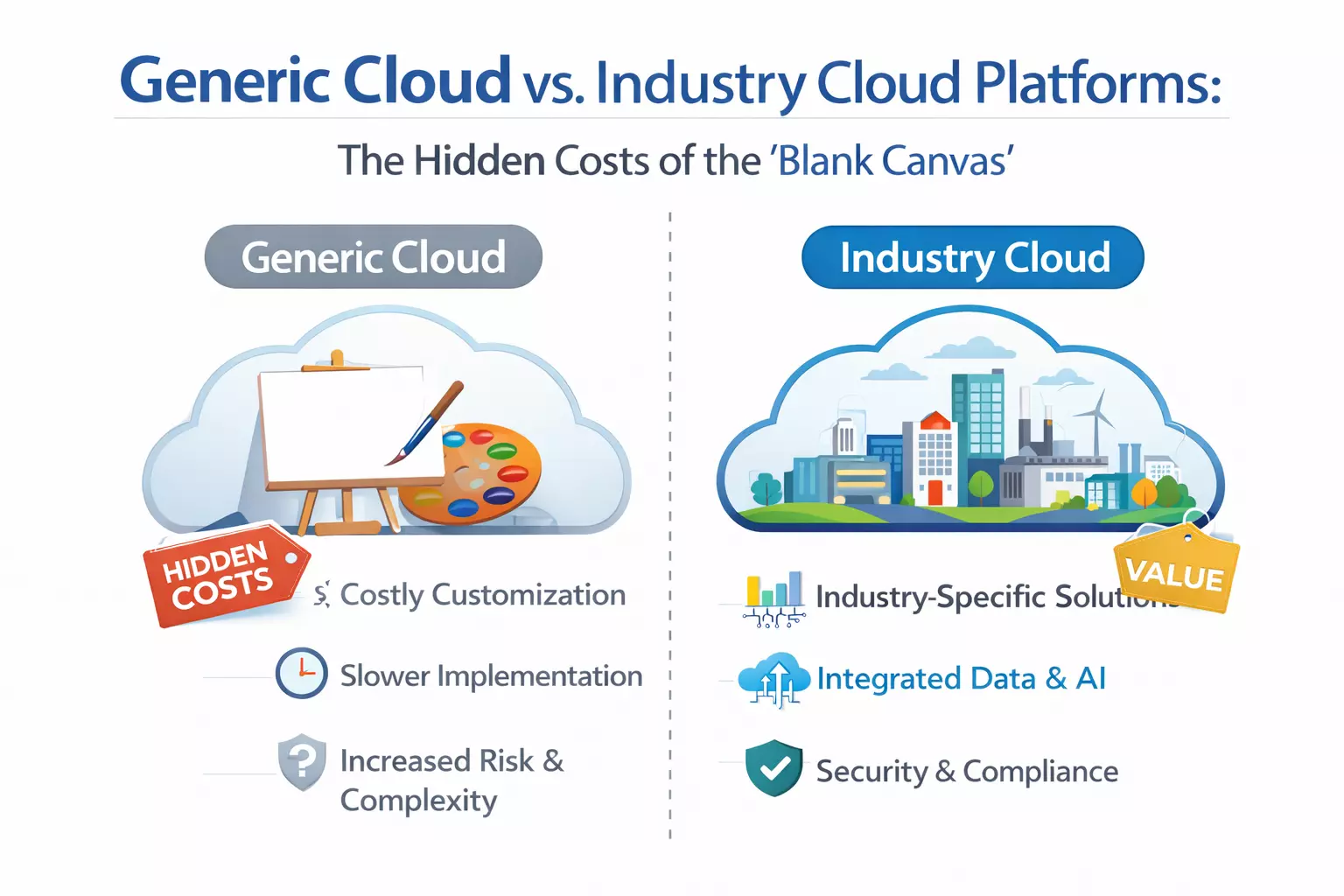
The promise of cheaper, more flexible generic cloud falls apart under real-world pressure. Think of it like a sports car delivered without seats, a steering wheel, or an engine tuned for the track — you're building it mid-race while competitors are already running laps in purpose-built vehicles.
Industry cloud is the purpose-built racer. Designed for your specific terrain, your rules, your championship. The generic option was never actually cheaper once you factored in everything you had to construct yourself. It just moved the cost somewhere less visible — and made it somebody else's problem to notice.
Let's put the contrast into sharper focus for enterprise leaders:
| Compliance & Governance | Deployment Time | Customization Effort | AI Capabilities | Cost Efficiency | Interoperability |
|---|---|---|---|---|---|
| Manual configuration, continuous patching, high audit burden | Slow (heavy architectural planning, custom coding, integration) | High effort, high cost, creates significant technical debt | Generic, broad algorithms requiring extensive training & context | Hidden costs in middleware, custom development, compliance management | Requires custom API development for legacy tools, complex middleware |
| Built-in, auto-updated to match regional regulations, automated audit trails | Fast (pre-configured, industry-standard models, minimal tweaking) | Sector-specific pre-configuration, focused customization for competitive edge | Industry-trained contextual AI out-of-the-box, immediate actionable insights | Optimized total cost of ownership (TCO), predictable operational expenses | Native connectors for industry-standard software, seamless ecosystem integration |
The sticker price is deceiving. Generic cloud storage looks attractive on a per-gigabyte basis, but that number doesn't include the integration work, the compliance overhead, or the custom development that quietly inflates the real bill. By the time you've accounted for all of it, a purpose-built vertical solution is often the more economical choice — not just marginally, but substantially.
More importantly, it's not only about the money. Every dollar and every talented person you're spending on rebuilding compliance frameworks or recreating industry workflows from scratch is a dollar and a person not working on anything that actually moves your business forward. Vertical cloud doesn't just reduce costs — it redirects capacity toward work that genuinely matters.
Keeping up with regulations is exhausting work, and it never really ends. Generic platforms give you the raw tools — firewalls, encryption, access controls — but configuring them to actually satisfy HIPAA, PCI-DSS, GDPR, SOX, or whatever local data sovereignty law applies to your markets is entirely your team's problem. And the moment something changes, your architects drop everything to figure out what needs to be rewritten. It's reactive by design, and the cost — in time, risk, and morale — adds up fast.
The more honest way to think about compliance is as a continuous, living process rather than a box you check during implementation. Regulations shift. Interpretations evolve. New jurisdictions impose new requirements. A one-time setup doesn't hold.
That's where sector-specific cloud environments change the dynamic. The platform carries the compliance burden rather than your internal team. Frameworks update as regulations change, audit preparation becomes far less painful, and the panic that typically accompanies a new regulatory announcement largely disappears.
But the bigger gain is what your engineers can do with the time they get back. If a meaningful portion of every sprint is currently going toward building and maintaining compliance guardrails, that's capacity being consumed by work that doesn't differentiate your product or move your revenue. Shift that burden to the platform, and those same people can focus on features that actually matter to your customers. Compliance stops being a constant fire drill and becomes something closer to a given — handled, reliable, and largely invisible.
The shift toward specialized infrastructure isn't theoretical — it's already reshaping how specific markets operate. The clearest proof is in the industries where the stakes are highest: those dealing with the strictest regulatory oversight and the most operationally complex environments. Here's what it actually looks like on the ground.
Healthcare sits at one of the sharpest intersections of urgency and caution in any industry. Patient data needs to be immediately accessible to the right people — and completely inaccessible to everyone else. Getting that balance wrong has real consequences, clinical and legal.
Generic cloud platforms don't understand that tension. Healthcare-specific platforms are built around it. They come pre-configured for HL7 FHIR data standards and are designed from the ground up to satisfy HIPAA, GDPR, and the various regional mandates that govern how patient information is stored, transmitted, and accessed.
In practice, that changes what a hospital or health system can actually do with its technology budget. Instead of spending months architecting compliant data pipelines before a single clinical application can go live, teams can move directly to building the things that matter — telemedicine tools, wearable integrations, predictive diagnostics. The platform already knows what a patient record is, how it needs to be encrypted, and who is legally permitted to touch it. That logic isn't something your team configured; it's embedded in the foundation.
The result is that innovation in patient care becomes genuinely faster, not just in theory but in practice. And because the compliance scaffolding is already sound, the regulatory risk that typically shadows healthcare technology projects shrinks considerably. Clinicians and patients both end up with systems they can actually trust — which, in healthcare, is the only kind worth building.
Financial institutions are fighting on two fronts simultaneously — sophisticated cyber threats on one side, an unrelenting stack of international regulations on the other. PCI-DSS, SOX, Basel III, GDPR — the list doesn't shrink.
Banking-specific cloud platforms absorb much of that pressure directly, with AML detection, fraud prevention, and secure transaction architecture already built in. The foundation arrives hardened.
What that unlocks is meaningful: new digital banking products, open-banking APIs, and FinTech partnerships that can move at actual speed. The security and compliance groundwork is already laid. Attention shifts from maintaining the basics to building what actually differentiates the institution.
Manufacturing has a problem that doesn't get enough attention in cloud conversations: the gap between what's happening on the factory floor and what the corporate systems actually see. Operational technology and enterprise IT have historically lived in separate worlds, and bridging them has been expensive, slow, and technically messy.
Vertical cloud platforms built for manufacturing close that gap by default. IoT connectors, predictive maintenance algorithms, and supply chain visibility tools come pre-built rather than custom-engineered. The underlying data ingestion and analytics architecture — the unglamorous plumbing that consumes enormous resources to build from scratch — is already there.
What manufacturers can do with that foundation is genuinely compelling. Real-time digital twins of production lines. Logistics networks that optimize dynamically. Quality control that operates at scale without requiring a separate data engineering project to support it. The factory stops being an environment that reacts to problems after they surface and starts becoming one that anticipates and corrects them before they do. That shift — from reactive to proactive — is where the real operational value lives.
Retail might lack the regulatory intensity of healthcare or finance, but the operational complexity is just as real. Vertical cloud platforms built for retail already understand SKUs, seasonal demand swings, omnichannel fulfillment, and customer personalization — no assembly required. Retailers stop stitching together generic databases with third-party tools and start working from a foundation that reflects how retail actually operates. Fewer stockouts, faster delivery, better customer experiences.
Organizations transitioning to domain-specific cloud environments experience several distinct advantages that drive competitive differentiation, operational resilience, and sustained growth.
In 2026, the AI advantage that vertical cloud platforms offer might be their most compelling differentiator yet. Generic AI tools require enormous amounts of training data and significant engineering investment before they're useful in any specific context. Vertical platforms skip that runway entirely.
A healthcare platform arrives with models already trained to spot anomalies in medical imaging. A financial platform carries algorithms tuned specifically for the micro-transaction patterns that signal fraud. A manufacturing cloud includes AI that listens to acoustic sensor data and predicts equipment failure before it happens.
None of that is accidental. It's the result of building for a specific industry from the ground up. The AI already speaks your language — and that head start translates directly into faster, more reliable outcomes.
Most enterprises aren't running a single system — they're managing a sprawling ecosystem of CRM, ERP, HRIS, IoT devices, payment gateways, and everything in between. On a generic cloud platform, getting those systems to talk to each other means custom API development, layers of middleware, and ongoing maintenance that never quite ends. Data silos form. Delays compound. The integration backlog becomes a permanent fixture.
Sector-specific platforms arrive with those connections already mapped. Native connectors for industry-standard software come built in, shrinking integration timelines from months to days. The new system doesn't need to be wrestled into your existing environment — it fits naturally, works immediately, and stays compatible as your stack continues to evolve.
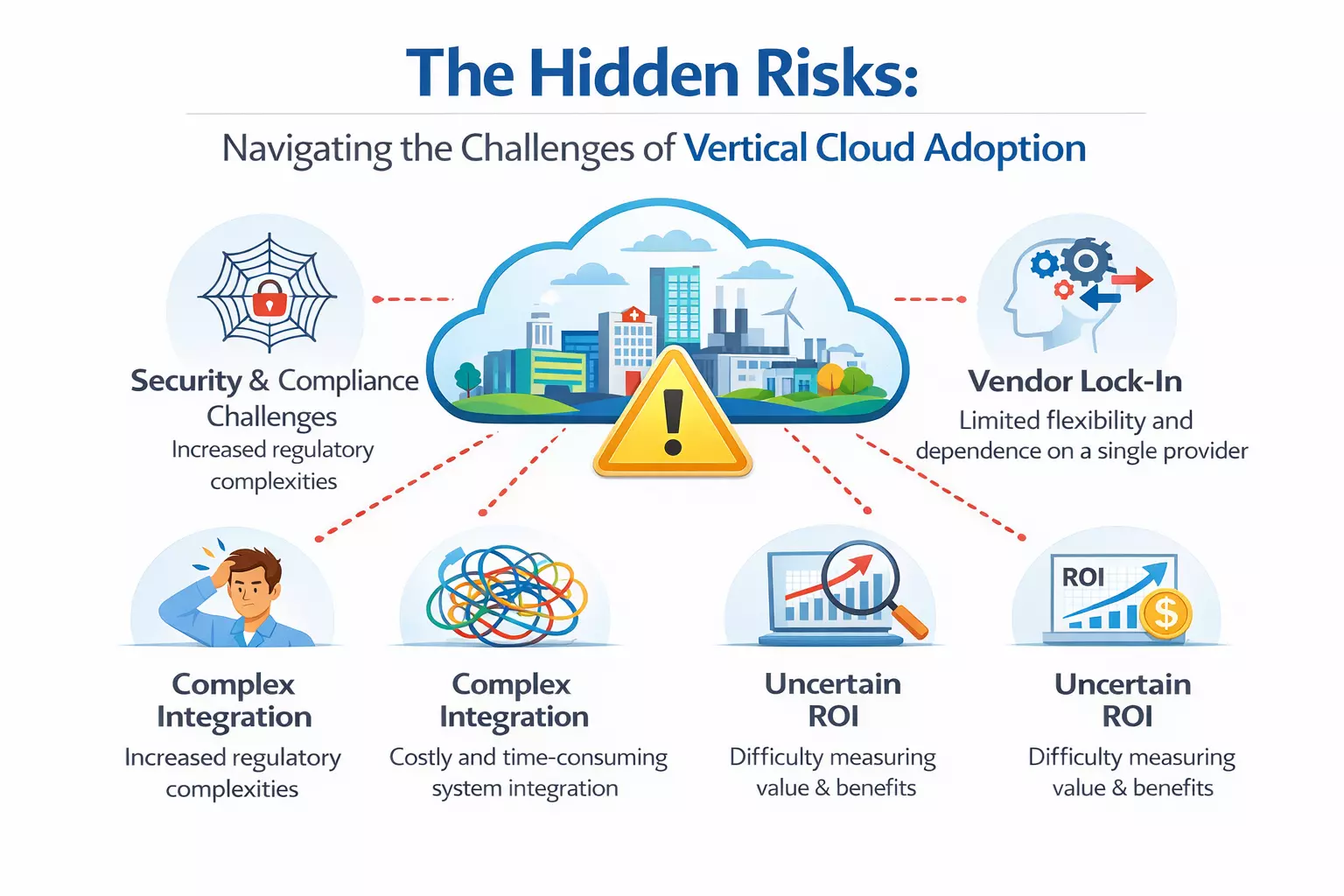
The benefits are real, but so is the risk of getting stuck. Vertical platforms are deeply embedded by design — that's literally the selling point — but it also means walking away becomes a serious undertaking. Migration costs, data extraction headaches, and retraining cycles. It's not impossible, but it's expensive enough that many organizations simply don't.
The answer isn't to avoid vertical clouds. It's to go in with your eyes open. Insist on open standards. Ask hard questions about data exportability before the contract is signed, not after. Build your core logic on containerized, portable architectures where you can.
The goal is deep integration on your terms — not dependency you drifted into without noticing.
Choosing the right vertical cloud platform isn’t a procurement exercise — it’s a strategic decision that will shape your operations for years. Five things genuinely matter when you’re evaluating options.
Compliance depth. Don’t settle for checkbox assurances. The platform should natively support the specific frameworks governing your sector and region — HIPAA, SOC 2, GDPR, ISO 27001 — and produce automated, exportable audit trails when you need them. Broad compliance claims are easy to make. Ask for specifics.
Integration capabilities. Your existing systems aren’t going anywhere overnight. The platform needs pre-built connectors for your legacy infrastructure, your ERP, your CRM, and the industry-specific tools your teams already depend on. Every gap in that coverage becomes a custom middleware project — which is exactly what you’re trying to escape.
Vendor expertise and roadmap. The technology matters, but so does whether the people behind it actually understand your industry. Can they speak fluently about your workflows, your market pressures, and your regulatory trajectory? A vendor who knows your world is a partner. One who doesn’t is just a supplier with a good deck.
Data sovereignty. For any organization operating across borders, this is non-negotiable. You need granular control over where your data lives and is processed — not a general assurance, but verifiable, contractual control that satisfies EU residency requirements, national security obligations, and whatever else your legal team raises.
Scalability that doesn’t require reinvention. strong> Growth should be additive, not architectural. The right platform handles new regions, new business units, and higher data volumes without forcing you back to the drawing board. Flexibility means adapting to what you don’t yet know is coming — not just handling what you can already forecast.
Moving to a vertical cloud platform is ultimately a strategic call, not a technical one. The technology question is straightforward — the harder question is whether your organization actually needs it right now.
A few honest signals that you probably do:
Compliance is consuming your best people. If regulatory audits feel like a permanent state of emergency, or your architects are spending significant time maintaining frameworks that have nothing to do with your product, that's a problem the right platform can largely solve.
Integration has become its own full-time job. When connecting industry-specific applications and legacy systems requires constant custom work and still produces fragile, unreliable data flows, you're paying a tax that shouldn't exist.
Your engineers are building foundations instead of features. If a meaningful portion of every sprint goes toward infrastructure and compliance groundwork rather than the capabilities that actually differentiate your product, you're not moving as fast as you think you are.
Your industry has high regulatory stakes. Healthcare, finance, and manufacturing — the baseline requirements in these sectors are steep enough that starting with a purpose-built platform isn't a luxury; it's a practical advantage from day one.
You need AI that actually understands your context. Generic models require enormous investment before they're useful in a specific industry. Vertical platforms bring that context pre-built.
None of this is about chasing a trend. It's about recognizing when the tools you're using are costing you more than they're giving back — and choosing something built for the environment you're actually operating in.
Infrastructure decisions stopped being purely an IT conversation a long time ago. The platform your organization runs on shapes how fast your sales team can move, how cleanly your finance function operates, and how confidently your operations team can scale. Getting it wrong has consequences that ripple well beyond the technology department.
That also means the evaluation process has to go deeper than technical specs. The right question isn't just whether a platform can handle your current workload — it's whether it's actually built for the market dynamics and growth trajectory specific to your business. Those are different questions, and conflating them is how organizations end up with technically capable platforms that still don't deliver what was promised.
Implementation is where a lot of that promise gets lost. Migrating to a new platform without rethinking the underlying business processes it's supposed to support rarely produces the returns leadership expected. The technology changes; the old ways of working persist underneath it. Real modernization means aligning new capabilities with evolved operational models — knowing how the business should actually function, not just which systems it will run on.
That kind of clarity is genuinely difficult to develop from the inside, particularly while managing day-to-day operations. The organizations that get this right tend to be the ones that bring in experienced guidance early — not to outsource the decision, but to stress-test their assumptions, sidestep the familiar pitfalls, and make sure the investment actually lands where it was intended to.
The gap between organizations that have made this shift and those still running on generic infrastructure is becoming harder to ignore. Early movers are spending less time on maintenance, moving faster on product, and walking into regulatory audits with considerably less anxiety. The difference isn't subtle anymore.
Gartner puts it plainly: by 2027, over 70% of businesses will be operating on industry cloud platforms in some form. That trajectory doesn't leave much room for extended deliberation.
AD Infosystem has spent years working inside the specific industries where these decisions carry the most weight. We understand the operational pressures, the regulatory environment, and the integration challenges that make this transition genuinely complex — and we know how to navigate them without the false starts that tend to derail these projects.
If generic infrastructure is quietly costing your organization more than it should — in engineering time, compliance overhead, or missed product velocity — it's worth a direct conversation. Get in touch with AD Infosystem and let's figure out what the right move actually looks like for your business.