Most enterprises lose 20–40% of their IT budget not to innovation or growth, but to maintaining legacy systems built on years of shortcuts, skipped upgrades, and undocumented decisions. This is technical debt, and it remains one of the most damaging hidden costs in enterprise IT today.
IT consulting services companies that specialize in technical debt remediation help organizations reduce software maintenance costs, improve engineering productivity, and modernize legacy infrastructure — all without disrupting day-to-day operations. This guide explains exactly how they do it: how technical debt is assessed, how remediation is ordered, and how planned intervention delivers real, measurable returns through improved scalability, reduced risk, and faster delivery.
Whether you are a CTO trying to make the case for remediation investment or an IT leader who suspects your systems are costing more than they should, this guide gives you the framework to act with confidence.
Technical debt is what happens when your team keeps saying "we'll fix it later" — and later never comes. Every shortcut taken to hit a deadline, every upgrade skipped because the timing was never right, every workaround layered on top of another workaround — it all piles up. And at some point, the pile starts running your engineering decisions instead of the other way around.
Ward Cunningham gave this problem a name back in 1992. The concept was simple: when teams emphasize speed over quality, they borrow against future productivity. The code ships. The deadline is met. But the cost does not disappear — it just moves to later.
Like financial debt, technical debt accrues interest. A shortcut taken today creates a constraint tomorrow. A constraint ignored creates a crisis next year. And by the time the crisis arrives, the debt has grown so entangled with the rest of the system that addressing it becomes a far more expensive undertaking than early intervention would have been.
Not all technical debt starts from negligence. Sometimes it is a deliberate business decision — a startup racing to market, an enterprise team facing a hard deadline, or an organization that lacked the resources to do things properly at the time. The debt itself is not the failure. The failure is allowing it to accumulate without measurement, management, or a plan to address it.
This is why the relationship between IT strategy and digital transformation matters so deeply here. Technical debt remediation represents a strategic decision, not a transformation project. Digital transformation introduces new capabilities. Debt remediation strengthens and stabilizes the foundation on which those capabilities must be built. Organizations that try to transform without first addressing their debt frequently find that their new initiatives are undermined by the same systemic weaknesses that created the debt in the first place.
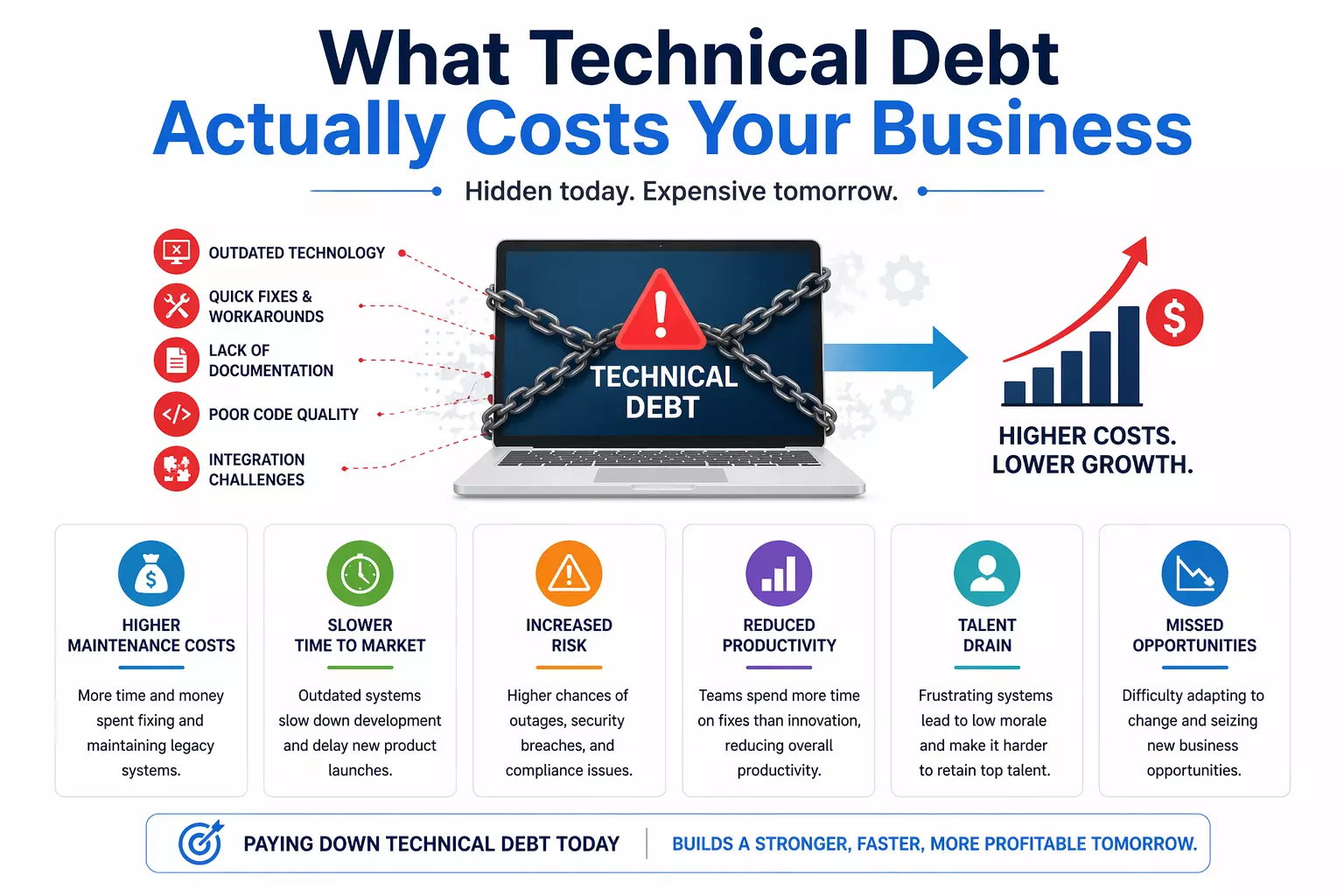
The most dangerous characteristic of technical debt is its invisibility. It does not appear on a balance sheet. It has no line item in a budget. Instead, its cost shows up diffusely and indirectly — as slower delivery cycles, as escalating incident response, as developer frustration, and as missed competitive opportunities.
A mid-size financial services company discovered during a structured audit that developers were spending 38 cents of every IT dollar on maintenance rather than new development. Translated into financial terms, that amounted to more than $2.4 million per year in developer time alone — before accounting for the cost of production incidents, delayed releases, or the competitive ground lost to faster-moving rivals.
This story repeats across industries. Manufacturing companies are running production systems on unsupported operating systems. Retail companies watch their e-commerce platforms buckle every holiday season — not because the team is incompetent, but because the architecture was never built to scale and nobody had time to fix it between deadlines. Healthcare organizations have nurses manually re-entering data across systems that should have been talking to each other years ago. The technology works, technically. It just makes everything harder than it needs to be.
That is what deferred investment looks like in practice. Not a single catastrophic failure — just a slow, invisible tax on every decision, every release, every person trying to get work done.
The numbers behind that tax are consistent across industries:
When these numbers get translated into financial terms — developer hours multiplied by fully-loaded cost, delivery delays mapped to lost revenue — the business case for fixing it stops being a technical argument and starts being an obvious financial one.
Not all technical debt looks the same — and treating it as one uniform problem is one of the most common reasons correction efforts fall short. Each type has a different origin, a different cost profile, and a different fix.
Deliberate debt is the shortcut your team took on purpose. Hard-coded values to hit a release date. A quick fix that was supposed to be temporary. The logic was sound at the time — ship now, clean up later. The problem is that it has a way of never arriving. Work piles on top of the shortcut. The shortcut becomes load-bearing. And what was a two-hour decision becomes a two-week refactor nobody has time to schedule.
Accidental debt is nobody's fault — it just aged badly. The framework your team chose five years ago was the right call then. It is unsupported now. The architecture that handled your original traffic loads starts breaking at ten times the scale. Nobody made a bad decision. The world progressed, and the system did not move with it.
Environmental debt is the infrastructure your organization has been meaning to update for years. Operating systems past end-of-life. Databases running versions that stopped receiving security patches. Cloud environments are provisioned manually with no automation and no consistency. This category carries the highest immediate risk — unpatched systems are not theoretical vulnerabilities, they are open doors.
Knowledge debt is the most dangerous category nobody talks about. It lives in the gap between what your systems do and what your current team understands about why. Undocumented architectures. Processes that exist only in the memory of the one engineer who has been there since the beginning. When that engineer leaves — and eventually they do — what they take with them cannot be recovered from a wiki or a ticket history.
Most organizations are carrying all four simultaneously. The starting point is not fixing them — it is knowing exactly what you have, where it lives, and what it is costing you.
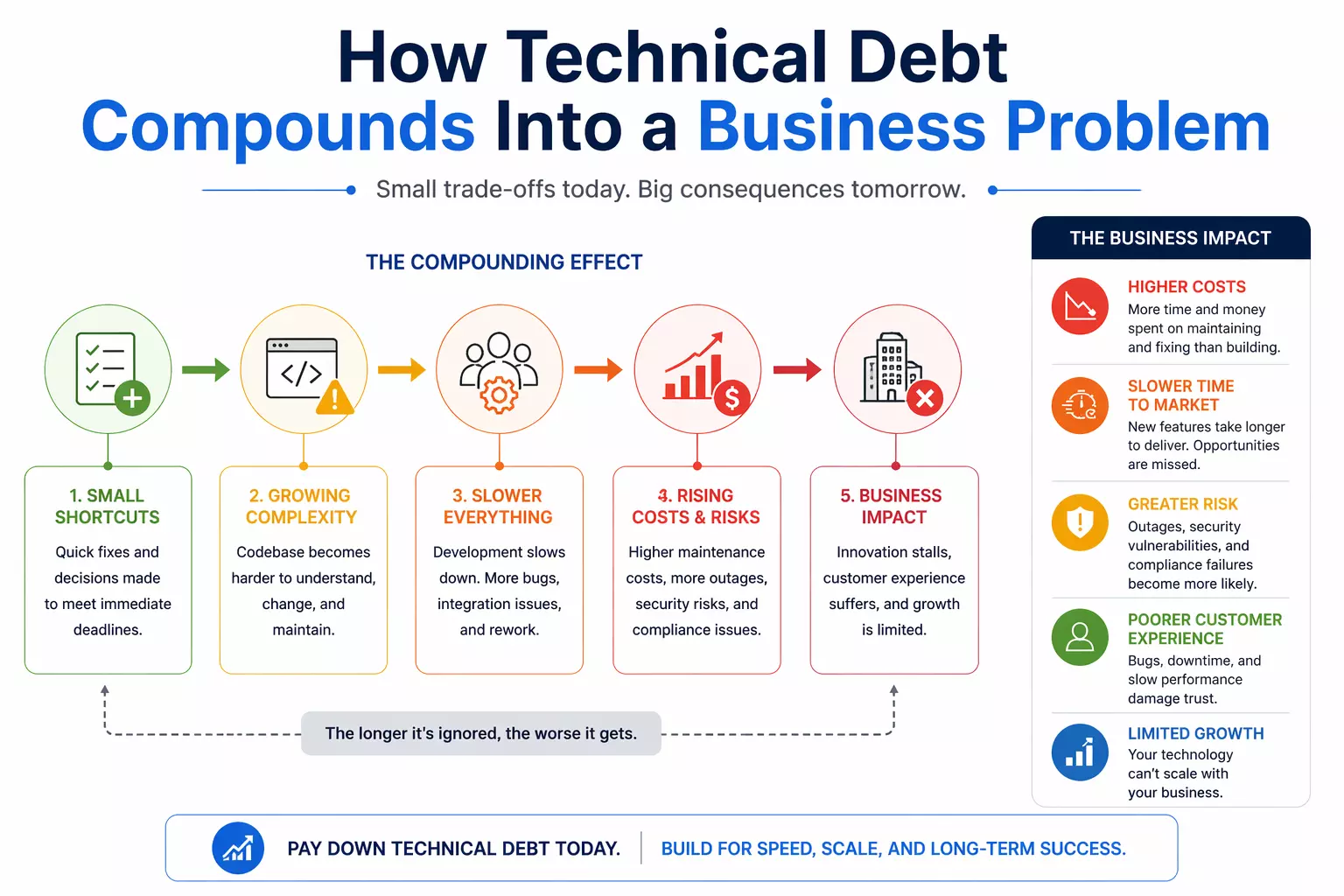
Technical debt does not announce itself as a crisis. It starts quietly — a few slow sprints, a backlog that never quite clears, an onboarding process that takes longer than anyone expects. By the time leadership notices the cost, the debt has usually been compounding for years.
The progression follows a pattern that is consistent enough to map.
Stage One: Friction. Things slow down. Developers spend more time reading old code than writing new code. Simple features touch systems that are fragile enough to require extra caution. Workarounds get built on top of other workarounds. The business impact is real but hard to pin down — slower releases, growing frustration, a backlog that keeps expanding no matter how many sprints go by.
Stage Two: Constraint. Friction hardens into something structural. The architecture that handled your original scale starts failing at the next one. Integrations that should take weeks take quarters. Good engineers start leaving — not always loudly, but consistently — because talented people do not stay in environments where the system fights them every day. Recruitment gets harder for the same reason.
Stage Three: Crisis. Production outages stop being surprises. Security vulnerabilities that were low priority become active incidents. The engineering team is spending most of its time keeping existing systems alive, leaving almost nothing for the work that actually moves the business forward.
The organizations that reach Stage Three almost always had earlier opportunities to act. The pattern is documented in detail in this $1.3 million IT consulting failure — delay compounding on delay, until the cost of inaction was far greater than early intervention would have been.
Stage One is the right time to act. The cost is lower, the disruption is manageable, and the return comes faster.
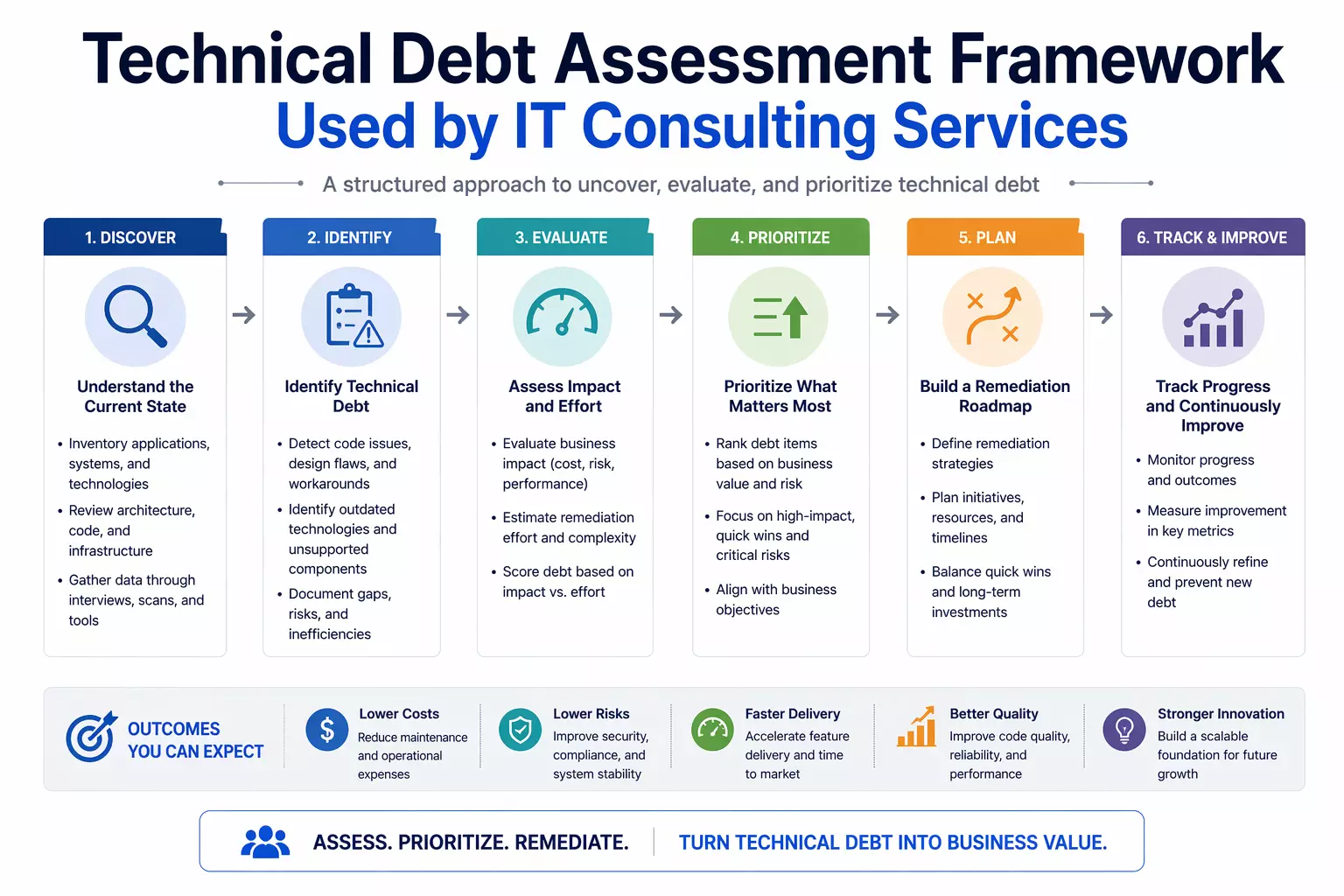
Remediation without a clear picture of what you are dealing with is just expensive guesswork. Before any fixing begins, the debt needs to be found, mapped, and translated into financial terms that leadership can act on.
At AD Infosystem, that assessment covers four dimensions.
Codebase Analysis examines the software itself — how complex it is, how maintainable it is, and where the highest-risk areas are concentrated. The tools that support this work — SonarQube, CodeClimate, and others — can process large codebases quickly. But the output requires interpretation. High complexity is not always a debt. Some of it reflects genuinely complicated business logic that needs documentation, not refactoring. Experienced consultants make that distinction. Automated tools do not.
An infrastructure audit examines the hardware on which the software runs. Unsupported operating systems. Databases that have not been upgraded in years. Disaster recovery procedures that exist on paper but have not been tested in practice. Cloud environments are provisioned manually, with no consistency or audit trail. Infrastructure debt carries the highest immediate risk — it is where security vulnerabilities live and where a single unpatched component can cause a production incident without warning.
Process Debt Assessment examines how software gets built and deployed. Manual deployment steps. Inconsistently applied testing. Release procedures that depend on individual knowledge rather than a documented process. This is where the connection to DevOps consulting services becomes direct. Some of the most valuable remediation work has nothing to do with rewriting code — it is about automating the processes surrounding it. Organizations that invest in CI/CD pipelines, infrastructure provisioning automation, and monitoring often see faster delivery and fewer incidents without touching a single line of application code.
Knowledge Mapping is the dimension most assessments skip — and the one that causes the most remediation failures. It identifies which systems are understood by fewer than 2 active team members, which processes exist only in the memory of long-tenured employees, and the real operational exposure if that knowledge walks out the door. The output is a risk register in plain financial terms: what it would cost to lose that knowledge versus what it costs to preserve it now.
The instinct when debt is finally measured is to fix everything at once. That instinct is expensive and usually counterproductive.
Effective prioritization works across three variables.
Business result comes first. Debt that is actively slowing product delivery or causing customer-facing reliability problems gets addressed before debt that is theoretical. The question is not which component is most technically compromised — it is which one is costing the organization the most right now.
Remediation cost determines sequencing within priority tiers. Some high-impact debt is also relatively inexpensive to fix — those items go first. Some high-impact debt requires a full architectural replacement — those get phased planning, not immediate execution.
Risk of deferral captures items that are not currently causing problems but will. A system is one unsupported dependency away from a production incident. A security vulnerability that has not been exploited yet. These items may not rank highest on impact today, but their risk profile changes rapidly — and the cost of addressing them after an incident is orders of magnitude higher than addressing them before.
Plotting debt items against these three dimensions produces a roadmap that leadership can evaluate in business terms. Not a list of engineering problems — a sequenced investment plan with projected returns at each phase.
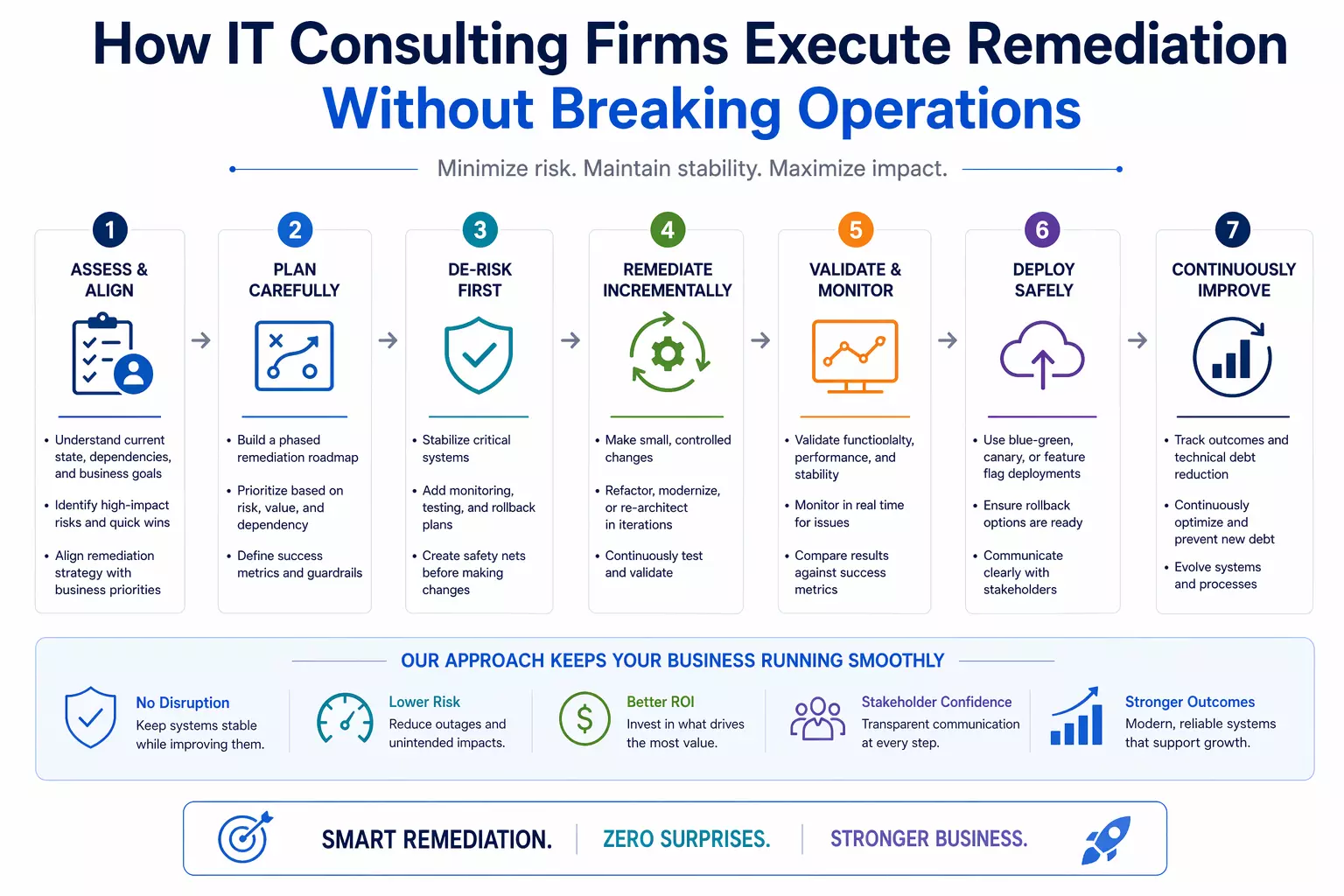
The fear that stops most organizations from acting is not the cost. It is the disruption. Everyone has seen a large-scale IT project go wrong, and nobody wants to be responsible for the next one.
That fear is legitimate. It is also the reason why digital transformation initiatives fail at such a consistent rate — organizations attempt too much change too quickly, without the incremental validation that makes large transitions survivable.
Experienced IT consulting firms use four approaches that address this directly.
The Strangler Fig Pattern replaces legacy systems incrementally rather than all at once. New functionality is built in modern, well-structured code alongside the existing system. Legacy components are migrated piece by piece and decommissioned as the new implementation proves itself in production. The old system does not get turned off until the new one has earned that outcome.
Automated Testing as a Safety Net establishes a behavioral baseline before any refactoring begins. Every existing behavior gets documented in tests. If a change breaks something, it is caught before it reaches production, making confident refactoring of even complex legacy code achievable.
Debt Budgeting treats remediation as a continuous practice rather than a one-time project. Allocating 20–30% of each sprint to debt reduction means debt gets paid down steadily rather than accumulating between periodic cleanup efforts that never quite happen on schedule.
Infrastructure Automation eliminates the class of debt that comes from manual, inconsistently applied configurations. When infrastructure is defined in code and deployed through automated pipelines, every environment is consistent, every change is auditable, and future modifications can be made with confidence rather than caution.
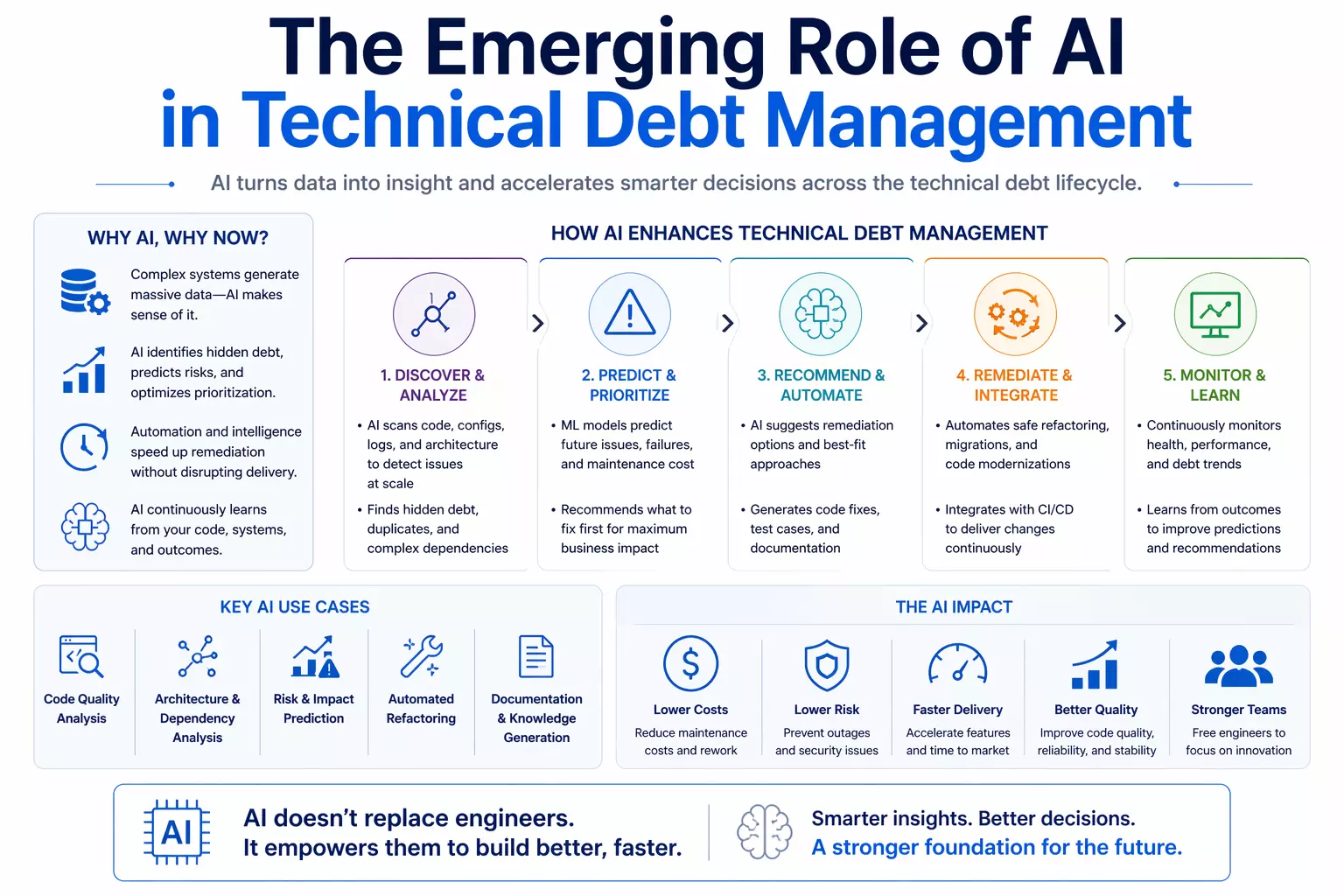
AI is not coming to technical debt management. It is already there — and it is changing what is possible faster than most organizations realize.
Work that used to take months is now taking days. Code reviews that required a senior engineer with deep codebase familiarity can now be run at scale by tools that do not need context, do not get tired, and do not miss patterns buried in a function nobody has touched in four years. That shift has real consequences for how IT consulting services approach remediation — and for the economics of doing it.
AI-assisted code reviews move through large codebases in a fraction of the time manual review requires. They flag excessive complexity, duplicated logic, deprecated API usage, and other patterns that signal debt — surfacing them for human judgment rather than requiring humans to find them first. The assessment phase, which used to be one of the longest parts of any engagement, gets compressed significantly.
Automated dependency analysis solves a problem that has always been practically unsolvable at scale. Enterprise applications often carry hundreds of dependencies, each with its own version history, vulnerability record, and transitive chain of further dependencies. Tracking that manually is not rigorous — it is theater. Automated tools map the full graph, identify what is outdated, flag what is vulnerable, and surface risks that would otherwise go undetected until they become incidents.
Intelligent refactoring suggestions change the dynamic for engineering teams working through remediation. Instead of starting from a blank page every time a problem is identified, teams get a proposed approach to react to. That is a different kind of work — faster, less draining, and less dependent on the specific experience of whoever happens to be on the team that week.
Automated test generation addresses what has historically been one of the most time-consuming parts of any legacy remediation effort. Before you can safely refactor old code, you need tests that document what it currently does. Building that coverage from scratch used to take weeks. AI tools generate baseline tests from existing code behavior — not perfectly, but well enough to` dramatically reduce the time required to establish a safety net that makes refactoring viable.
There is a bigger picture here that matters for any organization thinking seriously about where technology is headed.
Organizations preparing to leverage agentic AI in enterprise environments will find that technical debt is one of the first obstacles encountered. AI agents that interact with production systems need those systems to be structured, observable, and reliable. They need clean APIs, consistent data models, and infrastructure that behaves predictably. What they cannot work with is a system that has ten years of workarounds layered on top of each other, undocumented integrations, and components that nobody fully understands anymore.
Technical debt does not just slow down your current engineering team. It limits the return on every AI investment your organization makes going forward. Remediation is no longer just a maintenance priority — it is the foundation that future competitiveness gets built on.
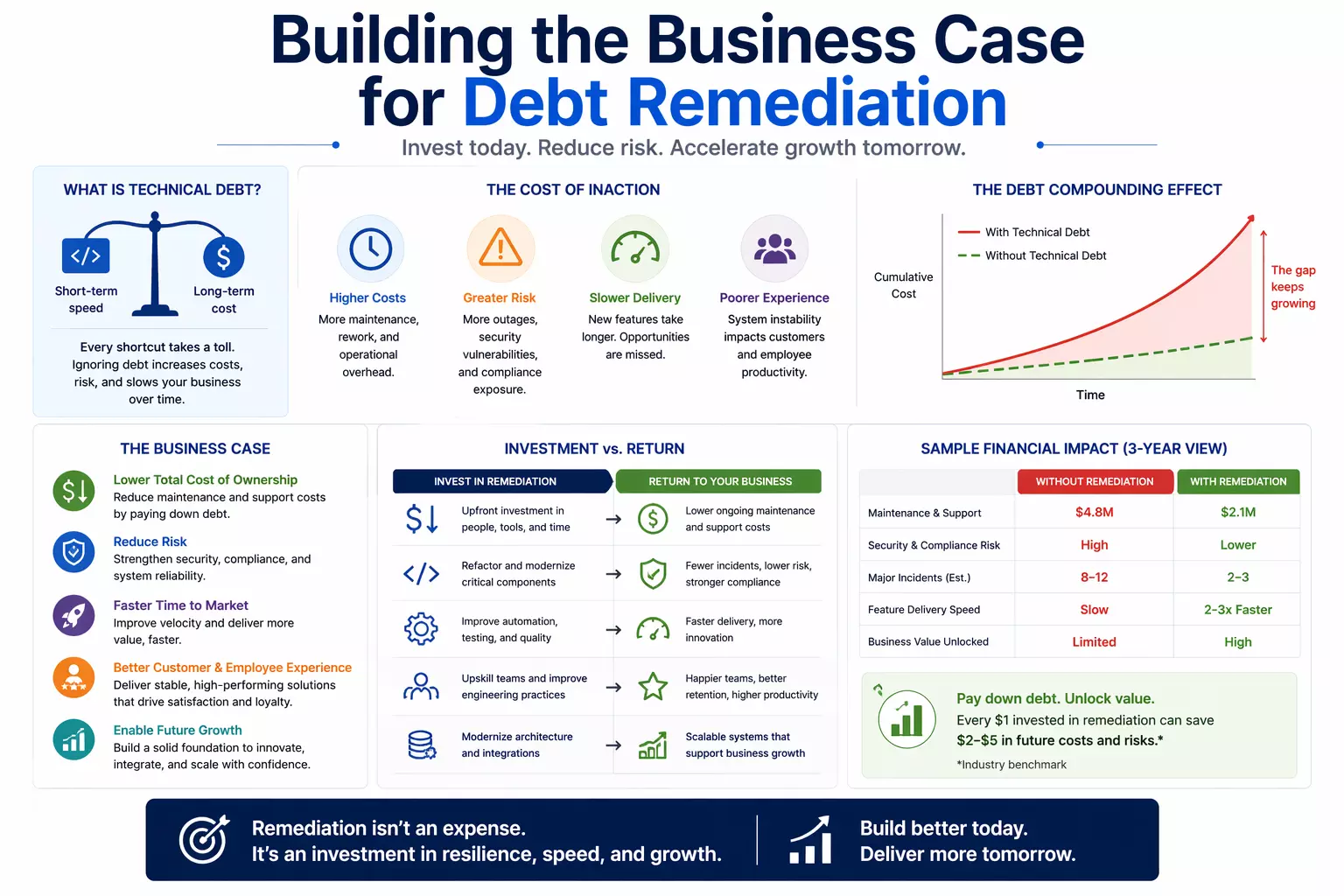
Getting budget approved for technical debt remediation is rarely a technical conversation. The engineers understand why it matters. The challenge is making the case to the people who control the investment — and that means translating a codebase problem into a financial one.
The organizations that secure remediation funding consistently do one thing differently: they stop presenting technical findings and start presenting business outcomes. Here is how IT consulting services structure that case across four categories of measurable value:
Developer Capacity Recovery is often the most compelling metric. If engineers are spending 40% of their time on legacy maintenance and remediation reduces that to 20%, the organization has effectively added capacity equivalent to 20% of its engineering headcount — without hiring anyone. For a team of 50 engineers at a fully-loaded cost of $200,000 per year, that is $2 million in recovered capacity annually.
Reduced Incident Cost captures the reliability improvements that follow from remediation. Incidents require immediate engineering response, often at off-hours rates, generate customer-facing impact, and create executive and compliance overhead. Organizations that track incident costs carefully find they represent a significant and largely avoidable expense.
Faster Delivery Timelines translate directly to competitive advantage. Technical debt that slows delivery is a tax on innovation — and remediation removes it. The ability to release new features and respond to market changes faster than competitors is one of the primary drivers of technology value.
Lower Risk Exposure encompasses security, compliance, and operational continuity risks that accumulate with unaddressed debt. Scenario analysis — what would a major breach cost? What would a three-day outage cost? — provides a framework for translating risk reduction into financial terms that resonate with boards and CFOs.
Not all IT consulting firms approach technical debt remediation with the same rigor or effectiveness. When evaluating providers, look for these qualities:
Structured Assessment Methodology. Look for firms with a repeatable assessment process that examines all four dimensions of technical debt and produces findings in financial terms — not just technical metrics.
Incremental Modernization Expertise. Ask how the firm has used approaches like the Strangler Fig Pattern to deliver modernization without operational disruption. Request specific examples with measurable outcomes.
Business-Focused Reporting. Technical findings must be translated into a language that resonates with business stakeholders. The best IT consulting services present remediation recommendations in terms of ROI, risk reduction, and business outcome.
Proven Execution Capability. Assessment without execution delivers no value. Evaluate firms on their track record of completing remediation projects — not just diagnosing problems.
Internal Capability Development. The best engagements build the client organization's internal capability rather than creating ongoing dependency on external consultants. Knowledge transfer, documentation, and team coaching should be explicit components of delivery.
Every year without intervention, technical debt compounds. Maintenance costs grow. Developer productivity declines. Security exposure widens. New hires inherit a codebase harder to understand and riskier to change than the one their predecessors inherited. The engineers who could fix it — senior developers who understand the system — are the first to leave when the environment becomes too frustrating.
The math of compounding works against inaction. Technical debt addressable today for $500,000 may cost $2 million in three years — because more workarounds have been layered on top, more documentation has been lost, and more of the system has become dependent on the problematic architecture.
There is also a talent dimension. Organizations with chronic technical debt develop reputations in engineering communities as places where ambition goes to die. The resulting recruitment and retention challenges compound the financial cost of inaction in ways that do not appear on any single budget line but are deeply damaging over time.
Most consulting firms show up with a technical assessment and leave you with a report. AD Infosystem shows up with a financial one and stays until the work is done.
Every engagement starts the same way — not with a code review, but with a conversation about what the debt is actually costing the business. Developer hours lost to maintenance. Incidents that should not be happening. Releases that take twice as long as they should. Those numbers get quantified before any remediation work begins, because the roadmap that follows needs to be sequenced by business impact — not by what is technically interesting to fix.
Financial-based technical debt assessment — every finding is translated into dollar terms. Not complexity scores or code metrics. Actual cost to the organization, in language a CFO can evaluate.
Business-prioritized remediation roadmap — work is sequenced by what delivers the most value earliest, not by what engineers find most compelling to refactor.
Incremental modernization approach — systems get modernized without the big-bang migrations that have ended careers and derailed budgets. Proven patterns, managed risk, and continuous delivery of value throughout the engagement.
DevOps automation implementation — CI/CD pipelines, infrastructure-as-code, and monitoring automation get built into delivery from day one, not bolted on at the end.
Knowledge documentation and risk reduction — the institutional knowledge that lives in people's heads gets documented, structured, and preserved before it walks out the door.
Internal capability building — every engagement is structured to make the client's team more capable, not more dependent. When the engagement ends, the organization should be able to sustain what was built.
Contact AD Infosystem today to request a technical debt assessment and find out exactly what your debt is costing you.
Every organization carrying significant technical debt reaches the same moment eventually. The sprint that should have taken two weeks takes six. The incident that should have been caught in testing makes it to production. The engineer who understood the most critical system gave their notice. And somewhere in a leadership meeting, someone asks why IT costs keep rising while output keeps shrinking.
That moment is the debt announcing itself. By the time it does, it has usually been compounding quietly for years.
The organizations that come out ahead are not the ones with the cleanest codebases or the most aggressive modernization roadmaps. They are the ones who stopped treating debt as a background problem and started treating it as a financial one. They measured it in dollars. They sequenced the fix by business impact. They moved incrementally, so the lights stayed on throughout. And they made sure the team that inherited the improved environment understood it well enough to keep it that way.
Acting early costs a fraction of acting late. The disruption is smaller. The options are wider. The return comes faster.
Those who keep deferring are not saving money. They are borrowing it — at a rate that gets worse every quarter they wait.
Visit AD Infosystem to explore IT consulting services built around measurable outcomes — and take the first step toward recovering the capacity, reliability, and speed your business needs to compete.